Introduction
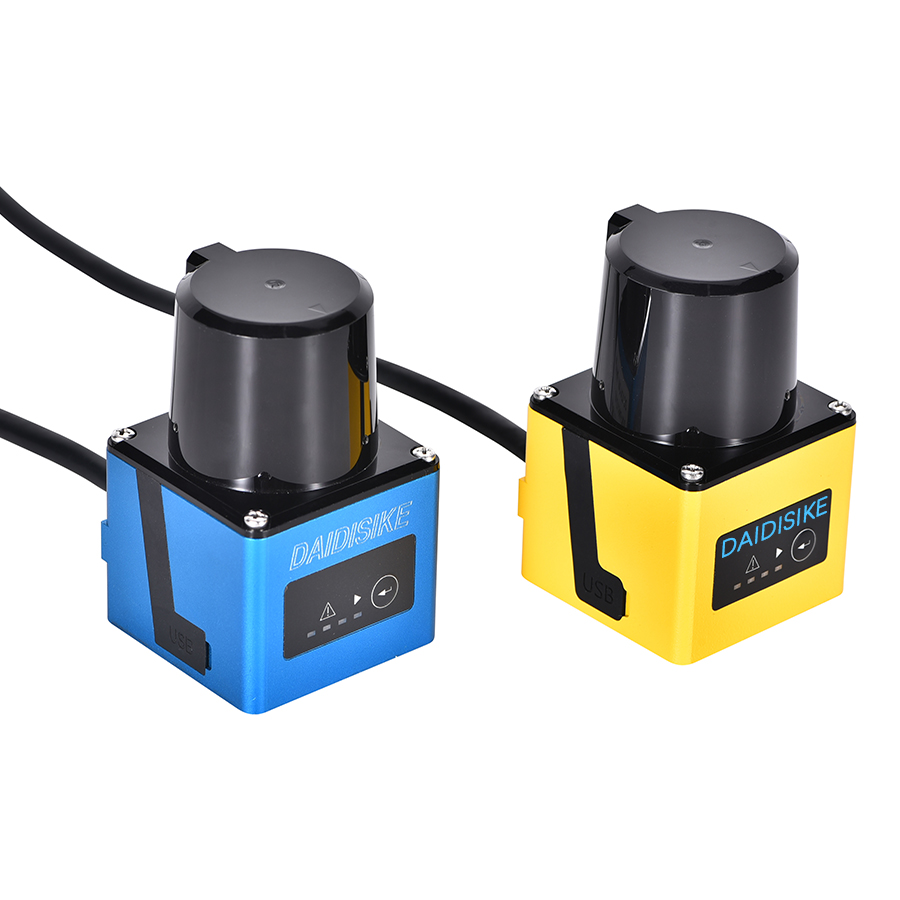
The Obstacle Avoidance LIDAR is a compact, high-performance 2D Time-of-Flight (TOF) laser radar designed for precise detection and navigation in dynamic environments. Available in models such as DLD05A3-3N/3P (with a working range of 0.05m to 5m) and DLD20A5-5N/5P (0.05m to 20m), this device utilizes a 905nm Class I laser for safe, reliable scanning. It features a 270° scan angle, adjustable frequencies of 15Hz or 30Hz, and self-learning capabilities to automatically map and generate protection zones. Ideal for industrial and robotic applications, it offers robust protection with IP65 rating, low power consumption, and versatile outputs (NPN or PNP), ensuring seamless integration into AGVs, robots, and safety systems.
Description
This LIDAR sensor is engineered with advanced mechanical and electronic parameters for durability and efficiency. It measures 50mm x 50mm x 76mm and weighs 150g (excluding cables), housed in a light blue enclosure with DB15 MALE or loose wire connections. Powered by DC 9V to 28V with only 2W consumption, it supports switch drives up to DC 30V 50mA MAX. The device includes a Micro-USB interface, GND/NCx4 inputs, and three switch outputs plus a status indicator, with signal hold times adjustable from 100ms to 10,000ms (typical 330ms) and response times varying by frequency (e.g., 67ms to 29,949ms at 15Hz). Environmentally resilient, it operates from -10°C to +55°C, withstands vibrations up to 20G, and resists ambient light over 15,000 lux. Performance highlights include near-arbitrary shape recognition, ±30mm measurement accuracy, and support for 16 zone groups (each with 3 zones). Visual indicators include one status light and three zone group lights, complemented by software interfaces for area monitoring and configuration.
Application Scenario
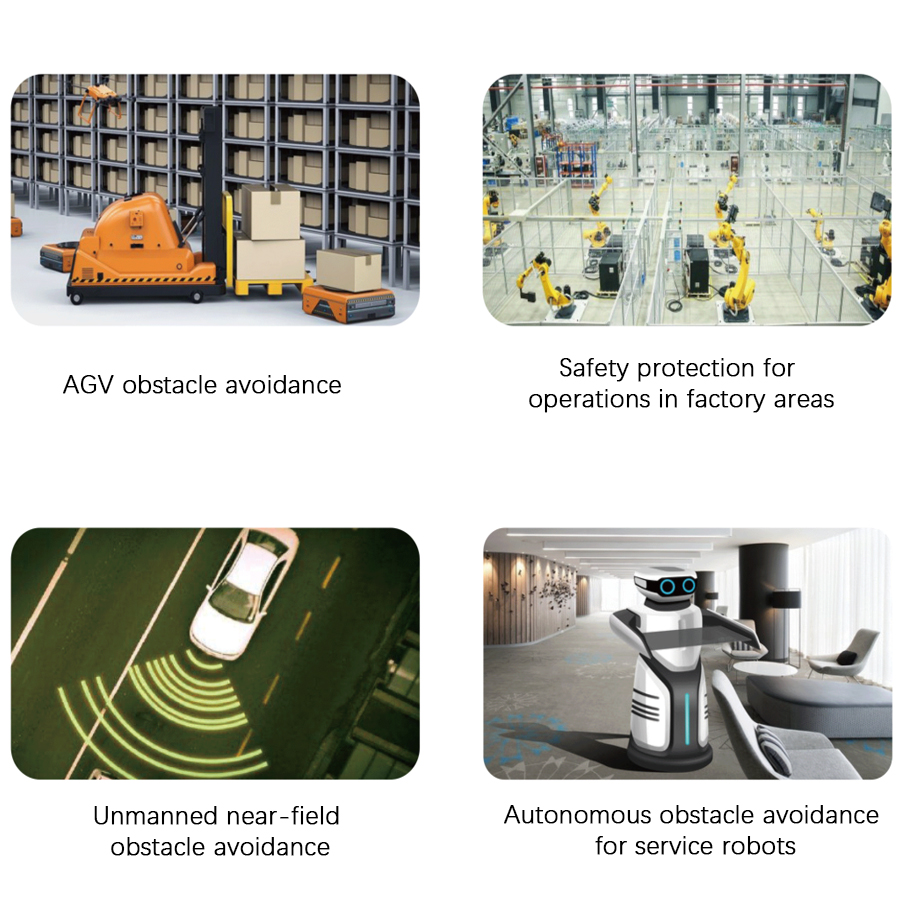
In a modern warehouse automation setup, the Obstacle Avoidance LIDAR is mounted on an Automated Guided Vehicle (AGV) navigating through aisles stocked with shelves and pallets. As the AGV transports goods, the LIDAR continuously scans a 270° field at 30Hz, detecting obstacles like fallen boxes or approaching workers within its 20m range. Upon identifying a hazard in predefined protection zones (e.g., a 5m warning area and 1m emergency stop zone), it triggers an immediate slowdown or halt via NPN outputs, preventing collisions. This integration enhances safety in industrial environments, such as robotic arms in assembly lines or service robots in hotels, where multi-zone monitoring and self-learning adapt to changing layouts, ensuring efficient operations under varying lighting and vibration conditions.
Working Principle
The Obstacle Avoidance LIDAR operates on the Time-of-Flight (TOF) principle, emitting pulsed 905nm laser beams across a 270° scanning angle using a rotating mechanism. Each pulse travels to an object and reflects back, with the sensor calculating distance based on the time taken for the light to return (distance = speed of light × time / 2). At frequencies of 15Hz or 30Hz, it achieves angular resolutions of 0.1° or 0.3°, generating a real-time 2D point cloud of the surroundings. The self-learning function scans the environment to automatically define and store up to 16 zone groups (each with alert, warning, and protection zones). When an intrusion is detected within these zones (accurate to ±30mm), the device outputs signals via NPN/PNP switches to activate responses like alarms or stops. Environmental factors are mitigated through robust filtering, ensuring reliable performance in dusty or lit areas, with status indicators providing immediate feedback on operational health.
Basic Information
| Product Name | 2D TOF Obstacle Avoidance Laser Radar |
|---|
| Product Model | DLD05A3-3N | DLD05A3-3P |
|---|
| Working Area | 0.05 m~5 m |
|---|
| Product Model | DLD20A5-5N | DLD20A5-5P |
|---|
| Working Area | 0.05 m~20m |
|---|
| LO Output | NPN | PNP |
|---|
Product Features
| Laser Light Source | 905 nm(class |) |
|---|
| Scan Angle Range | 270° |
|---|
| Scan Frequency | 15 Hz/30 Hz |
|---|
| Angular Resolution | 0.1°/0.39 |
|---|
| Self-learning Function | Automatic environmental scanning, generating zones. |
|---|
| Mechanical/Electronic Parameters |
|---|
| Electrical Connection | DB15 MALE/Loose wires |
|---|
| Power Supply Voltage | DC 9 V~28 V |
|---|
| Power Consumption | 2 W |
|---|
| Switch Drive | DC 30 V 50 mA MAX |
|---|
| Housing Color | Light Blue |
|---|
| Protection Level | IP65 |
|---|
| Weight | 150 g,不含电缆 |
|---|
| Dimensions (Length x Width x Height) | 50 mmx50 mmx76 mm |
|---|
| Performance |
|---|
| Recognizable Object Shapes | Almost any shape |
|---|
| Measurement Error | ±30 mm |
|---|
| Number of Zone Groups | 16 zone groups, with each zone group containing 3 zones |
|---|
| Interface |
|---|
| USB | Micro-USB |
|---|
| Input | GND/NCx4 |
|---|
| Switch Output | NPNx3, device operation status indicator x1
PNPx3, device operation status indicator x1 |
|---|
| Signal Output Hold Time | 100 ms~10,000 ms (adjustable), typical value: 330 ms |
|---|
| Response Time | 15 Hz: 67 ms~29,949 ms (adjustable), typical value: 134 ms 30 Hz: 33 ms~29,997 ms (adjustable), typical value: 66 ms |
|---|
| Status Indicator Light | Status indicator: 1 piece
Zone group indicator: 3 pieces |
|---|
| Environmental Parameters |
|---|
| Vibration Resistance | 10-55 Hz, amplitude 0.75 mm, along XYZ axes, 2 hours per axis; 50-200 Hz, 196 m/s² (20G), scanning speed 2 min/cycle, along XYZ axes, 2 hours per axis. |
|---|
| Operating Ambient Temperature | -10 ℃ ~+55 ℃ |
|---|
| Storage Temperature Range | -30 ℃ ~+75 ℃ |
|---|
| Resistance to Ambient Light | >15,000 lux |
|---|