DAIDISIKE — Safety Light Curtains & Industrial Safety Sensor Manufacturer
Safety light curtains, LiDAR scanners, proximity switches & safety relays — direct from our factory. OEM/ODM · low MOQ · 3–15 day lead time · exporting to 20+ countries since 2013.
+86 152 1890 9599 · OEM/ODM & export inquiries welcome
Start with the light curtain series and safety-documentation checks, or use the LiDAR category to distinguish ordinary measurement/navigation models from a documented safety scanner. A product family name is not a safety rating.

DDSK-J Series, Outdoor Laser Beam Sensor 500m

JHW Solar Wireless Infrared Anti-Tamper Detector

ABF Series Battery-Backed Infrared Alarm

AKT Outdoor Waterproof Infrared Beam Grating

DQA Safety Light Curtain Sensor

DQC Safety Light Curtain Hand Guard

DQB Safety Light Curtain Detector

DQR Waterproof Outdoor Safety Light Curtain

DQL/DQM detection and measurement grating

DQSA Area Safety Protection Light curtain guard

DD Series Diffuse Reflection Safety Light Curtains

DLD05A3-3N / DLD20A5-5N Obstacle Avoidance Laser Radar

JNS-Q120 Contact Type Displacement Grating Sensor

DX Series Industrial Safety Door Locks

LK-F Series Laser Displacement Sensor

DA31 Safety Relay Module

DKE-L3 Bending Machine Laser Protection

DK-G Series485 Laser Displacement

JER Economy Safety Light Curtain (ESPE)

DLD30T-5N Obstacle-Avoidance LiDAR — 30 m at 90% remission / 10 m at 10% remission

DX-D6 Series Safety Door Switch

NCF Servo Roller Feeder for Press Machine

UL Series Two-in-One Material Rack

A50A100BX150 Pressing Machine Feeder

Customized Metal Wire Straightening Machine

MT Series Heavy-Duty Material Rack

DQLV Vehicle Separation Light Curtain

E4J0102 Clock Measuring Pressure Delay Module

E4J0101 Universal Remote Control Delay Relay

D2J 0701 Ethernet to Serial Port Module

A1J0101 Optocoupler Relay Module

DQS Machine guarding light curtains(Press Guard)

JT14 Industrial Safety Carpet Sensor

DK-D461 Strip Photoelectric Switch

PZ-CM10 Visual Intelligent Learning Sensor

DDK-F Series Long Distance Laser Sensor
DAIDISIKE by the Numbers
Factory-Direct Safety Sensors, Built Your Way
Factory-direct pricing
You buy straight from the manufacturer in Foshan, Guangdong — no trading-company markup.
OEM / ODM customization
Private label, modified specifications or fully custom builds — resolution, length, output and housing to your drawing.
Low MOQ — from one unit
Sample a single unit or order in volume. No large minimum to get started.
Fast 3–15 day lead time
Stock items ship in days; custom ODM builds typically within ~15 days, far quicker than the 60–90 day norm.
Export documentation support
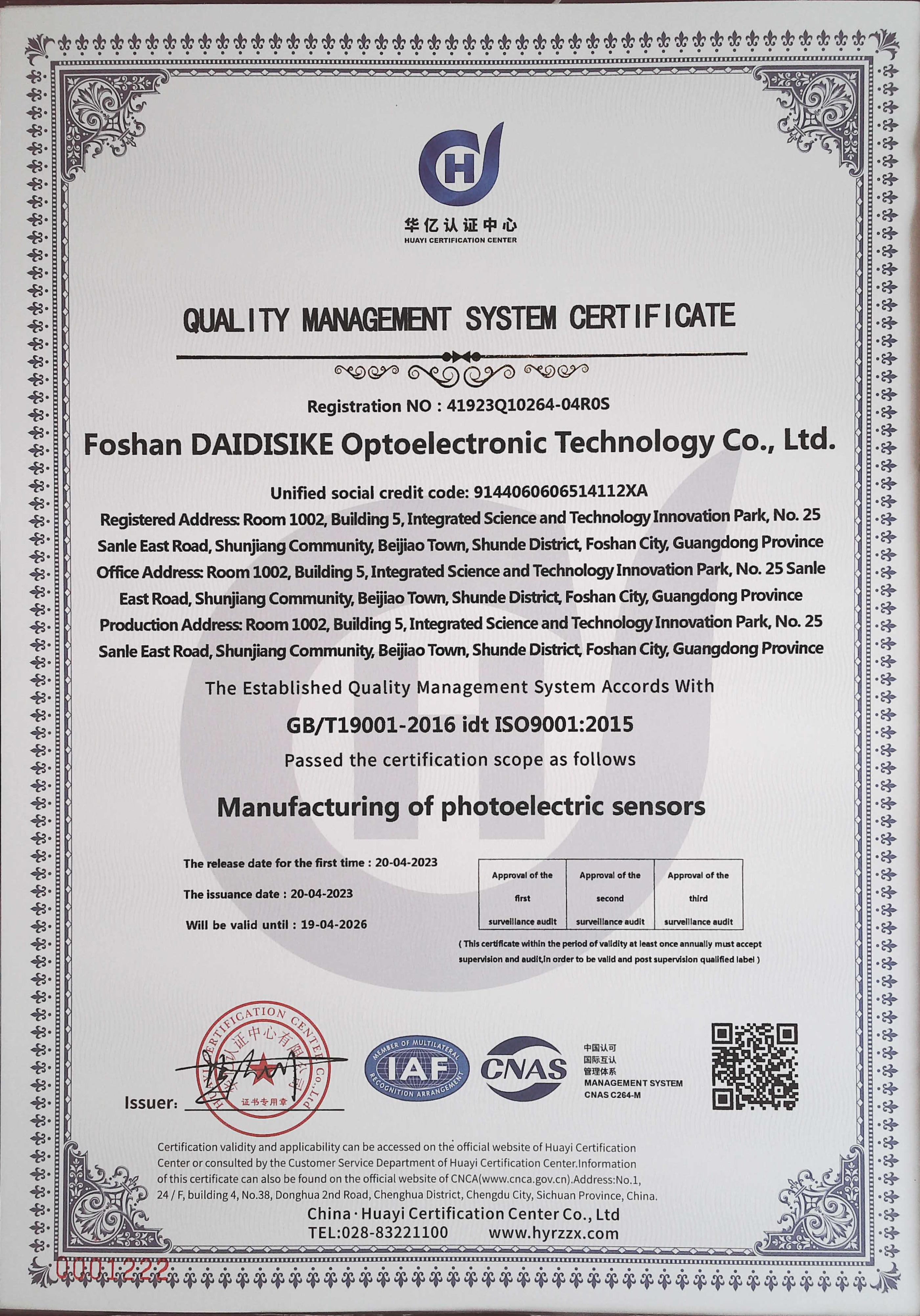
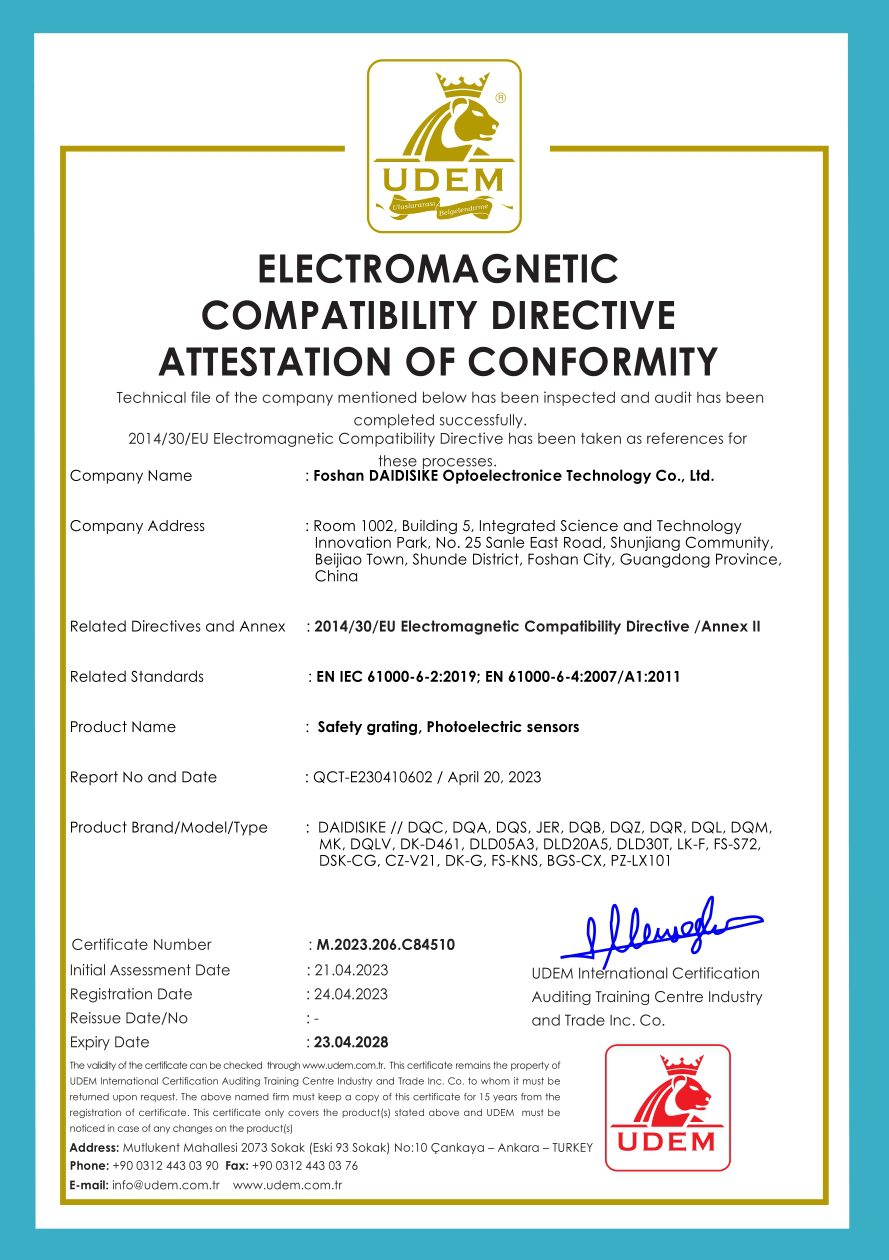
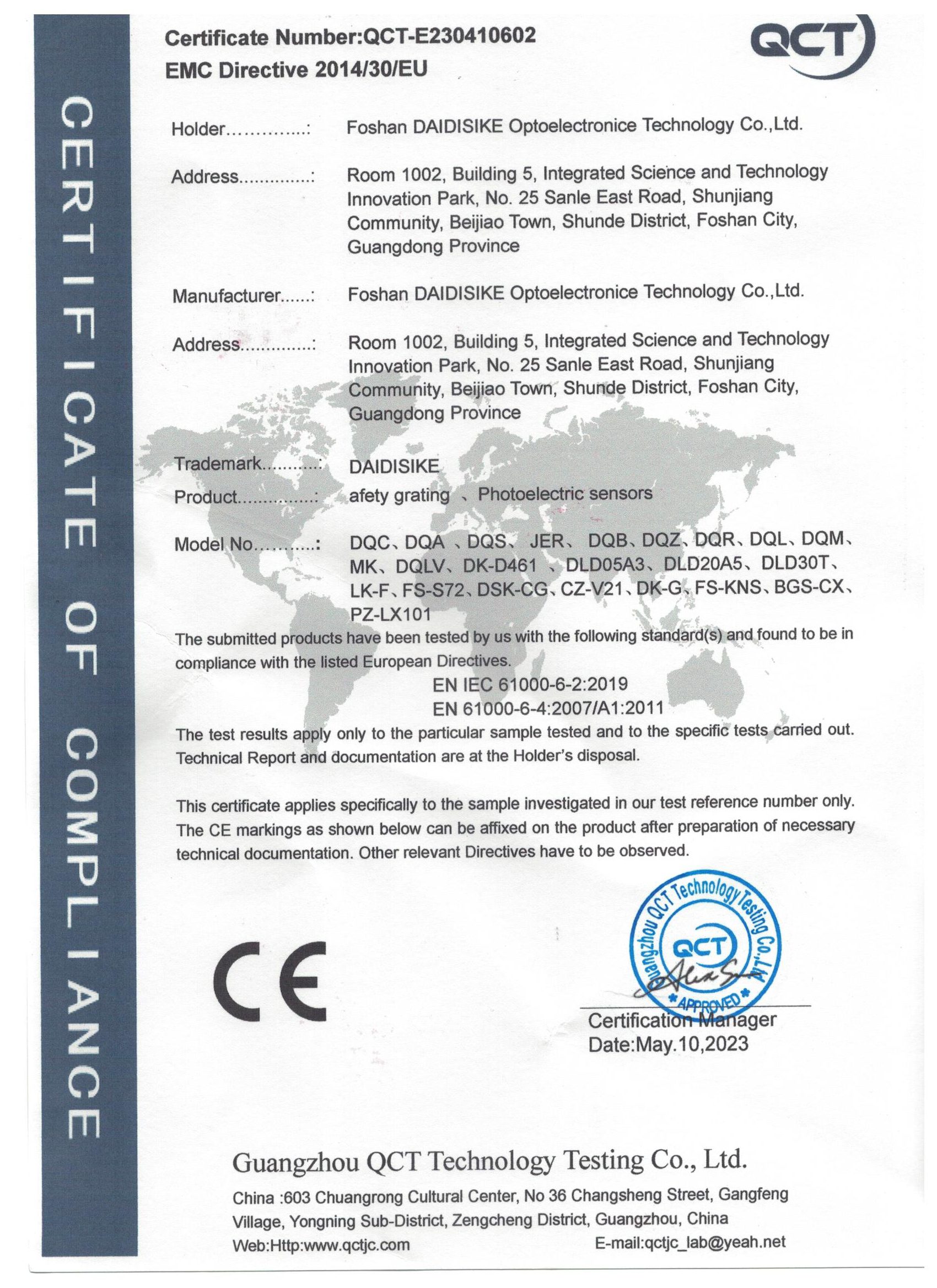
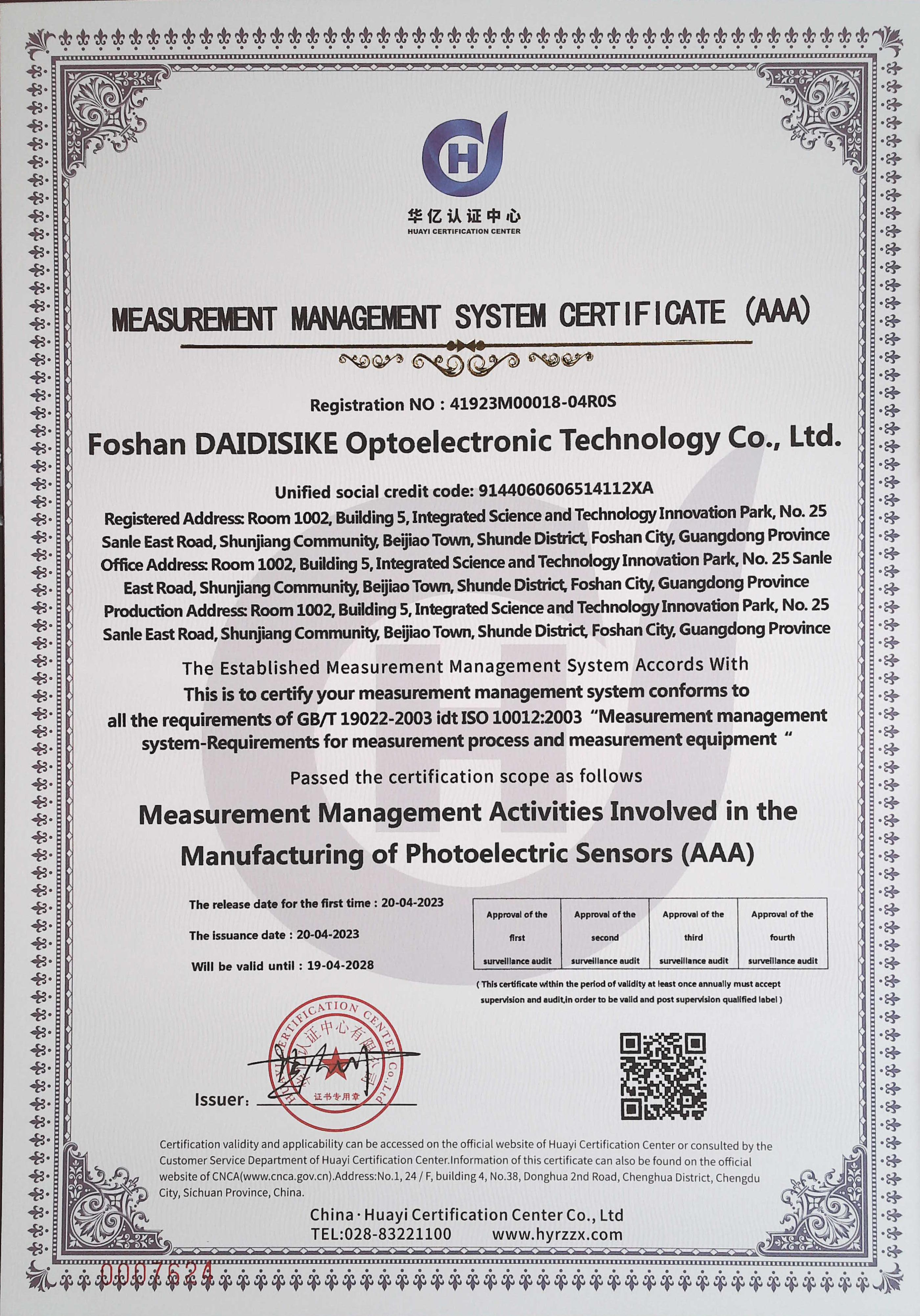
ISO 9001 quality system; applicable CE documents, technical descriptions, Certificate of Origin (CO) and Form E support for your shipment.
Model-specific safety options
DQT4 is catalogued with a Type 4 architecture. Confirm the ordered model's evidence, safety outputs and complete system capability before specification.
Built for Global OEMs, Integrators & Procurement
Lead time and MOQ depend on series and order volume — contact our sales team for a quote tailored to your project.
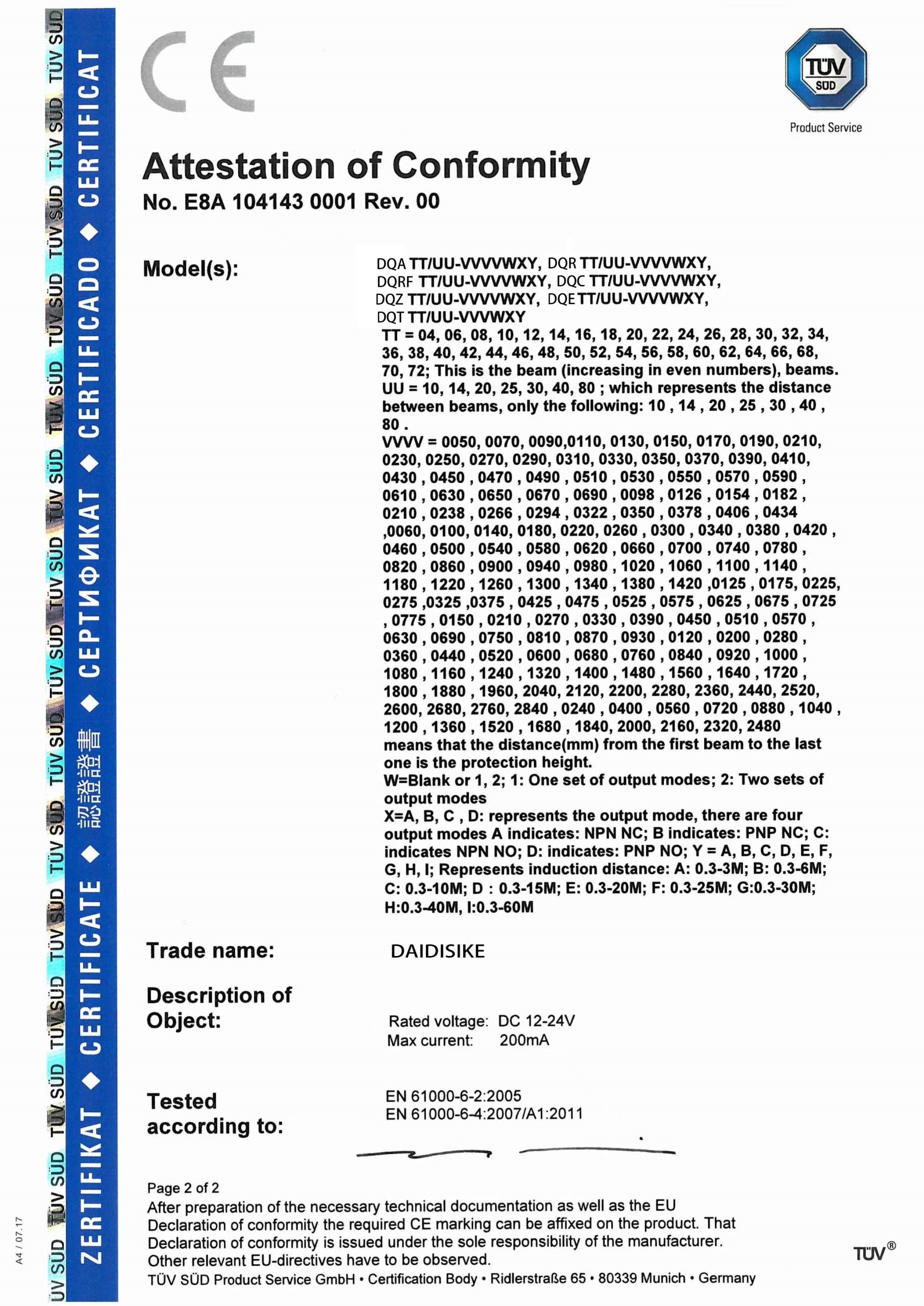
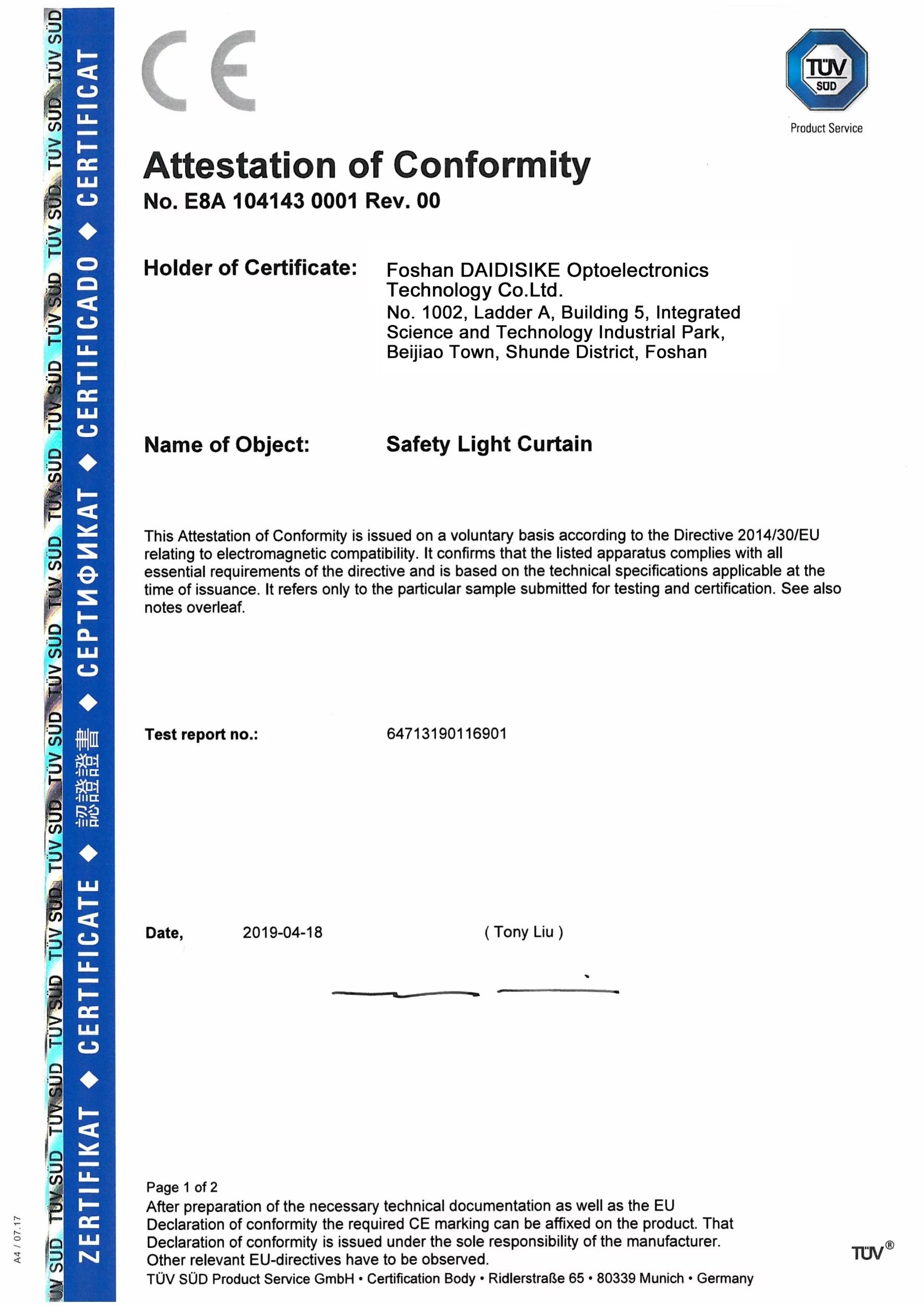
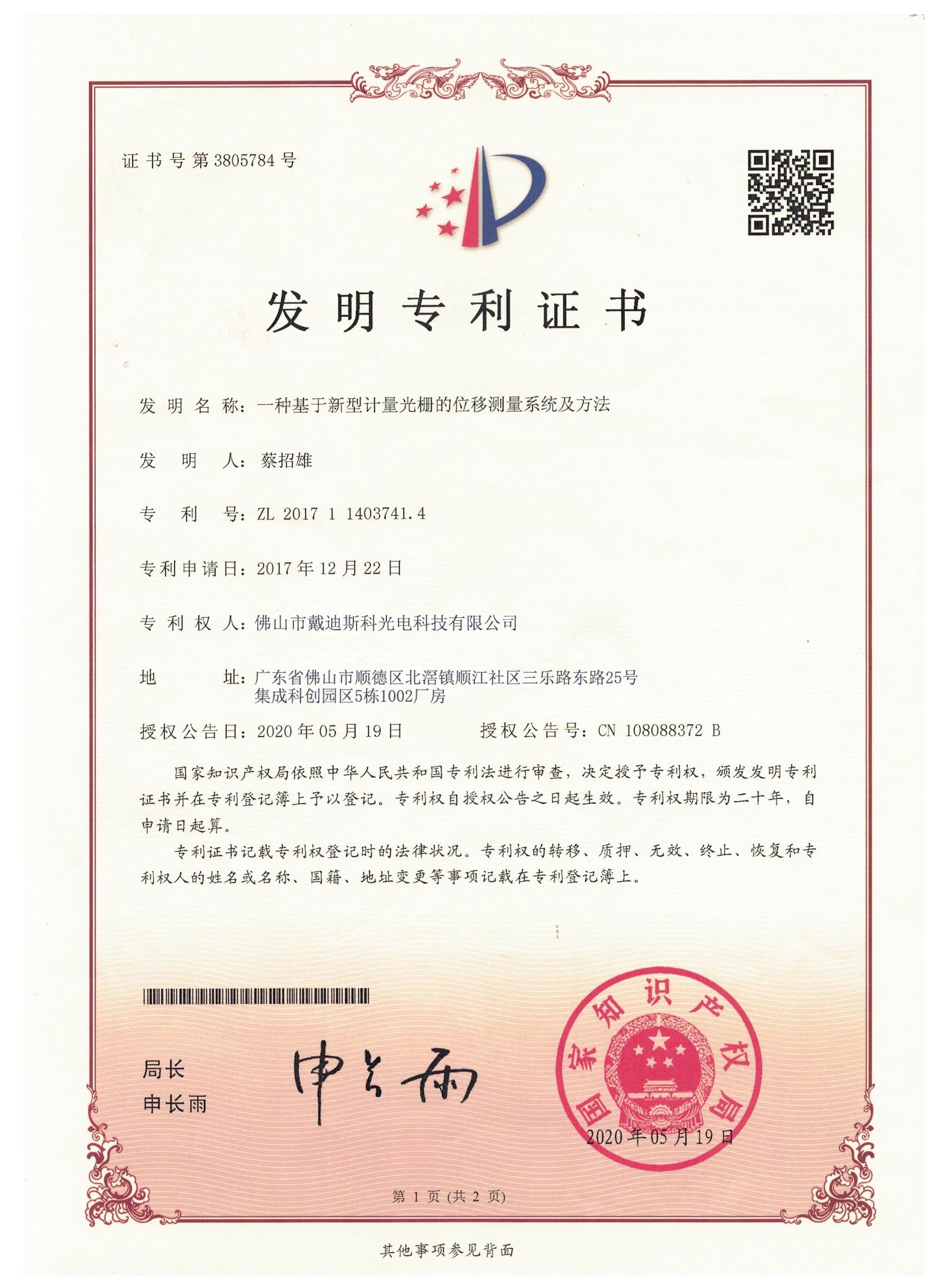
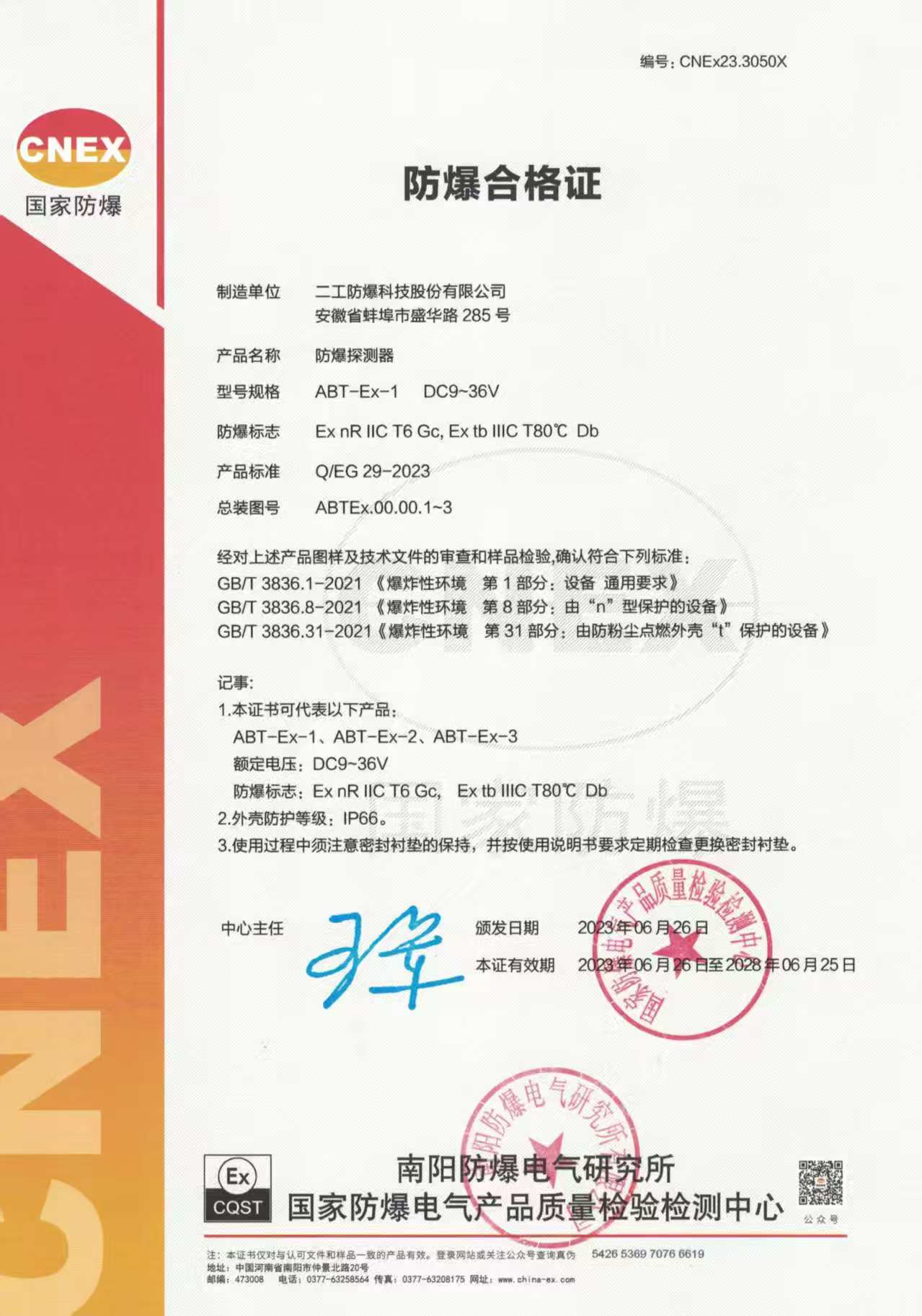
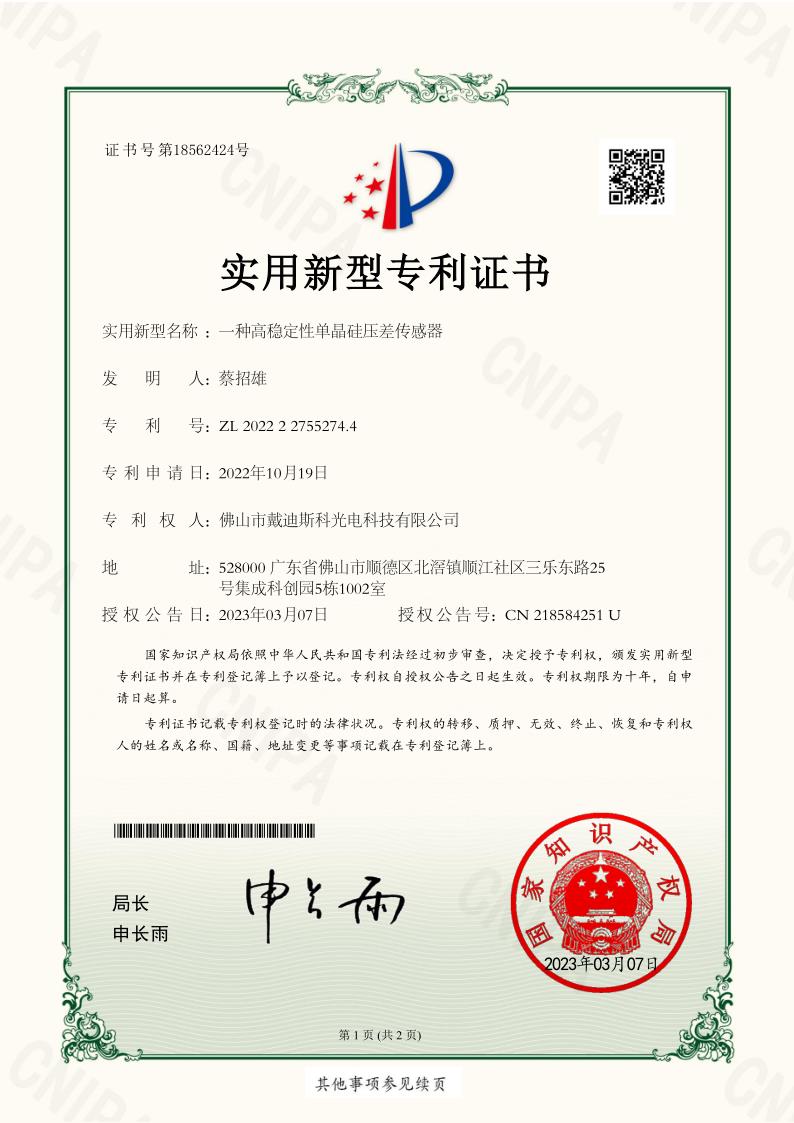
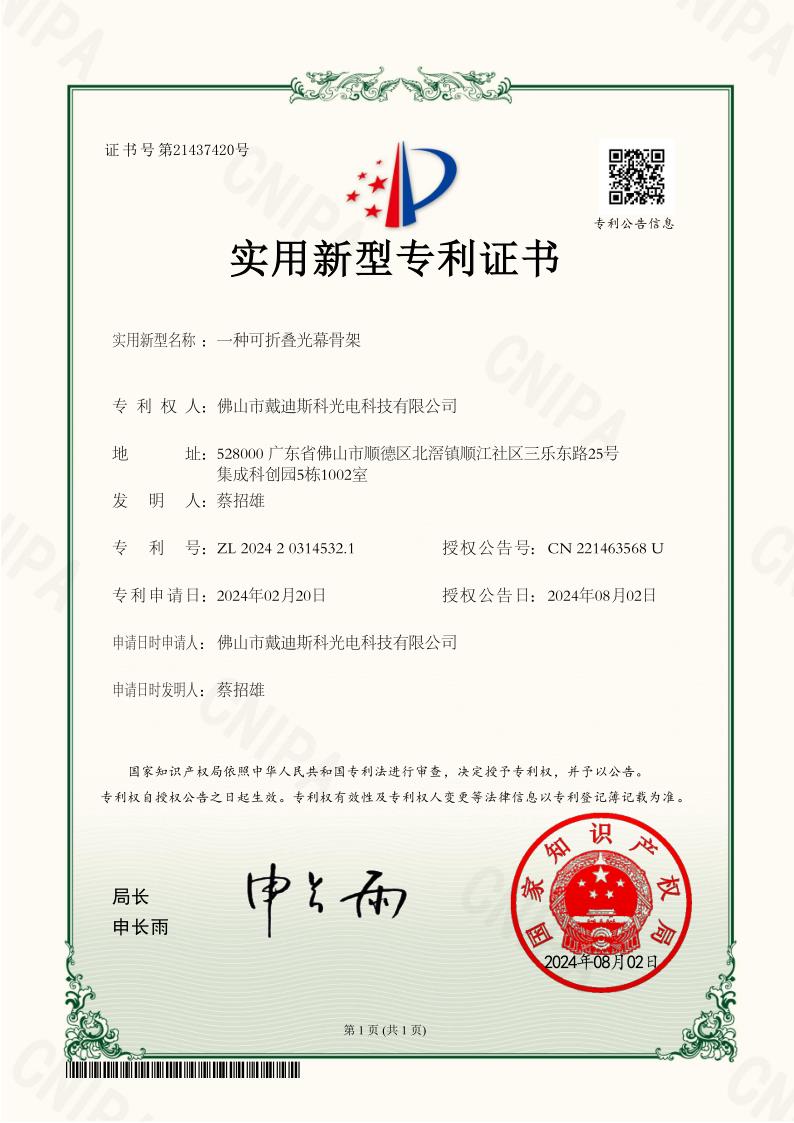
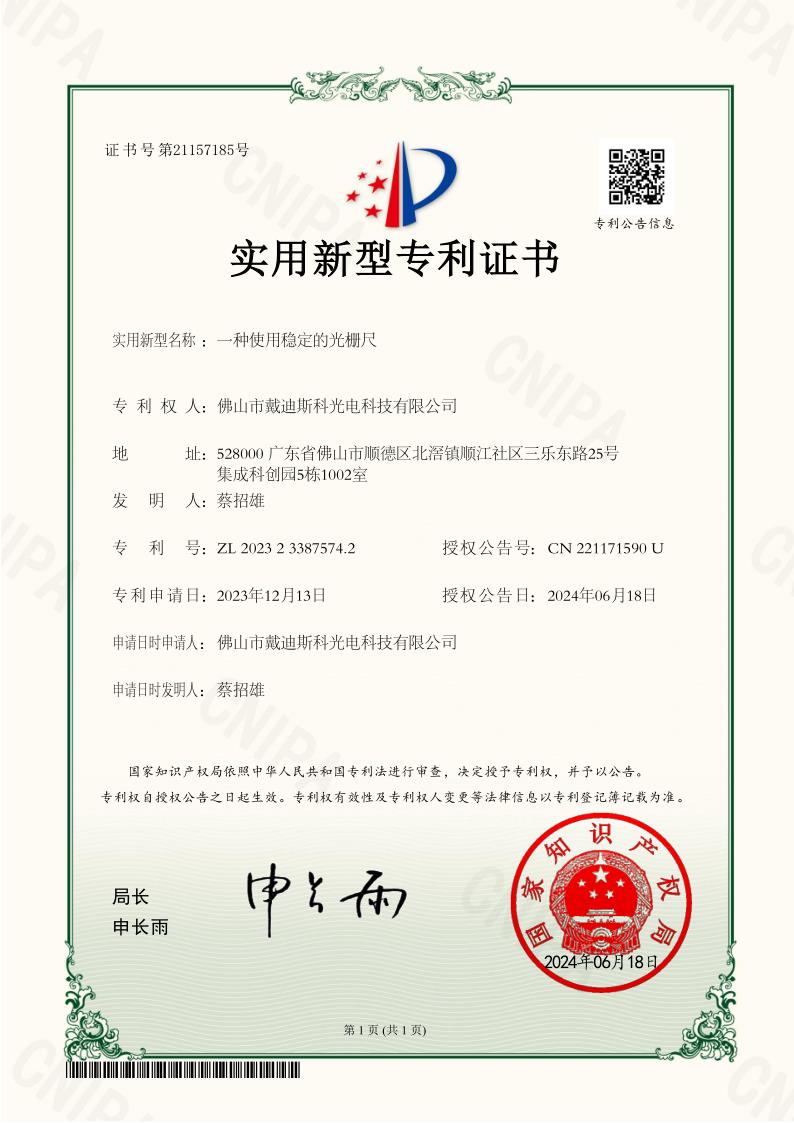
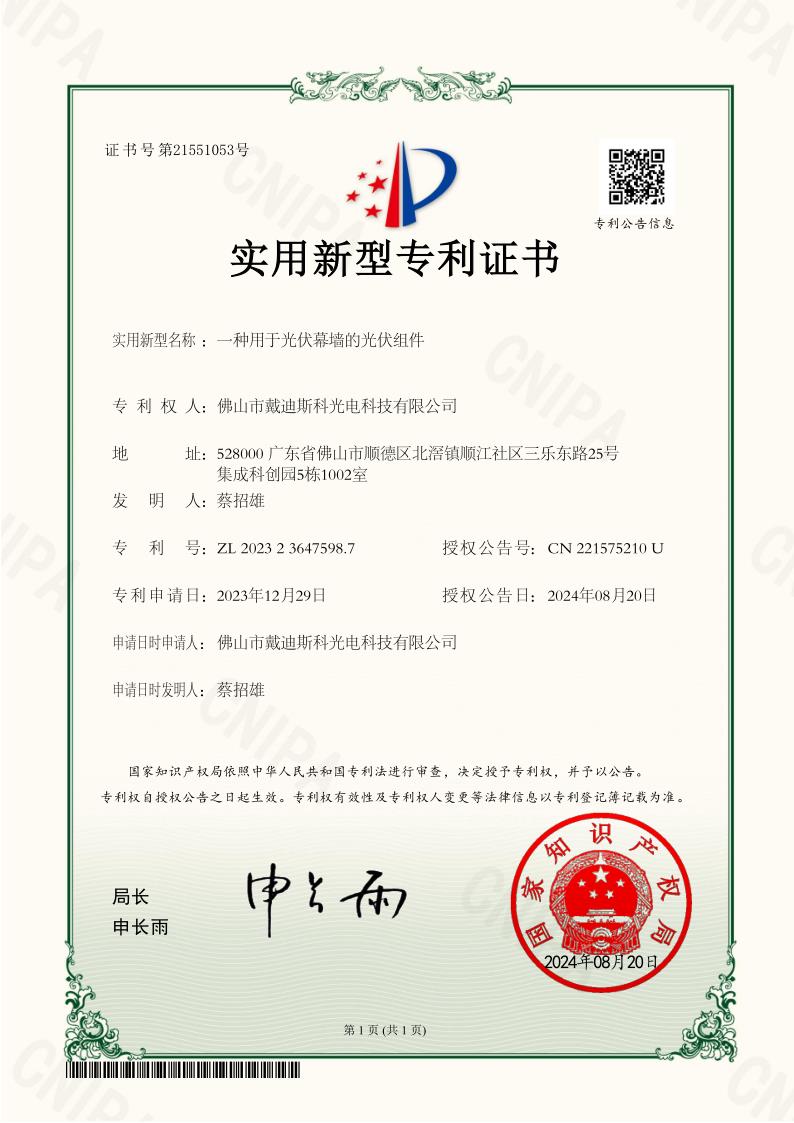
DAIDISIKE Certificates & Compliance
Official certificates, CE reports, ISO9001 quality management approvals and invention patents that support supplier qualification and product-document review. Check the model, scope and current validity of each document: company quality-system certificates and patents are not Type, PL or SIL evidence for every sensor.




1. Advanced Dimensional Measurement and Inspection Equipment (Photoelectric Switches)
This category is used in steel sheet and tube fabrication, automotive assembly and consumer electronics manufacturing, and recognizes issues like dents, bumps or burrs at an early stage to ensure high product quality.

2. Rapid Product Counting & Speed Tracking
Common uses: Packaging facilities, distribution warehouses, and printing facilities.
Utilized in: Conveyor belts, filling machinery, and palletizing systems.
Functionality: Precisely tallies items swiftly and without touch, offering a durable alternative to traditional mechanical counters.

3. Material Position & Height Detection
Material Position & Height Detection is commonly used in applications such as automated warehouses and AGV systems. This technology is typically found on AGVs, stacker cranes, and docking systems.
Its main function is to measure the position and height of materials in order to avoid collisions and ensure precise placement.

4. Effective Identification on Dim or Low-Reflectance Surfaces
Common uses: Checking automotive paint, rubber, and black plastic production facilities.
Located at: Inspection stations within production lines.
Purpose: Guarantees consistent identification of dark materials through the use of background suppression technology.

5. Safety Measures for Mechanical and Punch Presses
These protective devices are commonly utilized in the automotive and metal processing industries, where they are integrated into mechanical and hydraulic presses.
A suitable, correctly integrated device detects access and signals the validated stop circuit. Its response time and the measured machine stopping time determine the required separation; a light curtain does not stop machinery instantly.

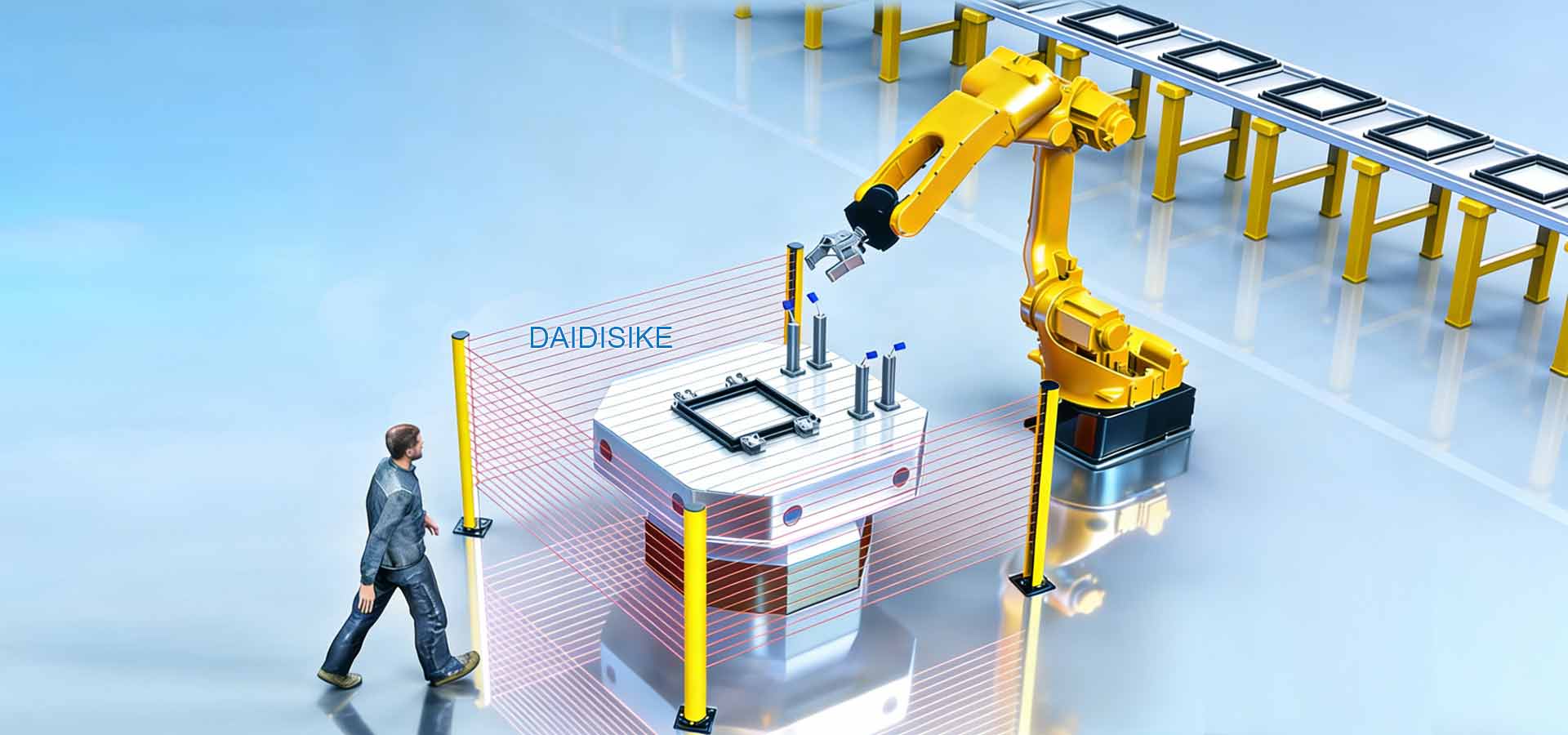
6. Safety Solutions for Robotic Workstations and Automated Systems
Typical applications: Robotic welding and high-volume manufacturing environments.
Installed on: Industrial robots and workcells.
What it does: These systems establish a protective barrier, separating workers from the hazardous movements of robotic equipment.
Safety Light Curtains & Sensor Application Concepts
Explore illustrated application concepts for machine access, product detection and inspection. These images are not verified customer installations or approved safety layouts; the exact device, complete stop circuit, separation and restart controls require application-specific validation.


What Is a Safety Light Curtain?
A safety light curtain is a contactless optoelectronic safeguarding device. An emitter projects a row of modulated infrared beams to a receiver, monitoring a defined access opening. Interruption changes the documented safety outputs so a compatible safety-control system can command a stop. The exact model response and measured machine stopping time set the required separation. It does not contain ejected material or remove the need for guarding around other access routes.
Read the full guide →How Do Safety Light Curtains Work?
A matched emitter and receiver evaluate modulated infrared beams. The output interface and diagnostics depend on the model: an ordinary transistor OUT is not proof of a dual safety OSSD pair. The appropriate safety relay or safety PLC evaluates the documented protective signals. Reset and restart interlocking follow the device manual and risk assessment; clearing the beams must not cause an unintended hazardous restart.
See how it works →Buying from DAIDISIKE — Common Questions
What does DAIDISIKE manufacture?
DAIDISIKE supplies safety light curtains, LiDAR / laser scanners, inductive proximity switches, laser sensors, safety relay modules and press-machine peripherals. Ordinary measurement and navigation sensors are separate from personnel-protection devices; confirm the role and safety evidence for the exact model.
Are DAIDISIKE products CE and ISO 9001 certified?
DAIDISIKE has ISO 9001 quality-management documentation and applicable CE documentation. A company quality-system certificate or CE marking does not establish every product's Type, PL or SIL. DQT4 is catalogued with an IEC 61496 Type 4 architecture; request the current documents for the exact ordered model and validate the complete safety function. Other families must not inherit that classification.
Do you offer OEM / ODM customization?
Yes. DAIDISIKE is an OEM/ODM manufacturer — we offer private labeling, modified specifications (resolution, protective height, output type, housing) and fully custom builds to your drawing.
What is the minimum order quantity (MOQ)?
MOQ is low — you can order from a single unit for sampling, or in volume for production. There is no large minimum to get started.
What is the typical lead time?
Typically 3–15 days. Stock items ship within days; custom ODM builds are usually ready in about 15 days, depending on the series and order volume.
Which safety light curtain resolution do I need?
Start with the machine risk assessment and access geometry, then select the documented detection capability and full safety distance. Typical examples include 14 mm finger-size detection and 20–30 mm hand-access designs, subject to the exact model. Beam pitch is not automatically detection capability, and coarse perimeter layouts need separate access checks. DQL/DQM measuring gratings are not personnel-protection alternatives.
Which countries does DAIDISIKE export to?
DAIDISIKE exports to 20+ countries across Asia, the EU, the Americas and Oceania, supplying OEMs, machine builders, integrators and procurement teams.
Can you provide a Certificate of Origin (CO) or Form E?
Yes. DAIDISIKE can issue a Certificate of Origin (CO) and a Form E (ASEAN–China Free Trade Area preferential certificate of origin) with your shipment. Form E lets importers in ASEAN member states — Thailand, Vietnam, Indonesia, Malaysia, the Philippines, Singapore, Myanmar, Cambodia, Laos and Brunei — claim the reduced ACFTA import duty. Tell us which document you need when you place the order, and confirm the consignee details early, because the certificate must match the commercial invoice and bill of lading exactly.
Partner Companies
DAIDISIKE cooperates with trusted manufacturers, integrators and solution providers in safety light curtains, infrared beam sensors, industrial automation and perimeter protection, building a stable supply chain for global OEM and engineering projects.
