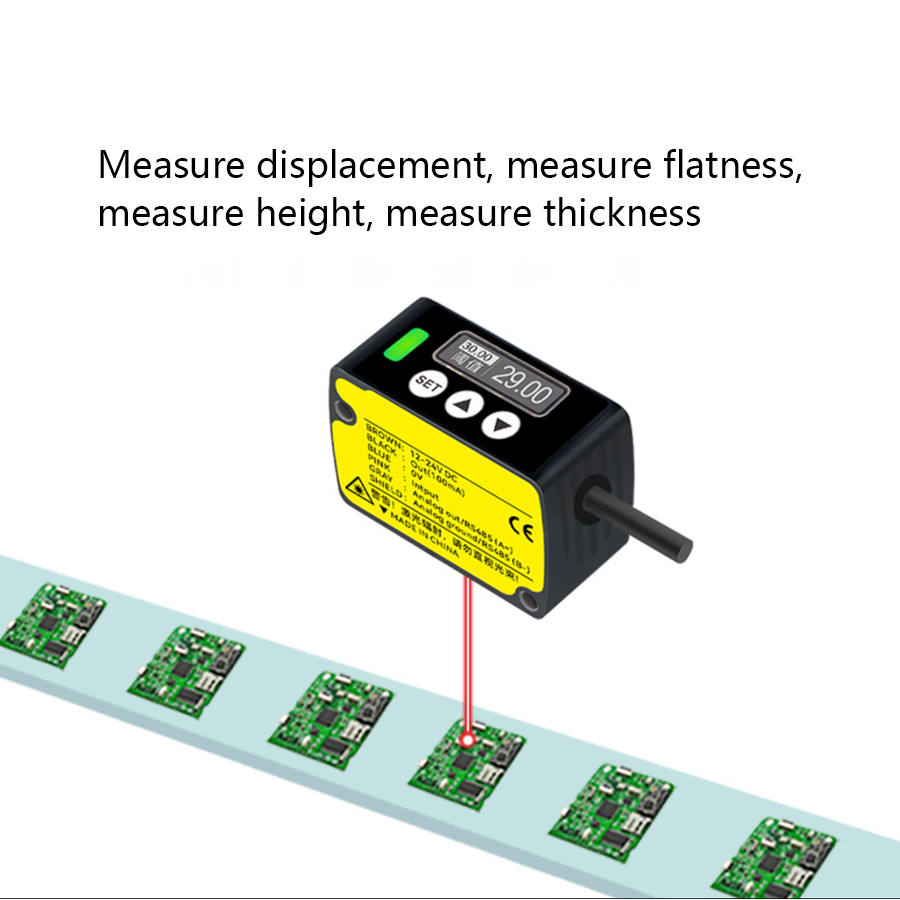
The DAIDISIKE DK-G CMOS laser sensor is a high-precision, non-contact device for industrial tasks like displacement, thickness, and vibration measurement. Using 665nm laser triangulation, it offers micron accuracy across 30-400mm ranges, with 10μm repeatability, ±0.1% F.S. linearity, and φ50μm spot size. Features include NPN/PNP and analog outputs, IP67 aluminum housing, multi-mode detection, adaptive light adjustment, and 1kHz sampling. CE-certified and Class 2/II compliant, it suits automotive, electronics, and semiconductor applications.
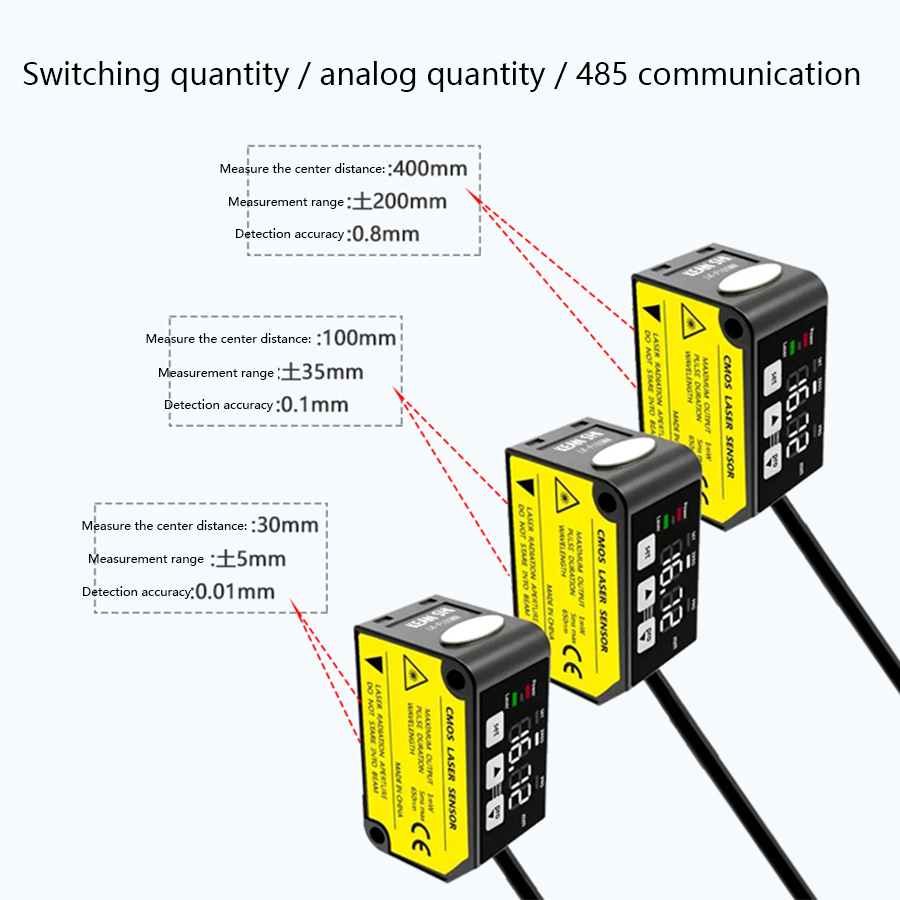
The DAIDISIKE DK-G series CMOS laser displacement sensor is a high-precision, non-contact optical measurement device designed for precision industrial applications, such as displacement detection, thickness measurement, surface profile scanning, and vibration analysis. This series employs advanced CMOS image sensor technology combined with the laser triangulation principle to achieve micron-level accuracy measurements, supporting various models to adapt to different measurement ranges, including short-range (30mm to 50mm), mid-range (100mm to 200mm), and long-range (400mm). The sensor detects changes in the position of reflected light on the CMOS by emitting a red visible laser (wavelength approximately 665nm, power less than 1mW) to calculate the displacement or distance of the target object. Product features include high repeatability (minimum 10μm), low linearity error (starting from ±0.1% F.S.), small spot size (starting from φ50μm), and strong anti-interference capabilities, supporting NPN/PNP switching outputs and analog outputs (voltage/current). The DAIDISIKE brand focuses on compact design and durability, with an aluminum alloy housing and IP64 (sensor head) / IP67 (cable connection) protection rating, suitable for harsh environments such as automotive parts inspection, electronics manufacturing, semiconductor processing, and material winding control. This series of sensors complies with IEC/JIS/FDA laser safety standards (Class 2/Class II), with electromagnetic compatibility (EMC) certified by CE, and is easy to integrate into PLC or industrial control systems. Advanced features include multi-mode detection (diffuse reflection/specular reflection), adaptive light intensity adjustment, and external trigger input, supporting high-speed sampling rates (up to 1kHz) for real-time dynamic measurements.
Specifications Table
The following is a detailed specifications table for the DK-G series sensors, categorized by measurement center distance, including short-range, mid-range, and long-range types. The table covers models, measurement ranges, accuracy indicators, light source parameters, power requirements, output modes, environmental adaptability, and other key specifications. Some models support analog output (M suffix).
Type
Measurement Center Distance
Model (NPN Output)
Model (PNP Output)
Model (Analog Output NPN)
Model (Analog Output PNP)
Measurement Range
Repeatability
Linearity Accuracy
Spot Diameter (Approx.)
Short-range
30mm
DK-G30NM
DK-G30PM
DK-G30N
DK-G30P
±5mm
10μm
±0.1% F.S. (f.s.=10mm)
φ50μm
50mm
DK-G50NM
DK-G50PM
DK-G50N
DK-G50P
±15mm
30μm
±0.1% F.S. (f.s.=30mm)
φ70μm
Mid-range
100mm
DK-G100NM
DK-G100PM
DK-G100N
DK-G100P
±35mm
70μm
±0.1% F.S. (f.s.=70mm)
φ120μm
200mm
DK-G200NM
DK-G200PM
DK-G200N
DK-G200P
±80mm
200μm
±0.2% F.S. (f.s.=160mm)
φ300μm
Long-range
400mm
DK-G400NM
DK-G400PM
DK-G400N
DK-G400P
±200mm
400μm (200-400mm)/800μm (400-600mm)
±0.8% F.S. (f.s.=400mm)
φ500μm
Additional Specification Details (Applicable to All Models Unless Specified Otherwise):
Light Source: Red semiconductor laser, wavelength 665nm, maximum output power 1mW (Class 2 laser product, compliant with IEC/JIS/FDA standards).
Resolution: 0.1μm (short-range) to 10μm (long-range), sampling period 0.15x0.15mm (near end) to 1.75x3.5mm (far end).
Power Supply Voltage: 12-24V DC ±10%, ripple (P-P) ≤5%.
Current Consumption: Maximum 60mA (switching output type), 50mA (analog output type).
Switching Output: NPN/PNP open collector, maximum load 100mA/DC30V, residual voltage 1.8V or less.
Analog Output: Voltage -5V to +5V (load resistance 100Ω), current 4-20mA (load resistance 300Ω or less); linear output range corresponds to measurement range, temperature drift ±0.08% F.S./°C.
Response Time: Fast mode max. 2ms, standard mode max. 11.5ms, high-precision mode max. 48.5ms, switchable via external input.
External Input (MF Input): NPN/PNP, multi-function input for mode switching, laser off, or zero reset, input resistance 10kΩ.
EMC Compliance: Compliant with EN standards, strong noise resistance.
Technical Parameters
The technical parameters of the DAIDISIKE DK-G series emphasize high resolution and stability, supporting multi-point calibration and real-time data processing. The sensor resolution is as low as 0.1μm, with a sampling rate up to 1kHz, linearity accuracy ±0.1% F.S. (Full Scale), repeatability ±0.05% F.S., and temperature drift coefficient ≤0.08%/°C. It integrates a digital signal processor (DSP) and analog-to-digital converter (ADC) to compensate for ambient light interference, surface reflectance variations, and tilt angle errors (maximum ±15°). Laser power control uses an automatic power control (APC) mechanism to ensure output stability. Data output supports ASCII/binary formats. Power consumption is as low as 300mW, suitable for portable devices. Advanced parameters include adjustable spot size (via focal length adjustment), dynamic range (DR) exceeding 100dB, electromagnetic interference (EMI) resistance compliant with industrial standards, and built-in filters (such as median filtering, moving average) to reduce noise. Compared to traditional inductive or ultrasonic sensors, this series provides higher accuracy and speed in non-contact measurements, ideal for micron-level applications like semiconductor wafer thickness inspection or precision mechanical assembly.
Working Principle
The working principle of the DAIDISIKE DK-G series CMOS laser displacement sensor is based on laser triangulation technique, an optical non-contact measurement method widely used in precision engineering. The sensor contains a semiconductor laser diode (Semiconductor Laser Diode) that emits a red visible laser beam (wavelength approximately 665nm), focused through a collimating lens (Collimating Lens) into a small spot beam projected onto the target object surface. The laser undergoes diffuse reflection (Diffuse Reflection) or specular reflection (Specular Reflection) on the surface, and the reflected light is imaged via a receiving lens (Receiving Lens) onto a linear CMOS image sensor (Linear CMOS Image Sensor), which consists of a high-resolution pixel array (Pixel Array) that precisely detects the center position of the spot (Centroid Position).
According to the triangulation principle, the sensor calculates the geometric relationship of the triangle formed by the emitted beam, reflected beam, and object surface. The specific formula is: displacement distance d = (f * b) / (Δx), where f is the focal length of the receiving lens (Focal Length), b is the baseline distance between the transmitter and receiver (Baseline Distance), and Δx is the position shift of the spot on the CMOS (from reference position x0 to actual position x'). Through the built-in analog-to-digital converter (Analog-to-Digital Converter, ADC) and microcontroller unit (Microcontroller Unit, MCU), it processes pixel data in real-time to convert it into digital displacement values. This process involves signal amplification (Signal Amplification), noise filtering (Noise Filtering), and linearization correction (Linearization Correction), unaffected by target color, texture, or slight tilt (under compensation algorithms). The sensor also integrates a photodiode (Photodiode) for laser intensity monitoring, enabling automatic power control (Automatic Power Control, APC) to maintain light source stability. The entire measurement cycle is less than 1ms, supporting high-speed dynamic measurements, such as vibration analysis (Vibration Analysis) or in-line quality control (In-Line Inspection). Compared to capacitive (Capacitive) or eddy current (Eddy Current) sensors, the laser triangulation method offers a longer measurement range (up to ±200mm) and higher accuracy, but attention should be paid to surface roughness (Ra < 10μm) and ambient light interference to avoid measurement errors.
Frequently Asked Questions
How accurate is the DK-G laser displacement sensor?
Accuracy scales with range. Short-range models give 10μm repeatability and ±0.1% F.S. linearity with a φ50μm spot, while the 400mm long-range model gives about 400–800μm repeatability. Resolution reaches 0.1μm. As a non-contact laser triangulation sensor, it suits micron-level displacement, thickness and vibration measurement on CMOS image-sensor technology.
What is the measurement range of the DK-G series?
The DK-G series spans short-range 30mm (±5mm) and 50mm (±15mm), mid-range 100mm (±35mm) and 200mm (±80mm), and long-range 400mm (±200mm) center distances. Pick the model whose center distance matches your standoff; closer ranges deliver finer resolution and a smaller laser spot for high-precision profile and thickness scanning.
Does it support NPN, PNP and analog outputs?
Yes. Each center distance is available with NPN or PNP open-collector switching output (max load 100mA/DC30V, residual voltage ≤1.8V). The analog models (M suffix) add a −5V to +5V voltage output or a 4–20mA current output for continuous displacement values, so the sensor integrates directly with PLCs, DAQ and industrial control systems.
Is the DK-G laser sensor eye-safe and CE compliant?
It uses a 665nm red semiconductor laser at ≤1mW maximum output, classified as a Class 2 (Class II) laser product compliant with IEC, JIS and FDA safety standards. Electromagnetic compatibility is CE-certified to EN standards. As with any Class 2 laser, avoid staring into the beam, but no protective enclosure is required for normal use.
What protection rating and operating conditions does it have?
The sensor head is rated IP64 and the cable connection IP67, with an aluminium-alloy housing and PMMA receiving lens. Operating temperature is −10°C to +45°C with no condensation, humidity 35–85% RH. It withstands 10–55Hz vibration and roughly 500G shock, making it suitable for inline inspection on automotive, electronics and semiconductor production lines.