
How to Calculate Safety Light Curtain Minimum Distance (ISO 13855)
Buying a top-tier safety light curtain is only half the battle. If you mount the sensor too close to the hazard, a worker's hand could still reach the dangerous area before the machine completely stops. That makes the entire investment useless.
To prevent this, international standards like ISO 13855 dictate exactly how far away your sensors need to be. Let's cut through the dense engineering jargon and look at how to actually calculate this minimum safety distance for your factory floor.
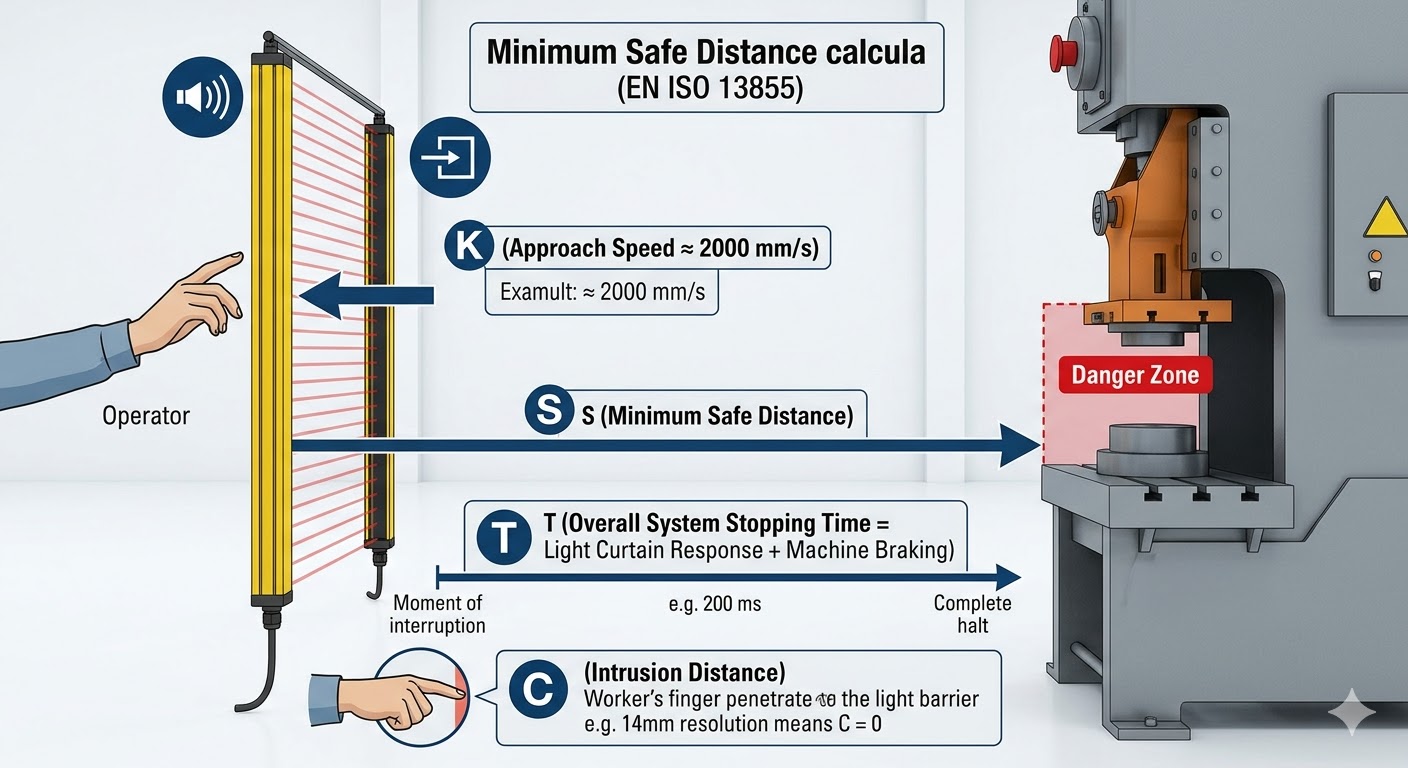
The ISO 13855 Formula Explained
According to the EN ISO 13855 standard, the formula for calculating the minimum safe distance is straightforward once you know the variables:
Here is what you are actually measuring:
- S (Minimum Safe Distance): The final distance from the light barrier to the hazard (measured in mm).
- K (Approach Speed): How fast a human body moves. The standard uses 2000 mm/s for fast hand/arm movements (if the distance is 500 mm or less) and 1600 mm/s for someone walking into the area.
- T (Total Stopping Time): This is crucial. It is NOT just the machine's braking time. It is the sensor's response time + the safety relay module's processing time + the machine's mechanical stopping time (measured in seconds).
- C (Intrusion Distance): An extra safety buffer depending on the sensor's resolution. If the infrared beams are further apart, a finger might slip through before being detected, meaning you need a larger ‘C’ value.
A Real-World Calculation Example
Let's say you are securing a heavy-duty mechanical stamping press. Here are your specs:
- You install a DAIDISIKE high-resolution safety light curtain with a 14 mm resolution (perfect for finger protection).
- The light curtain reacts in 0.015 seconds (15 ms).
- The press machine and relays take 0.150 seconds (150 ms) to completely halt.
Step 1: Find the Total Stopping Time (T)
Add the times together: 0.015 s + 0.150 s = 0.165 seconds.
Step 2: Find the Intrusion Distance (C)
For high-resolution curtains (d ≤ 40 mm), the rule is C = 8 × (d − 14). Since we are using a precise 14 mm sensor, our math is simple: 8 × (14 − 14) = 0 mm.
Step 3: Calculate the Final Distance (S)
Assuming the fast hand approach speed (2000 mm/s):
S = (2000 × 0.165) + 0 = 330 mm
The Verdict: You must mount this specific light curtain exactly 330 mm (or further) away from the press's danger zone. Any closer, and you risk a serious accident.
Why Sensor Resolution Can Save Factory Space
As you can see from the math, the resolution of your sensor changes everything. A 14 mm finger-detection curtain keeps the ‘C’ value at zero, allowing you to mount the unit much closer to the machine. If you used a standard 30 mm hand-detection curtain, the ‘C’ value increases, forcing you to push the safety perimeter further out into your valuable factory floor space.
When in doubt, don't guess. Machine braking times degrade as equipment ages, and regulatory bodies don't accept rough estimates. If you are unsure about which resolution fits your workflow or how to wire the setup correctly, the engineering team at DAIDISIKE can help you evaluate your equipment and recommend a fully compliant safety sensor system.