
How to use safety laser scanner for anti-collision in factories?
Factory “anti-collision” has two distinct outcomes: protect people (must achieve a certified safety stop) and avoid equipment collisions (warn, slow, or reroute). Use a safety-rated laser scanner for the first outcome, and industrial LiDAR for the second. This guide sets out a proven workflow: risk & standards → field design & sizing → wiring & logic → commissioning & validation → maintenance & change control. The aim is predictable behavior on real floors with oil mist, reflectors, forklift glare and vibration.
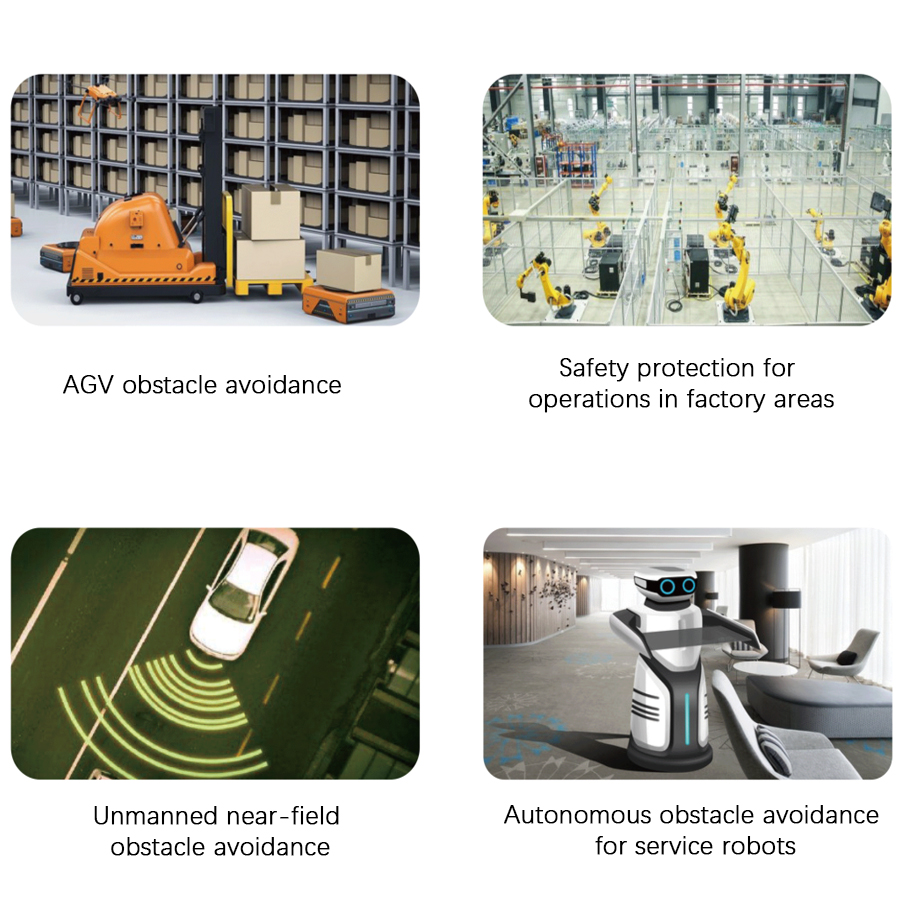
1) Choose the right class — safety scanner vs. industrial LiDAR
| Class | Primary purpose | Standards & notes | Typical scenes |
|---|---|---|---|
| Safety laser scanner | Human protective stop — certified device delivers safe OSSD outputs to a safety controller. | Meets IEC 61496-3 (AOPDDR). System validation to ISO 13849-1 (PL) or IEC 62061 (SIL). Safety distance by ISO 13855. | Robot cells, press lines, AGV safety stop, collaborative zones with approach hazards. |
| Industrial LiDAR | Collision avoidance & navigation aid — detection layer for warning/slow/route change (non-safety). | EMC/ENV tested but not safety-certified. Combine with certified safety measures if people are exposed. | DLD05A-1N/DLDO5A-1N (5 m) and DJNS 20A5-5N (20 m) for aisle monitoring, AGV mapping, perimeter pre-warning. |
2) Engineering workflow — from risk to verified stop
- Risk assessment — Identify hazards, exposure and possibility of avoidance (ISO 12100). Determine required PLr or SIL for safety functions.
- Motion model — For vehicles, capture nominal/max speed, acceleration/braking, controller latency; for machines, capture worst-case stopping time.
- Field strategy — Typically three layers: Warning → Slow/Creep → Stop. Safety scanners switch protective fields by speed/direction; industrial LiDAR feeds PLC logic for early slow-down or reroute.
- Mounting & FOV — Height for leg detection (200–300 mm), tilt to reduce floor glare, corner pairing to remove shadows, and shielding against pallets/mirrors.
- Interfaces — Safety OSSD/safe bus for safety scanners. For industrial LiDAR (e.g., DLD05A-1N/DLDO5A-1N, DJNS 20A5-5N) use NPN outputs or UART/CAN/Ethernet. Ensure deterministic timing.
3) Sizing protective/detection distance
Fixed machinery — Use ISO 13855: S = K × T + C. Here T is total stop time (sensor response + controller delay + mechanical brake), and C is intrusion allowance based on resolution. The 2024 edition adds terms for particular geometries (e.g., DDS, Z). Always measure stop time and file the record.
Mobile platforms (AGV/AMR) — Use ISO 3691-4. Protective field ≥ stopping distance at the current speed + control/odometry latency + position uncertainty. Implement speed-dependent field sets and verify with worst-case load and floor friction.
4) Installation rules that avoid false trips and blind spots
- Height & tilt: low mounting for leg/ankle detection; slight downward tilt limits floor specular returns.
- Corner coverage: 270° scanners need pairing at inner corners; ensure overlapping 10–20% to remove “V” gaps.
- Reflectors: paint bright edges matte; keep windows clean; add housings in oil-mist/welding areas.
- Cabling & EMC: segregate from VFD/motor runs; use shielded cables; bond housings; verify margins with the machine at full duty.
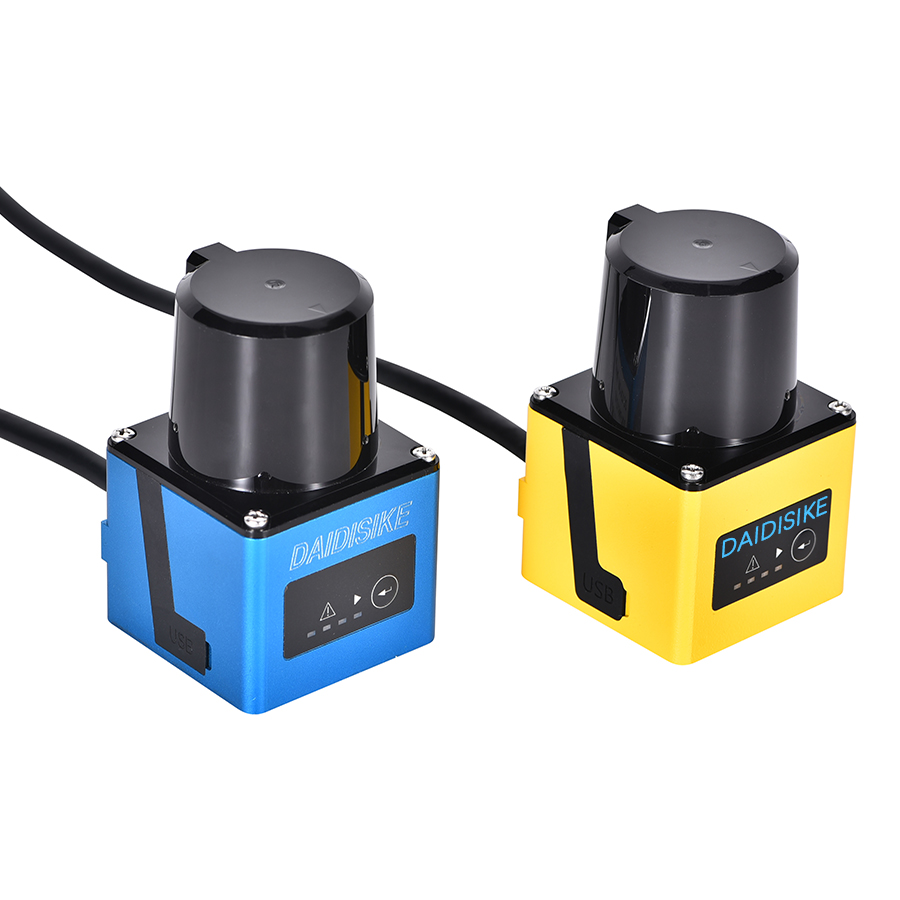
5) Logic & I/O — make the stop deterministic
- Safety scanners: wire OSSDs to a safety relay/PLC; configure restart interlock, external device monitoring (EDM), and field switching by speed/direction.
- Industrial LiDAR (DLD05A-1N/DLDO5A-1N, DJNS 20A5-5N): use NPN outputs for pre-warning/slow; the final stop must be executed by a certified safety function.
- Muting/blanking: for conveyors or gates, combine timers and confirmation sensors; document all bypass conditions and limits.
6) Commissioning & validation — what to prove
| Item | Acceptance criterion | Evidence |
|---|---|---|
| Stop distance | Protective field ≥ measured stopping distance + uncertainty margins | Stop-time test report; ISO 13855/ISO 3691-4 calculation sheet |
| Coverage | No blind spots at corners, under pallets or around fixtures | Field plots; corner walk-through test |
| EMC/ambient | No nuisance trips at full production duty | EMC run test with VFDs/welders active |
| Change control | Config locked; changes auditable | Parameter printout; password policy; revision log |
7) DAIDISIKE quick spec map (for planning)
| Model | Range | Outputs | Typical role |
|---|---|---|---|
| DLD05A-1N / DLDO5A-1N | 5 m | NPN | Close-range obstacle warning on AGV/cell entries; assists slow/creep modes. |
| DJNS 20A5-5N | 20 m | NPN | Aisle perimeter and approach detection; early warning before the safety stop chain. |
For human protective stop, use a safety-rated laser scanner (IEC 61496-3) and validate the safety function to ISO 13849-1 or IEC 62061.
8) Maintenance & change management
- Daily: lens cleanliness, indicator states, connectors, no new occlusions.
- Periodic: re-measure stop time, reconfirm field plots; in welding/oil-mist areas shorten the interval.
- After changes: any software/PLC update, speed change or layout shift requires re-validation before release.
- Records: parameter set (.cfg), stop-time logs, test checklists, and revision history stored with the machine file.
9) Standards you will cite in reports
- IEC 61496-3 — Safety laser scanners (AOPDDR) product requirements and type testing.
- ISO 13855 — Positioning of safeguards; safety-distance formulae and parameters.
- ISO 3691-4 — Driverless industrial trucks (AGV/AMR) safety requirements.
- ISO 12100 — Risk assessment & risk reduction framework for machinery.
- ISO 13849-1 / IEC 62061 — Functional safety (PL/SIL) at system level.
- ANSI B11.19 — Performance requirements for risk-reduction measures (North America).
Frequently Asked Questions
What is the difference between a safety laser scanner and an industrial LiDAR?
A safety laser scanner is a certified protective device (to IEC 61496-3) intended to stop a hazard when a person enters its field. An industrial LiDAR is a navigation or measurement sensor with no safety rating. For protecting people only a certified safety scanner may be used; LiDAR suits mapping and obstacle avoidance that is not safety-rated.
How do I size the protective field of a safety scanner?
The protective field must account for the approach speed, the scanner's response time, the vehicle or machine stopping distance, and a margin for measurement tolerance and ground clearance. On a moving platform a longer stopping distance means a larger field. The field is verified against the standard after installation.
How do I mount a safety scanner to avoid blind spots and false trips?
Mount at the height and angle specified for the application, keep the scan plane clear of fixed structures and reflective floors, and respect the minimum distance from walls. Contamination, vibration and reflective surfaces are common causes of false trips, so plan cleaning access and stable mounting.
How do I make the stop deterministic?
Wire the scanner's safety outputs into a safety controller or relay so a field violation reliably commands a stop, with defined response times and restart interlocks. The I/O logic and any field switching should be designed so the safe state is always reached within the calculated stopping budget.
What should I prove during commissioning?
Validate that the protective field covers the hazard with no gaps, that the measured stopping distance fits within the field, that the stop function triggers on intrusion, and that restart requires a deliberate action. Document the field configuration, response times and test results for the safety file.