What is Lidar Scanner
Understanding Lidar Scanner Technology
Lidar Scanner technology measures space using laser-based remote sensing. By emitting laser beams and analyzing their reflected signals, a Lidar Scanner determines distance, shape, and position with millimeter-level precision. The term “Lidar” stands for Light Detection and Ranging, a method that generates detailed 3D environmental models through point cloud data. Lidar Scanner technology serves critical functions across autonomous driving, geographic mapping, architectural planning, and environmental monitoring.
Working Principle of a Lidar Scanner
The core operation of a Lidar Scanner relies on Time of Flight (ToF) measurements or phase difference analysis. When a Lidar Scanner emits short laser pulses, these beams travel to target objects and reflect back to the sensor. Sophisticated algorithms calculate distances by measuring light speed and return time intervals. Modern Lidar Scanners incorporate rotating mirrors or MEMS (Micro-Electro-Mechanical Systems) technology to achieve 360° scanning coverage, enabling comprehensive spatial data collection. The resulting high-density point clouds form the foundation for generating accurate 3D models of scanned environments.
Technical Features of Modern Lidar Scanners
- High Precision Sensing
- Millimeter-level resolution enables detailed mapping
- Multi-beam systems capture complex geometries
- Advanced Operational Capabilities
- All-weather performance with infrared lasers
- Low-light operation for 24/7 functionality
- Versatile Applications
- Environmental monitoring and forestry management
- Robotic navigation and obstacle detection
- Data Processing Requirements
- High-performance computing for point cloud analysis
- Advanced algorithms for real-time object recognition
Lidar Scanner Applications
In autonomous vehicles, a Lidar Scanner provides real-time environmental perception by detecting pedestrians, vehicles, and road obstacles with unparalleled accuracy. Construction professionals utilize Lidar Scanners for creating as-built documentation and 3D building models that streamline design processes. Natural resource management employs Lidar Scanner technology for forest canopy analysis and terrain mapping, enabling precise biomass calculations and flood risk assessment. Industrial facilities implement Lidar Scanners for indoor robot navigation and safety monitoring.
Future Development of Lidar Scanners
Advancements in AI and sensor miniaturization continue to enhance Lidar Scanner capabilities. Solid-state Lidar technology eliminates moving parts, increasing reliability while reducing costs. The latest Lidar Scanner models feature expanded field-of-view and higher angular resolution, improving performance in challenging environments. As Lidar Scanners become more compact and affordable, integration into consumer electronics and smart city infrastructure accelerates. Industry forecasts predict a $1.5 billion valuation for Lidar in construction alone by 2030, reflecting the growing dominance of this revolutionary scanning technology.
DAIDISIKE Brand and LiDAR Product Overview
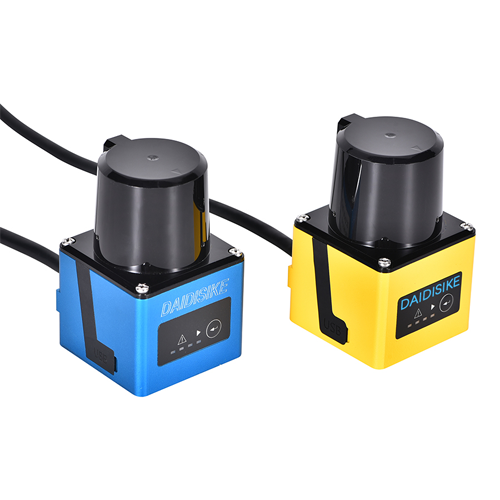
DAIDISIKE’s LiDAR is developed and manufactured with a focus on high performance and reliability. DAIDISIKE is a leading manufacturer specializing in the research, development, and production of high-performance, reliable LiDAR scanners. Our DLD series LiDAR products have been successfully deployed in the Chinese market for over a decade, earning widespread trust for their proven quality and performance through real-world applications.
We have introduced a range of LiDAR models, including:
- DLD05A3-3N: 5-meter detection range, ideal for high-precision, short-range detection scenarios.
- DLD20A5-5N: 20-meter detection range, suited for mid-range environmental monitoring and navigation.
- DLD30T-5N: 40-meter detection range, designed for long-range applications in complex environments.
- 5JPTG/10JPTG: Newly developed models with 5-meter and 10-meter detection ranges, optimized for performance and cost-efficiency.
- 100-meter LiDAR: Coming soon, stay tuned for updates.
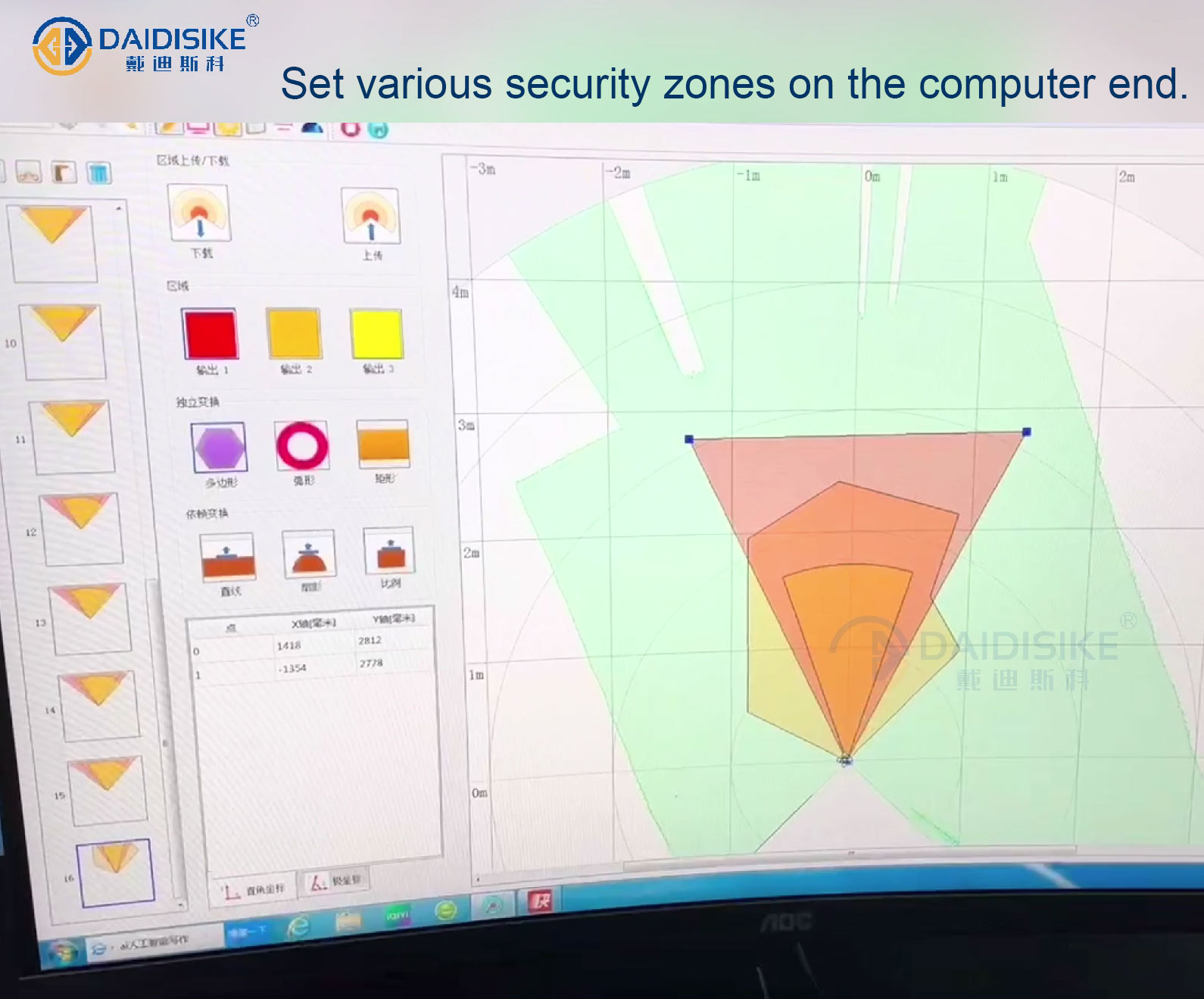
DAIDISIKE’s LiDAR scanners integrate obstacle avoidance, measurement, and real-time data transmission capabilities, enabling real-time data reception and signal alerts via computer. Known for their high precision, rapid response, and reliable performance, our products are widely used across various industries.
Application Scenarios
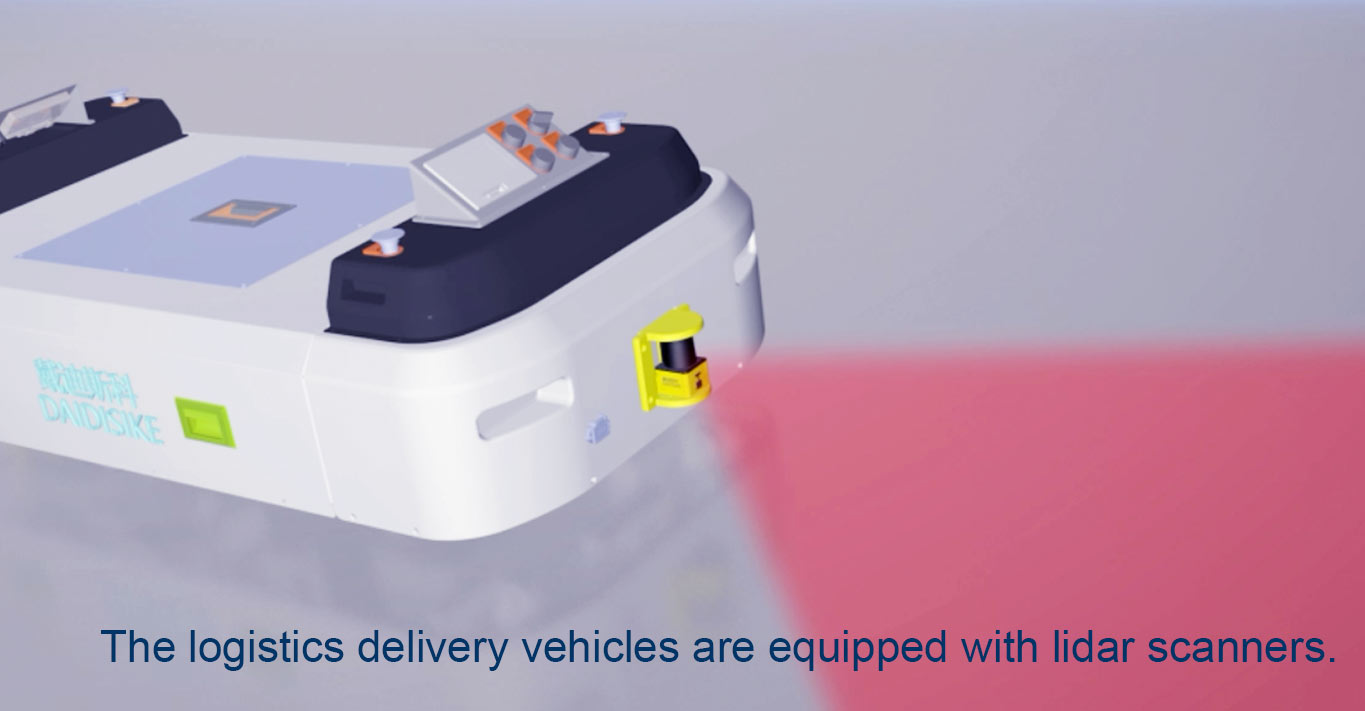
- AGV/AMR Autonomous Mobile Robot Navigation and Obstacle Avoidance: Supports 2D planar scanning, obstacle avoidance with deceleration, virtual walls, and safety zone switching, configurable via computer. Ideal for intelligent warehousing and factory logistics automation.
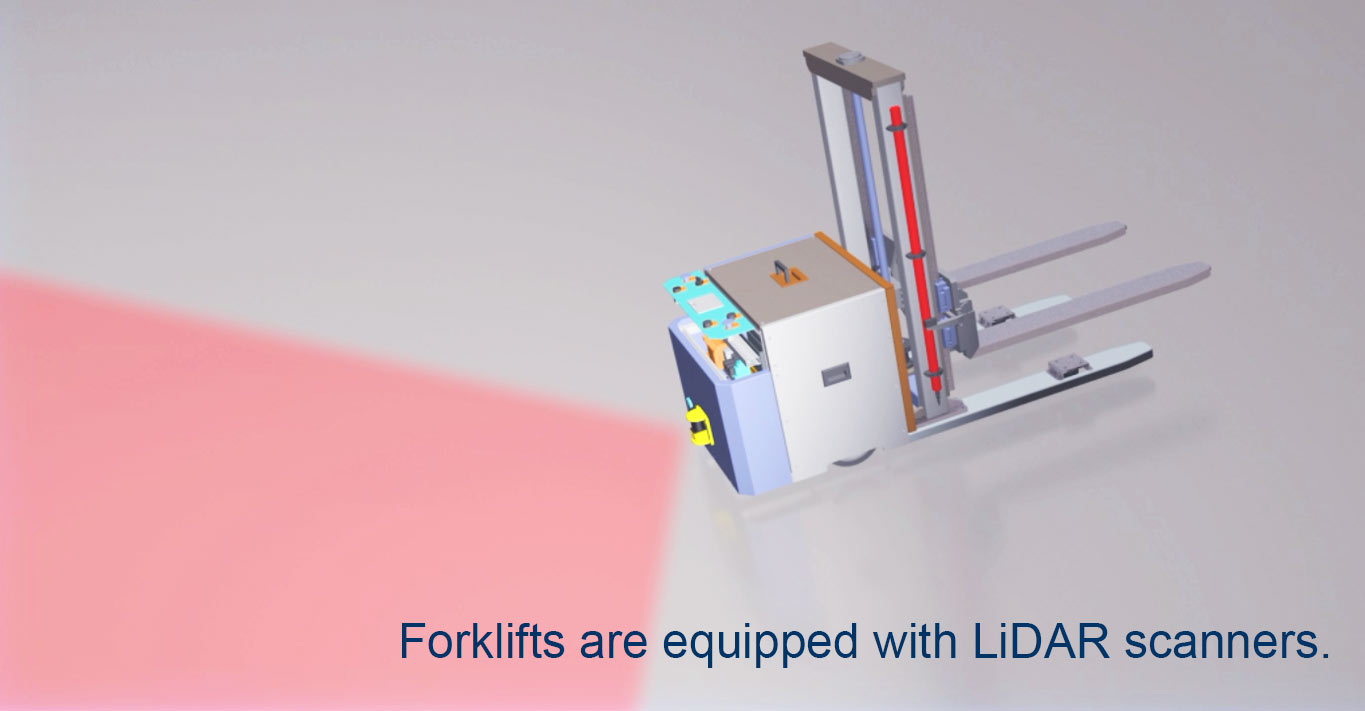
- Forklift and Tractor Collision Avoidance: Actively monitors safety zones around vehicles during low-speed operations, turns, or in blind spots, providing multi-range safety protection to reduce risks in mixed pedestrian-vehicle environments.
- Industrial Robot Workstation Safety: Establishes multi-level safety zones around robots, triggering deceleration or shutdown upon intrusion, with optional alarm light integration for enhanced safety in human-robot collaborative settings.
- Logistics Sorting and Conveyor Line Protection: Detects personnel intrusion and intercepts restricted areas along conveyors or sorting machines, minimizing accidental contact or injuries.
- Smart Access Control and Entry Management: Provides presence detection and anti-pinch/anti-collision features for gates, rolling shutters, and retractable doors in mixed pedestrian-vehicle scenarios.
- Parking Lot and Toll Booth Vehicle Profiling: Confirms vehicle presence, identifies dimensions and positioning, and optimizes lane throughput efficiency.
- Construction Site Perimeter Safety: Dynamically monitors and alerts for high-risk areas such as edges, lifting zones, or hazardous work zones, enhancing on-site safety compliance.
- Volume and Contour Measurement: Measures 2D contours and occupancy of pallets, packages, or boxes, facilitating automated sorting and billing on production lines (requires coordination with clients on operational details).
- Elevator and Automatic Door Anti-Pinch Detection: Detects people or objects in door zones to reduce the risk of pinching, improving passage safety and experience.
- Rail and Port Vehicle Safety Assistance: Performs low-speed area scanning for bridge cranes, yard vehicles, or rail vehicles to minimize blind spot risks.
- Crowd Management in Scenic Areas and Venues: Monitors crowd density and triggers congestion alerts to support operational scheduling.
- Agriculture and Specialty Vehicles: Enables forward obstacle avoidance and edge detection for orchard vehicles, sanitation trucks, and construction vehicles in complex terrains.
Product Advantages
- High-Precision Measurement: Delivers millimeter-level accuracy for reliable data.
- Real-Time Data Transmission: Supports fast data transfer for real-time monitoring in dynamic environments.
- Versatile Applications: Offers multiple detection ranges to suit short-, medium-, and long-range scenarios.
- Robust and Durable: Rigorously tested for stable, long-term performance in challenging environments.
- Easy Integration: Features standard interfaces for seamless integration with various devices and systems.
Why Choose DAIDISIKE?
DAIDISIKE’s LiDAR solutions are tailored to meet customer needs, with customized configurations backed by a decade of market-proven reliability. Our products are used in fields such as smart manufacturing, autonomous driving, and smart cities. By choosing DAIDISIKE, you gain access to high-performance LiDAR products and dedicated after-sales support for your project. We welcome inquiries for OEM and ODM partnerships. For more LiDAR demonstration videos, please click on our YouTube videos: 1, Computer operation demonstration ; 2, 3D animation demonstration.