IP67 vs. IP69K Safety Light Curtains: What Food & Beverage Factories Need
If you run a food processing plant, a brewery, or a pharmaceutical packaging line, you already know the drill. It's Friday night, production stops, and the sanitation crew comes in. Out come the 1,400 PSI hoses, the 80 °C (176 °F) hot water, and the caustic foaming detergents. They blast every inch of the machinery to kill bacteria and meet strict FDA or CE hygiene standards.
Come Monday morning, your packaging machine will not start. The maintenance team finds the culprit: the safety light curtain protecting the robotic palletizer has shorted out. Water got inside the lens.
The purchasing manager is confused. “But we bought an IP67-rated sensor! It's supposed to be waterproof!” This is one of the most expensive and common misunderstandings in the industrial automation world. Let's break down exactly why a standard IP67 sensor is doomed to fail in a washdown environment, and why upgrading to an IP69K safety light curtain is the only long-term solution.
The Big Misunderstanding: What IP67 Actually Means
The Ingress Protection (IP) rating system is often misunderstood. When engineers see “IP67,” they assume it means “100% waterproof in all conditions.” That is simply not true.
An IP67 rating means the device is completely protected against dust (the “6”) and can withstand being submerged in up to 1 meter of still water for 30 minutes (the “7”).
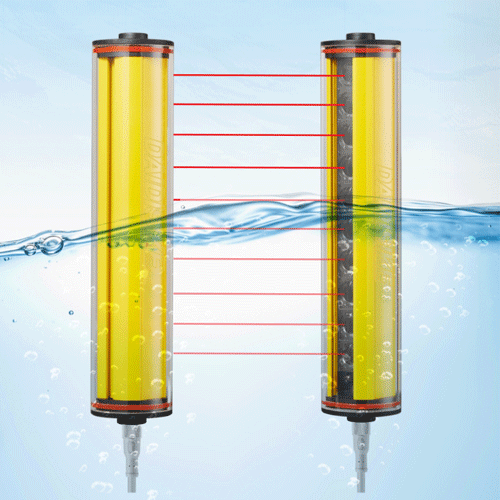
Here is the problem: A sanitation crew does not gently submerge your sensors in a bathtub. They hit them with high-velocity, high-temperature water jets. The kinetic force of a pressure washer easily bypasses standard rubber gaskets and silicone seals found on IP67 aluminum light curtains. Once moisture gets inside an optical sensor, the lenses fog up, the infrared beams break, and the machine triggers a false emergency stop.
Enter IP69K: The Heavyweight Champion of Washdowns
If your machinery faces regular cleaning, you need a true washdown safety curtain. This is where the IP69K rating comes in. Originally developed for road vehicles like cement mixers and dump trucks, IP69K is now the absolute gold standard for the food and beverage industry.
To achieve an IP69K rating, a sensor must survive a brutal testing process:
- Extreme Pressure: Water is sprayed at the device at 8 to 10 MPa (1160 to 1450 PSI).
- High Temperature: The water temperature is heated to a scalding 80 °C (176 °F).
- Close Proximity & Angles: The nozzle is held just 10 to 15 cm away from the sensor, hitting it from four different angles (0°, 30°, 60°, and 90°) while the device sits on a rotating turntable.
If a safety sensor survives that without a single drop of water penetrating the enclosure, it earns the IP69K badge. It proves the sensor can take a direct hit from a factory pressure washer.
The Hidden Enemy: Chemical Corrosion and Bacteria
High-pressure water is only half the battle. Food processing plants use harsh chemical cleaning agents — alkaline foams to break down fats and acidic sanitizers to eliminate bacteria.
Standard safety light curtains use extruded aluminum housings. Over time, these caustic chemicals eat away at the anodized aluminum and degrade the plastic end-caps. Even worse, the standard square-shaped housings have grooves, screw holes, and sharp corners. In the food industry, a sharp corner is a breeding ground for Listeria and Salmonella.
How to Future-Proof Your Washdown Lines
Replacing waterlogged sensors every three months is a terrible strategy. The cost of a replacement sensor is nothing compared to the cost of a packaging line being shut down for six hours while you wait for a technician to rewire a new unit.
When selecting machine guarding for meat processing, dairy bottling, or pharmaceutical lines, you must look for three specific features:
- A certified IP69K rating (not just IP67).
- A smooth, tubular housing design that prevents liquid pooling and bacterial growth.
- IP69K-rated cables and M12 connectors (because if water gets into the connector port, the sensor will still short out).
At DAIDISIKE, we manufacture specialized waterproof safety light curtains engineered specifically to survive the worst your sanitation crew can throw at them. Stop treating your safety sensors like disposable items. Contact our engineering team today, and let's equip your washdown zones with hardware built to last.