
DK-D461 & DK-D561 Strip Photoelectric Switch (Background Suppression Sensor)
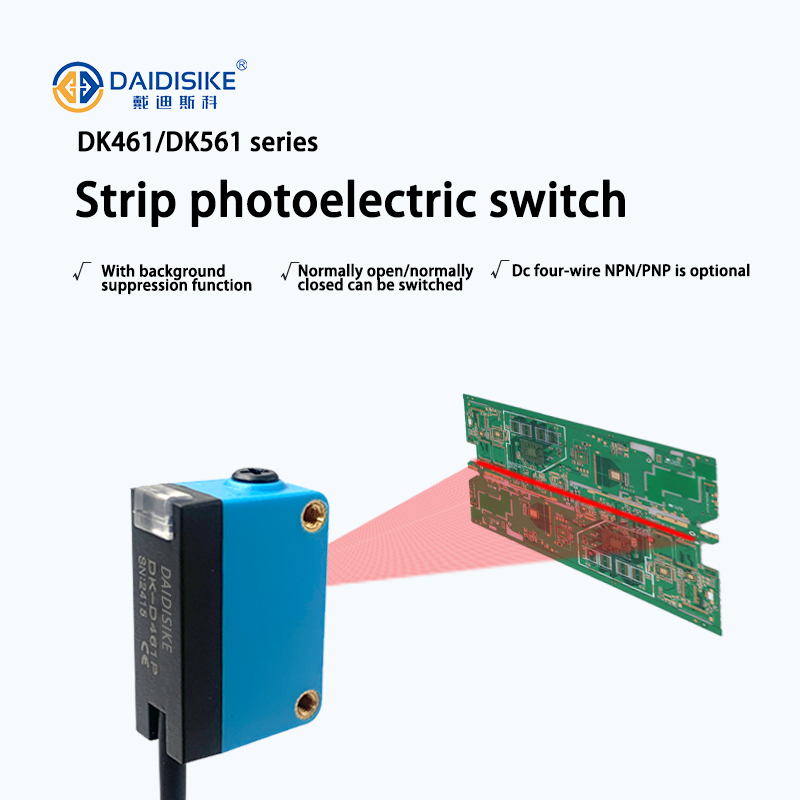
High-precision photoelectric sensors designed for reliable detection of irregular, hollow, transparent, or uneven surfaces in packaging, filling, and industrial automation applications.
Product Overview
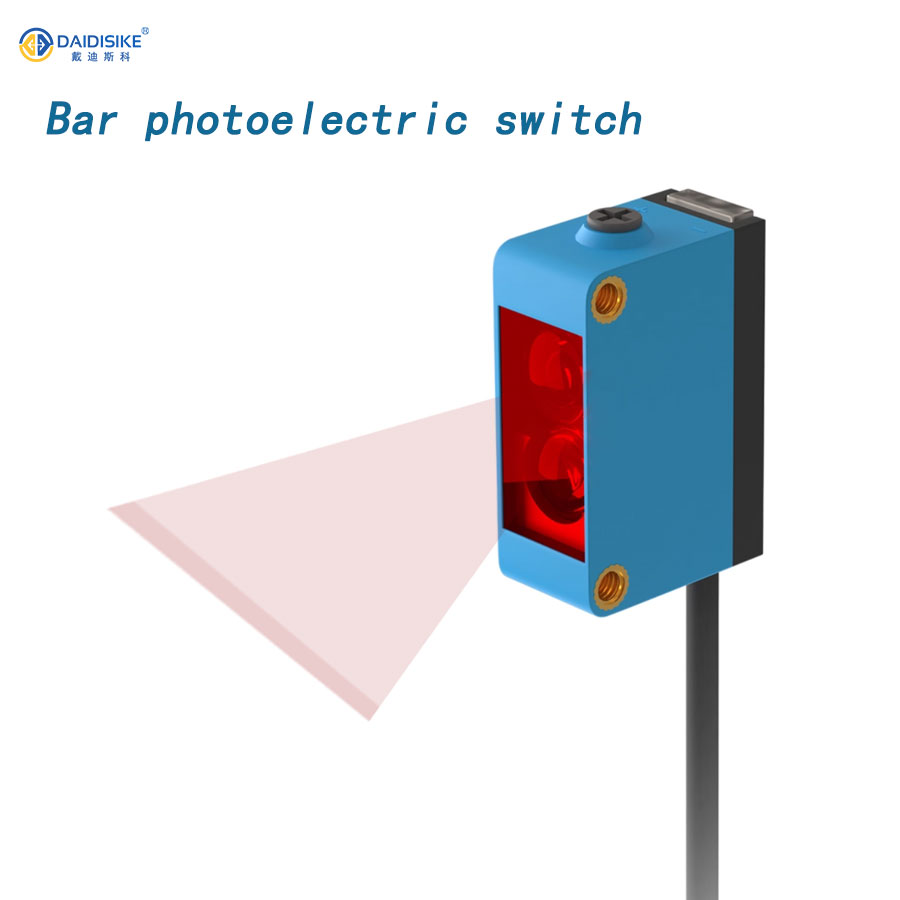
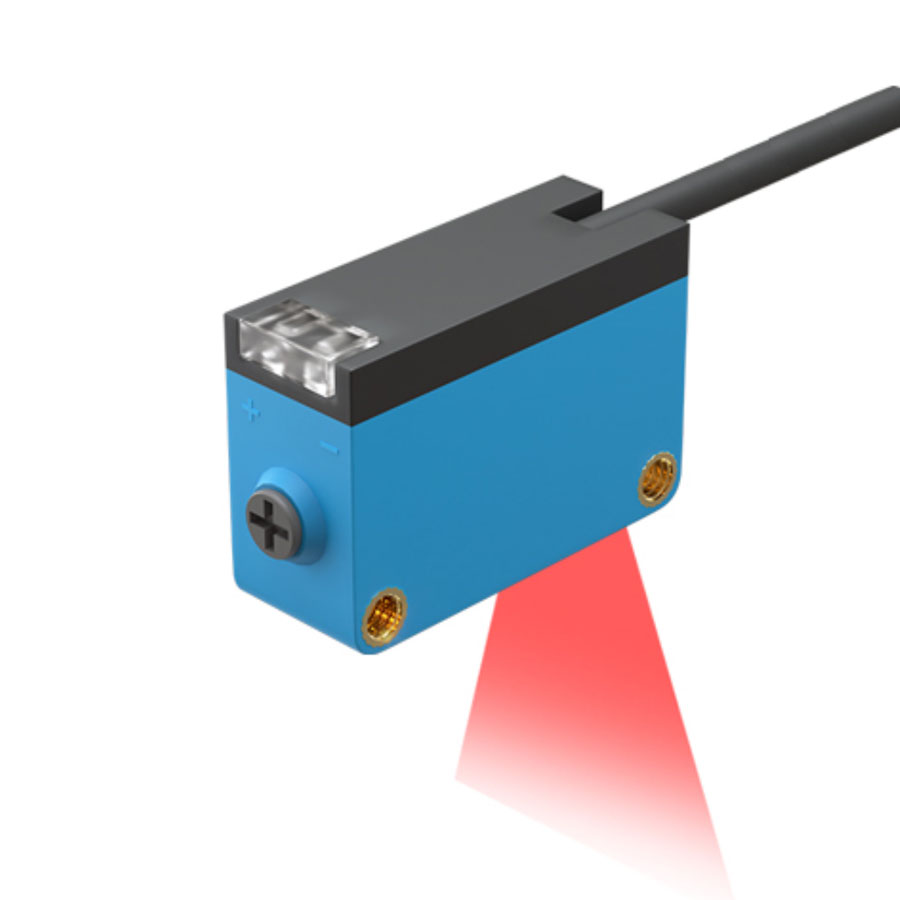
DAIDISIKE strip photoelectric switches feature advanced background suppression technology, enabling stable detection of complex targets even against reflective, transparent, or dark backgrounds.
Working Principle (Authoritative):
Based on the photoelectric effect, these sensors emit an infrared beam (LED or laser) and detect the reflected light. When an object enters the sensing zone, the reflected signal triggers an internal switch output. Background suppression models use triangulation or intensity thresholding to ignore distant background objects, responding only to targets within the preset detection range—solving a key limitation of standard diffuse sensors.
With 5 ms response time, IP65 protection, and easy installation, these sensors are ideal replacements for mechanical limit switches in demanding industrial environments.
DK-D461 Specifications (LED Strip Light)
| Basic Parameters | |
|---|---|
| Brand | DAIDISIKE |
| Principle | Diffuse reflective with background suppression |
| Adjustment | 5-turn potentiometer |
| Sensing Distance | 5–200 mm (adjustable) |
| Light Source | Visible red LED |
| Beam Size | 60 mm (L) × 4 mm (W) |
| Supply Voltage | 10–30 VDC |
| Max Load | 150 mA |
| Switching Frequency | 100 Hz |
| Response Time | 5 ms |
| Protection Rating | IP65 |
| Cable Length | 2 m |
| Output Mode | Light-ON / Dark-ON selectable |
DK-D561 Specifications (Laser Strip Light)
| Basic Parameters | |
|---|---|
| Brand | DAIDISIKE |
| Principle | Diffuse reflective with background suppression |
| Adjustment | 5-turn potentiometer |
| Sensing Distance | 5–100 mm (adjustable) |
| Light Source | Visible red laser |
| Beam Size | 60 mm (L) × 2 mm (W) |
| Supply Voltage | 10–30 VDC |
| Max Load | 150 mA |
| Switching Frequency | 100 Hz |
| Response Time | 5 ms |
| Protection Rating | IP65 |
| Cable Length | 2 m |
| Output Mode | Light-ON / Dark-ON selectable |
Detailed Technical Specifications
| Common Specifications | |
|---|---|
| Model | DK-D461NPN / DK-D461PNP |
| Detection Method | Distance-set reflective |
| Max Sensing Distance | 200 mm (DK-D461) / 100 mm (DK-D561) |
| Emitter | Red LED / Laser, 1 mm strip, up to 100 mm long |
| Repeatability | ±1 mm (along beam), ±0.2 mm (perpendicular) |
| Differential Distance | <2% of operating distance |
| Response Time | <1 ms (ON/OFF) |
| Supply Voltage | DC 12–24 V ±10% ripple |
| Current Consumption | <30 mA |
| Output Type | NPN/PNP open collector: ≤26.4 V, ≤100 mA, ≤1 V residual |
| Operation Mode | NO/NC selectable |
| Indicators | Red (output), Green (power) |
| Protection | Reverse polarity, short-circuit |
| Enclosure Rating | IP65 |
| Ambient Light Immunity | ≤3,000 lx (incandescent), ≤10,000 lx (sunlight) |
| Operating Temp. | −25 ~ +55°C (storage: −40 ~ +70°C) |
| Humidity | 35–85% RH (operating), 35–95% RH (storage) |
| Insulation Resistance | ≥20 MΩ @ DC 500 V |
| Withstand Voltage | AC 1,000 V, 1 min |
| Vibration Resistance | 10–55 Hz, 1.5 mm amplitude, 2 h per axis |
| Shock Resistance | 500 m/s² (50G), 3 times per axis |
| Cable | 2 m, 4-core φ4 rubber cable (0.2 mm²) |
| Housing Material | PBT + PMMA lens |
| Weight | 60 g |
Wiring Diagrams
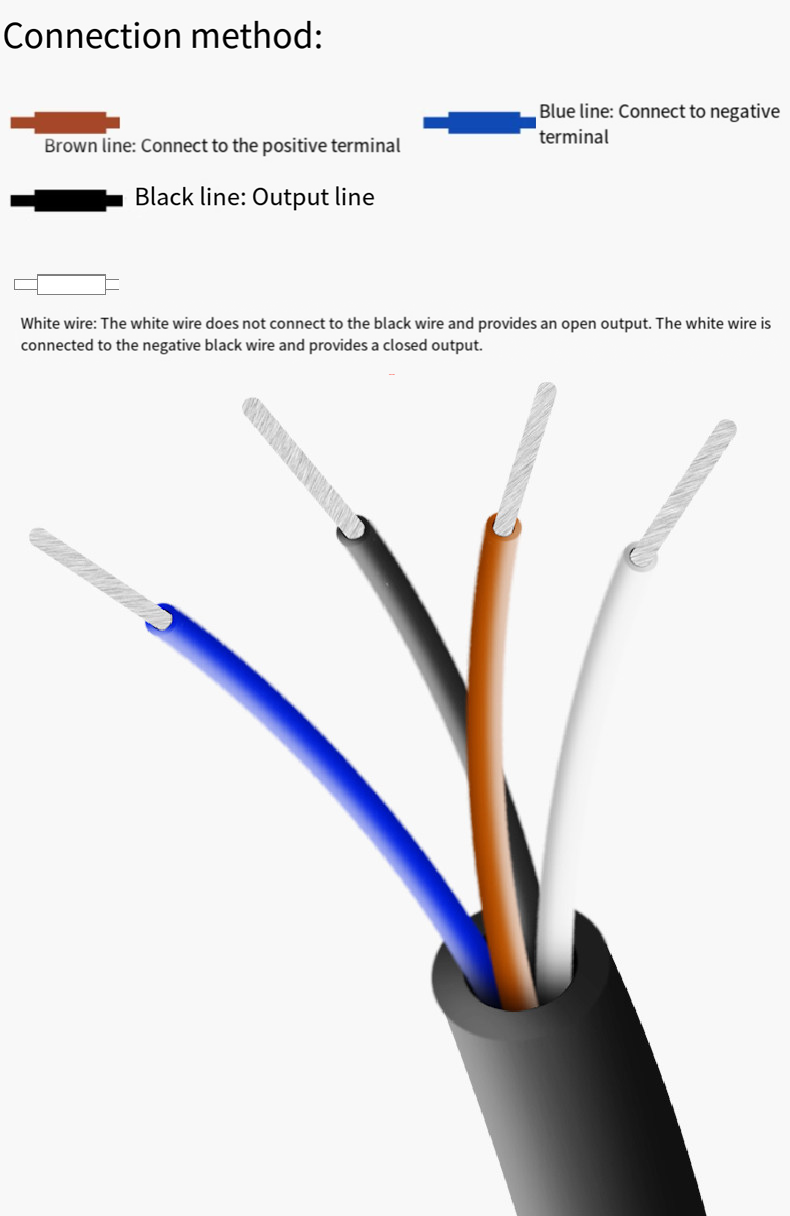
Note: For Light-ON mode, leave the white wire unconnected. For Dark-ON mode, connect the white wire to the blue (negative) line.
DK-D461 NPN Output Wiring
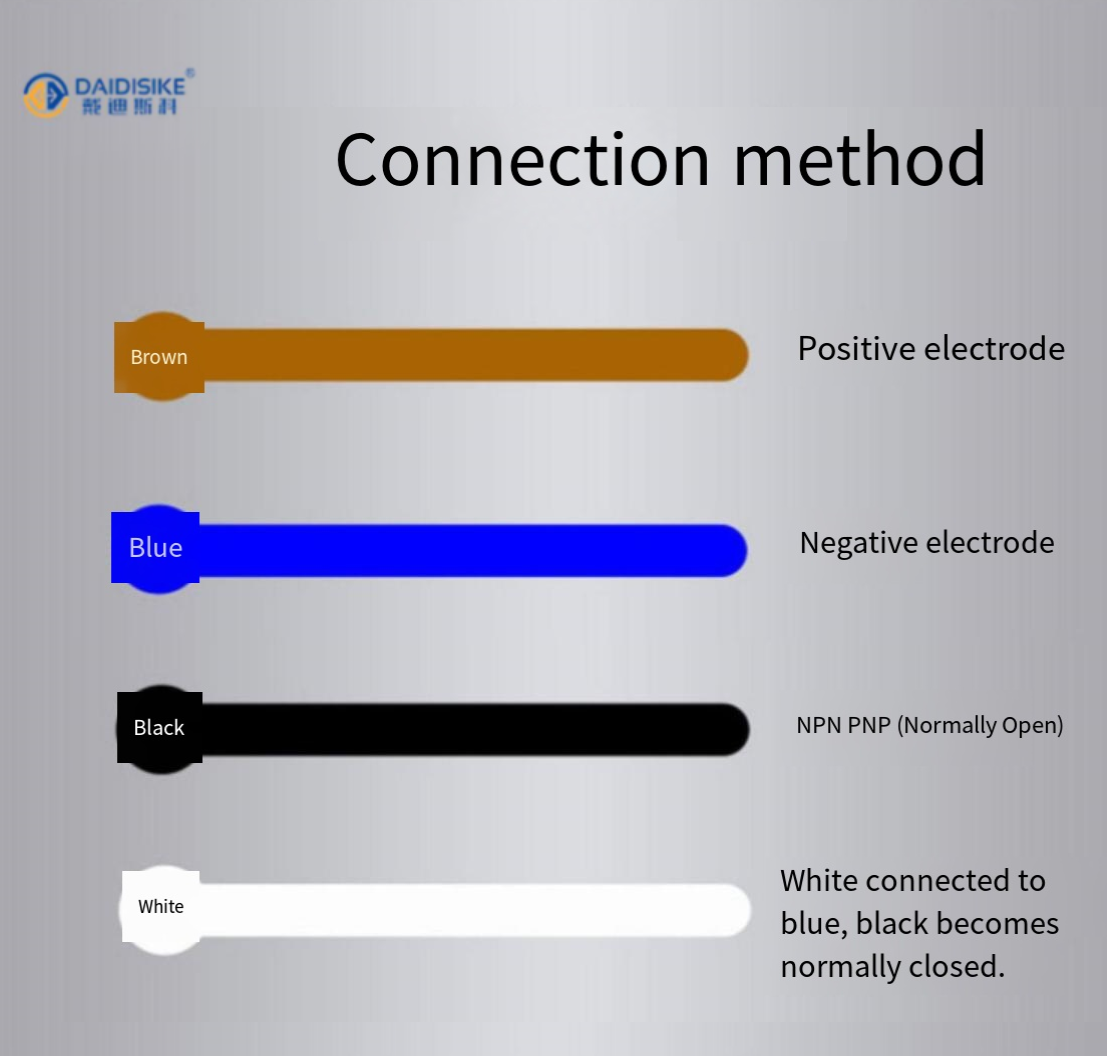
● Brown: +V
● Blue: GND
● Black: Output
● White: Dark-ON / Light-ON selection
DK-D461 PNP Output Wiring
Dimension Drawings
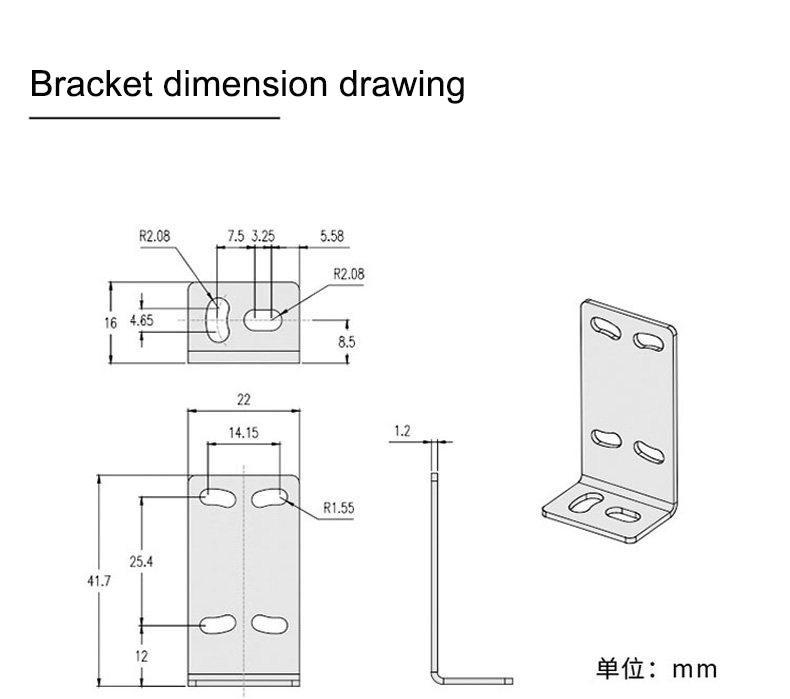
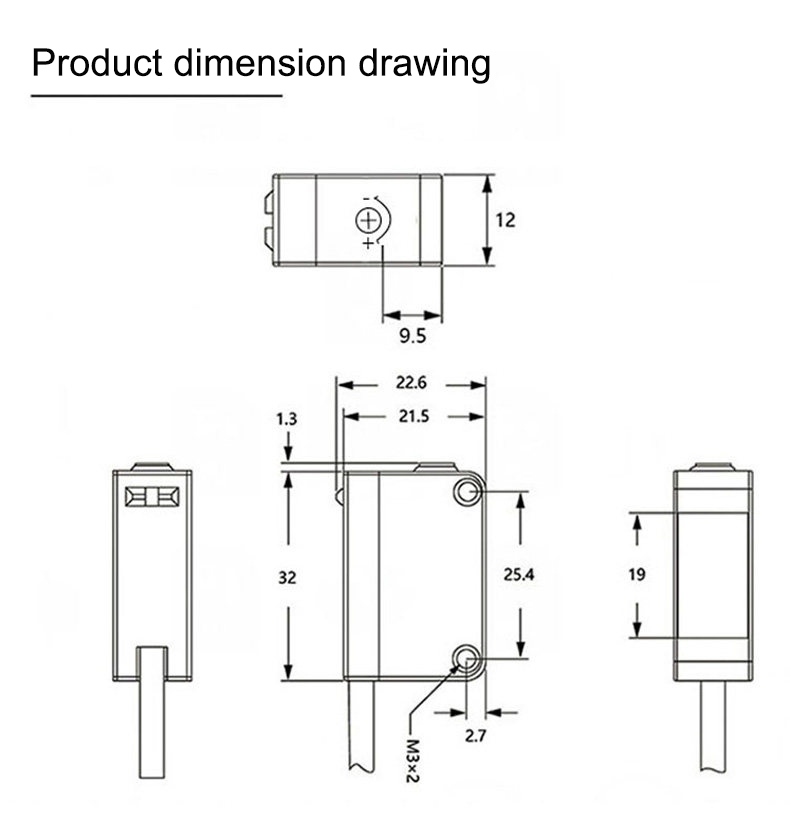
Both models feature a compact design for installation in tight spaces. Dimension drawings clearly indicate mounting holes, housing contours, and critical dimensions for seamless integration.
Installation Tips:
Ensure stable mounting away from strong ambient light or excessive vibration. After installation, adjust the potentiometer according to your specific application for optimal performance.
Frequently Asked Questions
What is background suppression in a photoelectric switch, and why does it matter?
Background suppression (BGS) uses triangulation to detect only targets inside a preset distance and ignore anything beyond it. The DK-D461/DK-D561 set this cutoff with a 5-turn potentiometer (5–200 mm for the LED model, 5–100 mm for the laser). This lets the sensor reliably detect dark, shiny, or transparent objects without false-tripping on reflective backgrounds or conveyor surfaces.
Can the DK-D461 detect transparent, hollow, or irregular objects?
Yes. The strip-beam emitter (60 mm long, 4 mm wide on the LED DK-D461, 2 mm on the laser DK-D561) spreads light across an area, so gaps, curved edges, and clear bottles still reflect enough signal to trigger. Combined with background suppression, this makes it well suited to packaging, bottling, and filling lines where standard diffuse sensors miss uneven targets.
What is the difference between the LED DK-D461 and the laser DK-D561?
Both share the same housing, 5 ms response, IP65 rating, and NPN/PNP output. The DK-D461 uses a visible red LED with a 60×4 mm strip and 5–200 mm range, good for general wide-area detection. The DK-D561 uses a visible red laser with a narrower 60×2 mm strip and 5–100 mm range, giving tighter spot precision for small or finely positioned parts.
How do I wire NPN versus PNP, and select Light-ON or Dark-ON?
Connect brown to +V (10–30 VDC), blue to GND, and black to the output. Choose NPN (sinking) or PNP (sourcing) to match your PLC input card. The white wire selects mode: leave it unconnected for Light-ON, or tie it to the blue (negative) line for Dark-ON. Both outputs include reverse-polarity and short-circuit protection.
What protection rating and operating conditions does the sensor support?
The DK-D461/DK-D561 carry an IP65 enclosure rating with a PBT body and PMMA lens, operate from −25 to +55 °C, and tolerate 35–85% RH. Ambient light immunity is up to 3,000 lx incandescent and 10,000 lx sunlight, and the unit withstands 10–55 Hz vibration and 50 G shock, making it a robust replacement for mechanical limit switches.
Specs reviewed by Engineer Cai, Senior Application Engineer. See certificates.