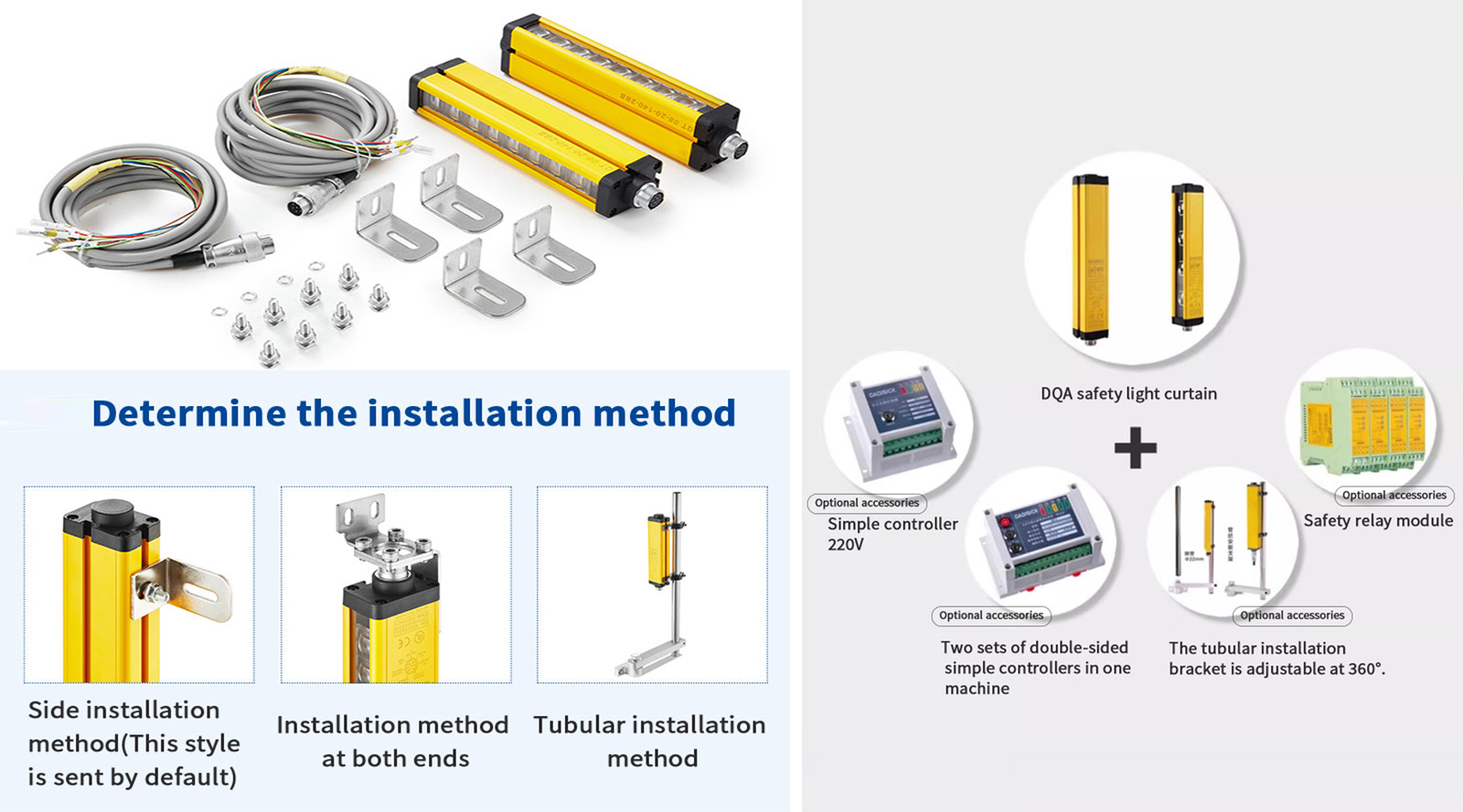

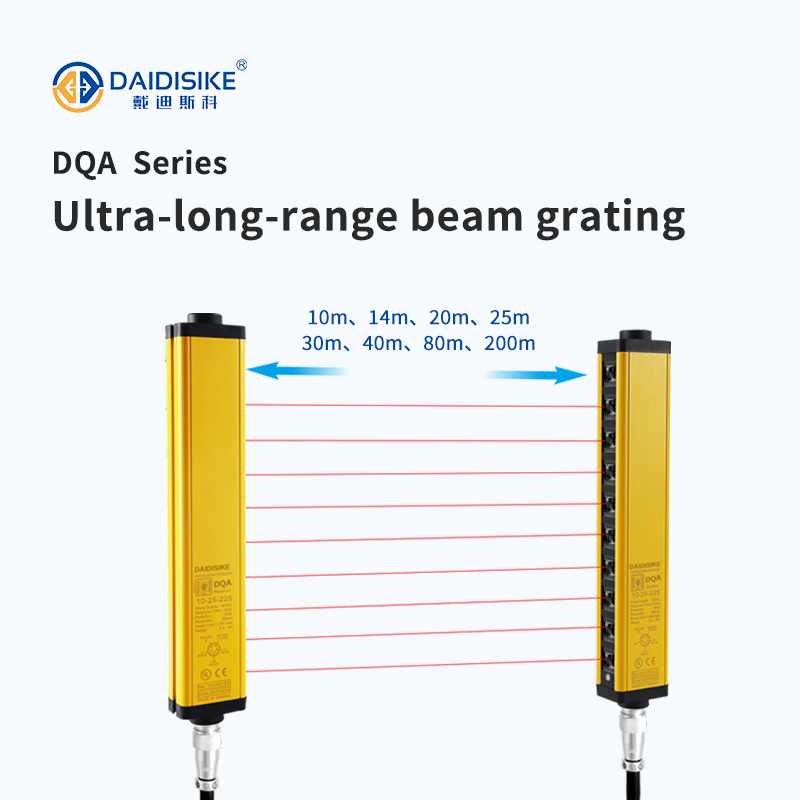
Long-range through-beam ESPE for guarding presses, shears, large machines and robot cells. Typical response ≤15 ms, high ambient-light immunity ≥10,000 Lux, optical synchronization, dual OSSD NPN/PNP, enclosure IP65. Resolutions 10/14/20/25/30/40/80/200 mm to match finger–body protection.
The DQA is DAIDISIKE's flagship safety light curtain — a through-beam ESPE designed to the IEC 61496-1/-2 Type 4 architecture and intended for use in safety functions targeting PL e (EN ISO 13849-1) / SIL 3 (IEC 61508) when integrated with a certified safety relay or safety PLC (verification by the integrator is required). It is built for the machinery where a missed detection causes serious injury: power presses, press brakes, shears, robot cells, and automated assembly stations. The DQA offers a wider resolution range (10-200 mm in eight standard steps) than competitors such as Omron's F3SG-SR, Keyence's SL-V, SICK's deTec4, and Pilz's PSEN op series, a deeper distance class catalog (up to 50 m), and direct mounting-bracket compatibility so a swap doesn't require recutting your cabinet panel.
What makes a Type 4 light curtain different from a Type 2 is the two-channel architecture with continuous cross-monitoring: every beam scan is verified by both internal channels, every fault on the curtain or in the OSSD output line triggers a lockout instead of a dangerous failure, and the device is architected to support a Category 4 / PL e / SIL 3 safety function as defined in ISO 13849-1 and IEC 61508 (final PL/SIL of the complete chain to be validated by the integrator). The DQA implements that architecture with a ≤15 ms total response time, which directly shortens the ISO 13855 safety distance you can stand the operator at — relevant on every press-brake and stamping line where rebuilding the operator's workstation around a slower curtain is a no-go.
The DQA family ships ex-stock with 1-2 week lead time for the everyday resolutions and lengths; custom builds (extended range, special bracket patterns, alternative connectors) run 4-6 weeks. Every unit ships with a calibration certificate, the appropriate test rod for periodic verification, the mounting hardware for the height ordered, and a quick-start guide that walks a competent maintenance technician through commissioning in under 30 minutes.
Values represent typical DQA series capabilities. For exact ratings on a specific build, refer to the delivered datasheet and unit label.
| Resolution (K) | Typical Application |
|---|---|
| 10 / 14 mm | Finger protection — power presses, stamping fixtures, close-guarded operations |
| 20 / 25 mm | Palm / hand protection — press brakes, robot cell access, manual feed stations |
| 30 / 40 mm | Hand / arm presence — automated assembly, AS/RS aisle entry |
| 80 / 200 mm | Body presence — wide aisles, perimeter zones, large-equipment access |
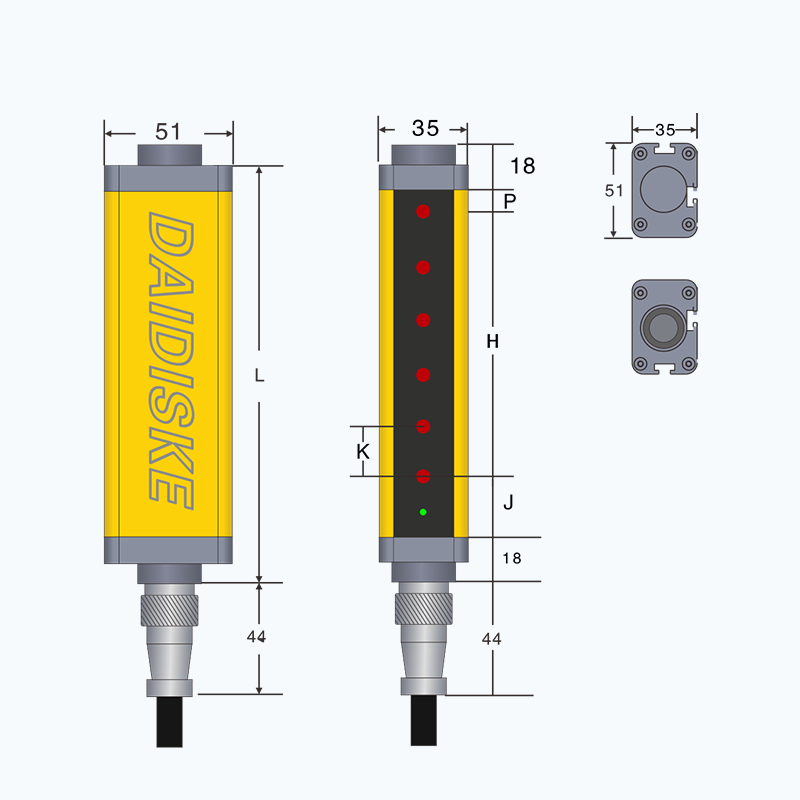
Protective height H = (n − 1) × K, where n is the beam count. Overall mechanical length L follows the drawing rule L = P + H + J + end allowances. See the auto-generated spec tables below for every standard combination.
The DQA competes head-on with the established Tier-1 European and Japanese safety-light-curtain brands. Side-by-side on the spec sheet:
| Type / safety level | DAIDISIKE DQA | Omron F3SG-SR | Keyence SL-V | SICK deTec4 |
|---|---|---|---|---|
| Designed to Type 4 / suitable for PL e / SIL 3 chains | ✓ (DAIDISIKE design intent) | ✓ (vendor cert.) | ✓ (vendor cert.) | ✓ (vendor cert.) |
| Response time (typ.) | ≤ 15 ms | ≤ 10 ms | ≤ 10.6 ms | ≤ 16 ms |
| Resolutions available | 10 / 14 / 20 / 25 / 30 / 40 / 80 / 200 mm | 14 / 25 / 30 / 45 mm | 14 / 25 / 35 / 45 mm | 14 / 30 / 40 mm |
| Max range | Up to 50 m (H variant) | Up to 20 m | Up to 15 m | Up to 19 m |
| Ambient light immunity | ≥ 10,000 Lux | Comparable | Comparable | Comparable |
| Housing IP rating | IP65 (aluminum) | IP65/IP67 | IP65/IP67 | IP65/IP67 |
| OSSD output | Dual, NPN or PNP | Dual, PNP | Dual, PNP | Dual, PNP |
| Mounting bracket compatibility | Universal + competitor brackets available | Proprietary | Proprietary | Proprietary |
| Typical lead time | 1–2 weeks ex-stock | Varies (see vendor) | Varies (see vendor) | Varies (see vendor) |
Where the DQA differentiates: a broad resolution count (8 standard steps — useful for retrofits where matching the original resolution exactly avoids re-calculating safety distance), maximum range (up to 50 m — relevant for wide press lines and AS/RS aisles), and lead time (ex-stock 1-2 weeks from our factory). Where competing units may pull ahead: some Omron and Keyence models offer faster response times (~10 ms vs DQA's 15 ms), which matters only on stopping-distance-critical applications where the machine's own stopping time is already well-optimized. Please verify current specifications against each manufacturer's published datasheet.
The DQA is a configurable product family, not a single SKU. Walk through these seven steps to land on the right part number:
ISO 13855 maps body part to required resolution. 14 mm finger protection — required for high-risk press-brake and stamping operations. 20-30 mm hand/wrist — robot cells, fixture access. 40-80 mm whole-body presence — aisle and large equipment perimeters. The smaller the K, the closer you can stand to the hazard (smaller C constant in the safety-distance formula).
H = (n − 1) × K, where n is the beam count. The DQA spec table lists every standard combination of K and H — pick the row that covers your hazard's full vertical reach. Common heights are 150 mm (finger protection on fixtures) to 1800 mm (full body for press operators).
DQA distance classes go A through H: A=3 m, B=6 m, C=10 m, D=15 m, E=20 m, F=25 m, G=30 m, H=50 m. Pick one class above the actual emitter-to-receiver distance you'll mount at — the headroom keeps the optical signal strong against dust, smoke, and minor misalignment over the years.
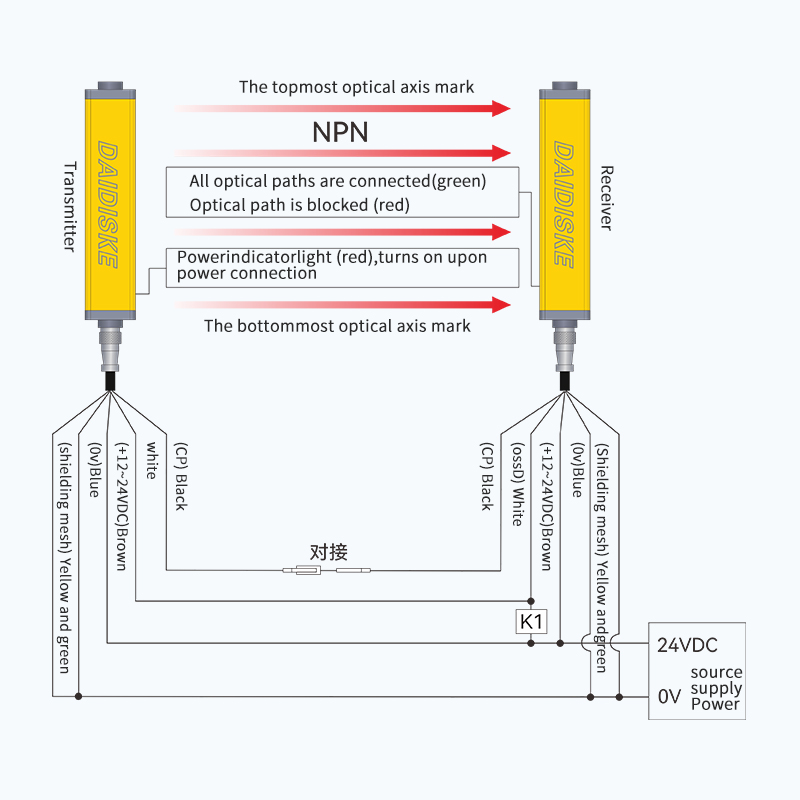
PNP is the global default — pick this unless your factory standardizes on NPN (some Japanese and Korean OEM lines do). Both options ship with dual OSSD outputs as the Type 4 standard requires.
M12 8-pin (standard) for cabinet-installed safety relays, or aviation plug (legacy compatibility) for OEM panels expecting the older style. Both options carry the same OSSD + auxiliary signals.
DQA ships with optical synchronization standard — emitter and receiver self-sync from the first beam pair, no extra cable. Wired sync is offered as a build option for noisy electrical environments where a hardwired clock improves reliability margin. Optical sync handles 95% of installations cleanly.
Mounting brackets (standard L-bracket, side-mount, or competitor-bracket adapter), test rod (14 mm / 25 mm / 40 mm depending on resolution chosen, required for periodic verification under ISO 13855), and corner mirrors if you need to wrap protection around a turn without two emitter/receiver pairs.
Not sure which combination to pick? Send a short description of your machine and operating conditions through the contact form — our engineering team will respond with a specific part-number recommendation, usually within 24 hours.
| Category | Item | Typical Value / Option | Notes |
|---|---|---|---|
| Optical | Principle | Through-beam IR LED, modulated | Emitter/receiver pair; optical sync |
| Resolutions | 10 / 14 / 20 / 25 / 30 / 40 / 80 / 200 mm | Finger → body presence | |
| Response | ≤ 15 ms (typ.) | Depends on beam count | |
| Ambient immunity | ≥ 10,000 Lux | Incidence ≥ 5° | |
| Range | 0.3–3 m (A) up to 0.3–50 m (H) | A…H distance classes (see below) | |
| Indicators | Power / Run / Blocked | Front status LEDs | |
| Electrical | Supply | DC 12/24 V (10–30 VDC); AC 110–220 V via controller | Reverse/over-voltage protections |
| Safety outputs | Dual OSSD (NPN or PNP), NO/NC variants | EDM & interlock supported via controller/PLC | |
| Channel current | ≤ 200 mA (typ.) | Transistor outputs | |
| Protections | Short / over-current / overload | Auto recovery | |
| Sync | Optical synchronization (standard) | Fewer cables, stable commissioning | |
| Connectors | M12 / aviation plug | Per build | |
| Mechanical | Body section | ≈ 51 × 35 mm | Aluminum housing |
| Ingress protection | IP65 | Dust-tight, water-jet resistant | |
| Operating temp. | −10 ~ +40 °C | Storage −25 ~ +55 °C | |
| Humidity | 35–85 %RH | Non-condensing | |
| Compliance | Standards | IEC 61496-1/-2, EN ISO 13849-1, IEC 61508 | Safety distance per ISO 13855 |
| Architecture | Designed to Type 4 (IEC 61496); suitable for PL e / SIL 3 / Cat. 4 safety chains when integrated with a certified safety relay/PLC | Dual independent channels with cross-monitoring; final PL/SIL validated for the complete function | |
| Notes | Markings per delivered unit | Contact us for country-specific approvals |
Distance classes A…H: A 0.3–3 m · B 0.3–6 m · C 0.3–10 m · D 0.3–15 m · E 0.3–20 m · F 0.3–25 m · G 0.3–30 m · H 0.3–50 m (selected variants).
| K (mm) | Beams n | Protective Height H (mm) | Model Example | Range |
|---|---|---|---|---|
| 10 | 6 | 50 | DQA06/10-50 | 0.3–3 m (A) |
| 10 | 8 | 70 | DQA08/10-70 | 0.3–3 m (A) |
| 10 | 10 | 90 | DQA10/10-90 | 0.3–3 m (A) |
| 10 | 12 | 110 | DQA12/10-110 | 0.3–3 m (A) |
| 10 | 14 | 130 | DQA14/10-130 | 0.3–3 m (A) |
| 10 | 16 | 150 | DQA16/10-150 | 0.3–3 m (A) |
| 10 | 18 | 170 | DQA18/10-170 | 0.3–3 m (A) |
| 10 | 20 | 190 | DQA20/10-190 | 0.3–3 m (A) |
| 10 | 22 | 210 | DQA22/10-210 | 0.3–3 m (A) |
| 10 | 24 | 230 | DQA24/10-230 | 0.3–3 m (A) |
| 10 | 26 | 250 | DQA26/10-250 | 0.3–3 m (A) |
| 10 | 28 | 270 | DQA28/10-270 | 0.3–3 m (A) |
| 10 | 30 | 290 | DQA30/10-290 | 0.3–3 m (A) |
| 10 | 32 | 310 | DQA32/10-310 | 0.3–3 m (A) |
Model rule: DQA-K-NN-H (e.g., DQA-40-08-280). Distance classes A…H available; A:0.3–3 m (std) · B–H up to 50 m. For exact dimensional constants (P/J) use the drawing in the datasheet.
The DQA 14 mm finger-protection variant is the standard choice for power-press guarding under ISO 16092. Mount the emitter/receiver pair across the die-access opening; the ≤15 ms response time combined with a typical press stopping time of 150-200 ms gives an ISO 13855 safety distance under 350 mm for finger-resolution protection — short enough for hand-fed operations without forcing the operator into an uncomfortable reach.
Press brakes use the DQA 20-25 mm palm/wrist resolution along the front working edge of the brake. Together with a foot-pedal two-hand control and a safety relay running EDM feedback, the system is fully compliant with ISO 16092-3 for press brakes and ISO 16092-4 for shears. For laser-guard alternative on press brakes see the DKE-L3 laser-guard product page.
Around collaborative robot cells, the DQA 30-40 mm hand/arm resolution forms the perimeter break-line. Operator entering the cell breaks the beam, robot transitions to safe-stop, exit clears the beam, manual reset on the safety relay re-enables motion. Pairs with the DA31 safety relay module for a complete certified loop.
For wide doorways into automated material-handling zones or pallet-stacker cells, the DQA 80-200 mm body-presence variant covers the full opening with a single emitter/receiver pair. Long-range H-class (up to 50 m) handles cross-bay protection without intermediate units.
AS/RS aisles use DQA presence-detection variants to mute the safety stop when a pallet legitimately enters the cell and re-arm immediately on operator presence. Muting is implemented in the safety relay logic, not on the DQA itself — keeping the certification intact.
Single-operator assembly stations with manual loading + automated operation use the DQA 14-20 mm finger/hand resolution to ensure the operator's hands are clear before the cycle starts. Common pairing with two-hand palm buttons for cycle initiation.
Safety distance reference (ISO 13855): S = K × T + C. Use our interactive calculator at /iso-13855-safety-distance-calculator to plug in your machine's stopping time and confirm the mounting distance for any of the resolutions above.
The three ratings sound interchangeable but come from different standards bodies with different historical reasons. They all converge on the same practical question: can this safety function be trusted to stop the machine when a person enters the danger zone?
For a typical machinery installation in the EU, satisfying ISO 13849-1 PL e is the path of least resistance: the DAIDISIKE DQA datasheet provides the design parameters intended to support PL e / Cat 4 use, the safety relay documentation provides matching numbers, and a competent risk assessment under ISO 12100 + ISO 13849-1 documents and validates the complete chain. See our PL/SIL quick-reference article for the verification logic and what the actual calculations look like.
Type 2 is single-channel with diagnostics — adequate for low-risk machinery where the risk assessment justifies PL c / Cat 2 safety. Type 4 is dual-channel with cross-monitoring, fault-detection-on-itself, and PL e / SIL 3 capability when integrated correctly — required for high-risk machinery (stamping presses, shears, press brakes, robot cells with serious crush or shear hazards). The DQA is designed to the IEC 61496 Type 4 architecture. If a risk assessment under ISO 12100 / ISO 13849-1 puts your application at PL d or PL e, a Type 4-architecture device like the DQA is the right starting point — the integrator must still verify the complete safety function during commissioning.
In most cases yes. The DQA mounting brackets include adapter plates for the Omron, Keyence, SICK, and Pilz bolt patterns. The M12 8-pin connector pinout follows the IEC 61140 industrial convention used by Omron and SICK; for Keyence (which uses a proprietary connector) we ship a pigtail adapter. The critical check: confirm the DQA OSSD response time (typically ≤15 ms) is the same or faster than the original — if it's slower, the ISO 13855 safety distance you previously calculated may no longer hold and the installation will need re-validation. Contact our engineering team with the existing part number for a direct replacement recommendation.
Formula: S (mm) = K × T + C. K is the body-approach speed (2000 mm/s for hand approach toward the danger zone). T is total system stopping time in seconds — light curtain response (15 ms for DQA) + safety relay response (typically 20-40 ms) + machine stopping time (the biggest term, measured by overrun test, typically 100-300 ms for hydraulic systems). C is the intrusion-depth constant: 8 × (resolution − 14) mm for resolutions above 14 mm, capped at 850 mm; or 128 mm for whole-body protection (40+ mm resolution). Use our interactive calculator at /iso-13855-safety-distance-calculator for the full math with a worked example for your specific machine.
Different rating systems, similar levels. PL (Performance Level) e is defined in ISO 13849-1 and rates the safety function's reliability based on category, MTTFd, DC (diagnostic coverage), and CCF (common-cause failure). SIL (Safety Integrity Level) 3 is defined in IEC 61508 / IEC 62061 with a similar but mathematically different framework. For practical purposes, a safety function rated PL e is equivalent to SIL 3 in terms of reliability targets. The DQA is designed to support safety functions targeting both PL e and SIL 3 when used in a dual-channel architecture with a certified safety relay and EDM feedback — which is the standard wiring topology for any Type 4 light curtain installation. Final classification of the complete safety chain is validated by the integrator during commissioning.
The DQA is electronics-only — no mechanical contacts to wear, no LEDs at end-of-life concerns for the application timescale. Expected service life under typical industrial conditions (24/7 operation, indoor environment, IP65 housing intact) is well over 10 years. The IEC 61496 lifetime data assumes 100,000 demands on the safety function over the product life, which corresponds to about 1 demand per hour across 10+ years — far below typical industrial usage rates. Periodic test-rod verification every 6-12 months under ISO 13855 keeps the safety function validated regardless of calendar age.
Optical synchronization means the emitter and receiver share the modulated-light signal that the system already uses for beam detection — the first beam pair carries the sync clock, and all subsequent beams scan in lock-step. No extra cable is needed between emitter and receiver besides the alignment of the optical pair itself. This works cleanly for 95% of installations. Wired sync — a dedicated synchronization wire between emitter and receiver — is offered as an option for unusual environments: very high EMC noise floors (large servo-motor banks), unusual ambient-light patterns (welding flash, halogen flood), or installations where the optical-sync first-beam alignment is too constrained by mechanical layout. Most installations should default to optical sync.
Yes — but the test is fast. ISO 13855 considers the entire stop-chain from light-curtain output through to actuator de-energization. Replacing the safety relay with a different model can change the T value by 10-30 ms, which shifts the calculated safety distance by 20-60 mm. The recommended practice: re-measure the machine's actual stopping time (with the new relay/contactor in place) using a calibrated stop-time analyzer, then plug the new T value into the safety-distance formula. If the result is bigger than your physical mounting distance, you need to move the light curtain back to stay compliant. Document the test in your safety file.
Specs reviewed by Engineer Cai, Senior Application Engineer. See certificates.
Real installations from DAIDISIKE clients. Click any case to view in full. Filter by scenario to quickly find a similar setup.