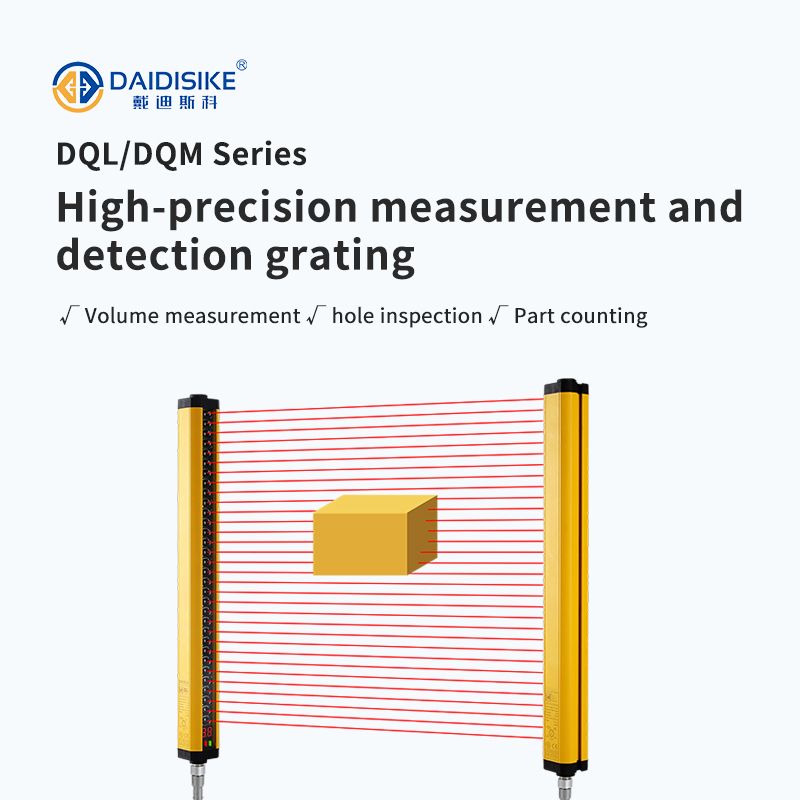
Large object sizing, passage counting, area detection
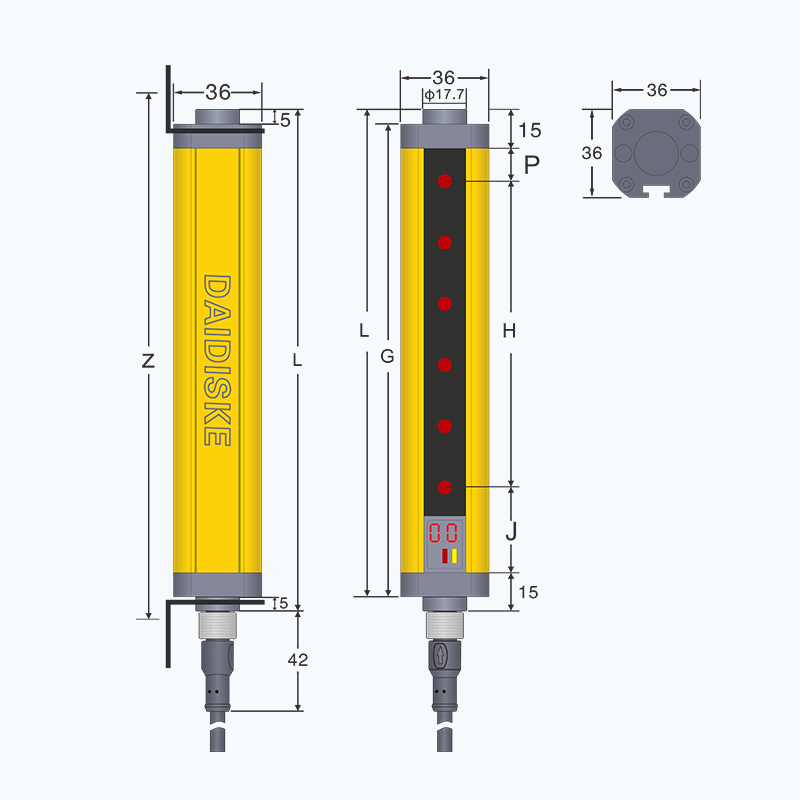
Protective/measurement height H = (n − 1) × K. Overall length L ≈ H + addon (see spec tables).
Technical Parameters (DQL Series)
Category
Item
Typical Value / Option
Notes
Optical
Operating principle
Through-beam infrared LED, modulated
Emitter/receiver pair; synchronous scanning
Spacing (K)
1.25 / 2.5 / 5 / 10 / 20 / 40 / 80 mm
1.25 & 2.5 mm for fine measurement
Measurement height (H)
H = (n−1) × K
n = number of beams
Response time
≤ 15 ms
Varies with beams
Ambient light immunity
≥ 10,000 Lux
Incidence ≥ 5°
Range
0.3–3 m (typ.); 1.25 mm: 0.2–1 m
0.3–6 m optional (except 1.25 mm)
Electrical / I/O
Supply
DC 12/24 V; AC 110–220 V (with controller)
Reverse/over-voltage protection
Outputs
RS485 (Modbus RTU) / 4–20 mA / 0–10 V
Real-time measuring data
Indicators
Power / Beam OK / Block
Clear status display
Connector
Circular aviation connector
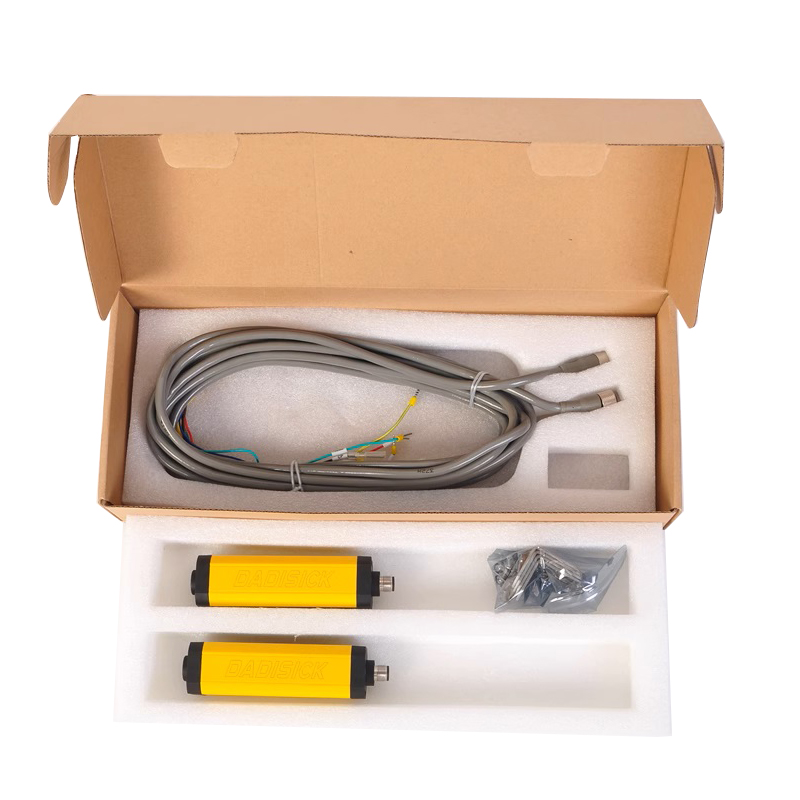
Dedicated cables
Short/over-current protection
Yes
Auto recovery
Synchronization
Optical
Fewer cables, strong immunity
Protocol
Modbus RTU 4800–38400 bps
8N1, 16-bit CRC
Mechanical / Environment
Body section
Approx. 36 × 36 mm
Aluminum, ABS reinforced nylon endcaps
Overall length
L ≈ H + addon
Addon depends on K
Ingress protection
IP65
Dust-tight, water-jet resistant
Operating temp.
−10 ~ +40 °C
Storage −25 ~ +55 °C
Humidity
Operating 35–85 %RH
Storage 35–95 %RH
DQL Series Detailed Specifications
Tables list typical beam counts (n) for each spacing (K) with measurement height H and overall length L. Model format: DQLnn/K-H. Example: DQL40/2.5-97.5. Output mode is selected by wiring (RS485 / 4–20 mA / 0–10 V).
K (mm)
Beams n
Measurement Height H (mm)
Overall Length L (mm)
Model Example
Range
Outputs
1.25
64
78.8
132.8
DQL64/1.25-78.8
0.2–1 m
RS485 / 4–20 mA / 0–10 V
1.25
96
118.8
172.8
DQL96/1.25-118.8
0.2–1 m
RS485 / 4–20 mA / 0–10 V
1.25
128
158.8
212.8
DQL128/1.25-158.8
0.2–1 m
RS485 / 4–20 mA / 0–10 V
1.25
160
198.8
252.8
DQL160/1.25-198.8
0.2–1 m
RS485 / 4–20 mA / 0–10 V
1.25
192
238.8
292.8
DQL192/1.25-238.8
0.2–1 m
RS485 / 4–20 mA / 0–10 V
1.25
224
278.8
332.8
DQL224/1.25-278.8
0.2–1 m
RS485 / 4–20 mA / 0–10 V
1.25
256
318.8
372.8
DQL256/1.25-318.8
0.2–1 m
RS485 / 4–20 mA / 0–10 V
1.25
288
358.8
412.8
DQL288/1.25-358.8
0.2–1 m
RS485 / 4–20 mA / 0–10 V
Model format DQLnn/K-H. For long-range (0.3–6 m) builds (except 1.25 mm), specify on order.
General automation: connect RS485 / analog to PLC or DAQ for measurement and monitoring.
For safety stop functions use DQA/DQC/DQR safety light curtains; DQL is for measurement output.
Working Principle
The DQL series uses opposed infrared beams. The emitter sends modulated pulses scanned sequentially; the receiver detects each channel. When an object blocks one or more beams, the controller calculates the blocked-channel count/position and outputs measurement via RS485 (Modbus RTU) or analog 4–20 mA / 0–10 V. Optical synchronization and filtering ensure strong ambient-light immunity; self-diagnostics guarantee reliable data.
Frequently Asked Questions
What is a measurement light curtain and how does the DQL differ from a safety light curtain?
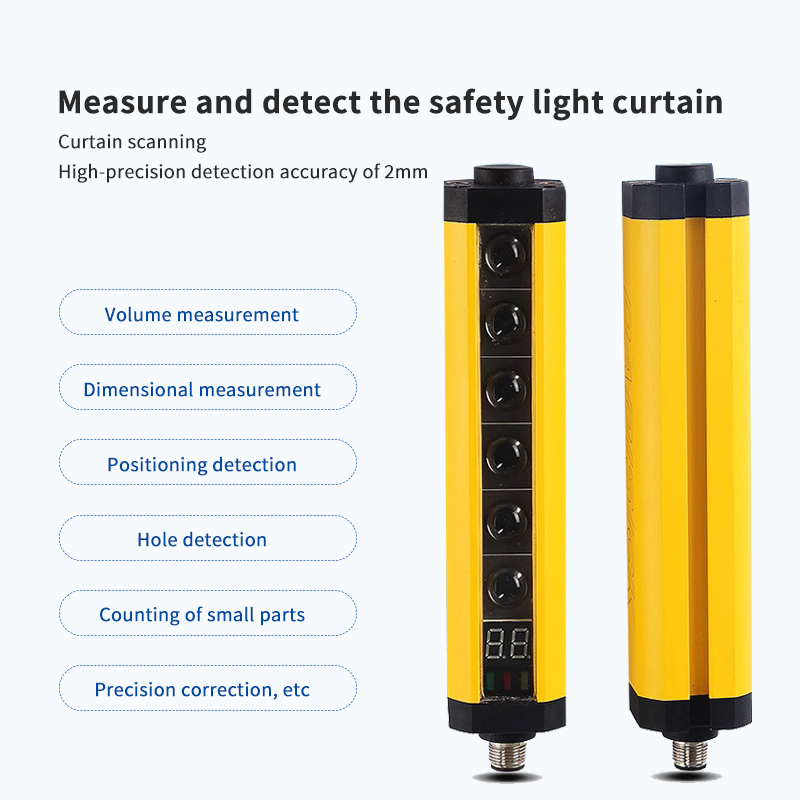
A measurement (measuring) light curtain uses an array of through-beam infrared beams to size, profile, count or measure object height by reporting which beams are blocked. The DQL outputs measuring data over RS485 (Modbus RTU), 4–20 mA or 0–10 V, unlike a Type 4 safety light curtain whose job is to stop a machine. For safety stop functions use DAIDISIKE DQA/DQC/DQR safety models instead.
What beam spacing should I choose for my measurement application?
Beam spacing (K) sets resolution. Choose 1.25 or 2.5 mm for fine height, edge and profile measurement or precision sizing; 5 or 10 mm for general dimensioning and presence detection; and 20/40/80 mm for large-object sizing, passage counting and area detection. Measurement height follows H = (n − 1) × K, where n is the number of beams.
What is the measuring range and response time of the DQL?
Typical range is 0.3–3 m, with a 0.3–6 m option available for spacings other than 1.25 mm; the fine 1.25 mm version covers 0.2–1 m. Response time is ≤15 ms and varies with beam count. Ambient light immunity is ≥10,000 Lux at incidence ≥5°, so it resists EMI, welding arc and strobe interference on busy production lines.
How does the DQL connect to a PLC, SCADA or DAQ system?
The DQL provides industrial outputs you select by wiring: RS485 Modbus RTU (4800–38400 bps, 8N1, 16-bit CRC) for serial data, plus analog 4–20 mA and 0–10 V. This lets it integrate directly with most PLC, SCADA or data-acquisition systems for real-time measurement and monitoring. A circular aviation connector and dedicated cables simplify field installation.
What ingress protection and operating environment does the DQL support?
The DQL has an IP65-rated aluminum profile body (approx. 36 × 36 mm) with ABS reinforced-nylon endcaps, making it dust-tight and water-jet resistant. Operating temperature is −10 to +40 °C (storage −25 to +55 °C) with operating humidity 35–85 %RH. Optical synchronization and self-diagnostics ensure reliable measurement data in harsh industrial conditions.