
TOF Laser ranging sensors DAI-JNS10 and DAI-G20
Compact TOF laser sensors for reliable distance / presence detection in complex scenes: DAI-JNS10 (0.05–5 m, ≤0.5 ms, Class 2) and DAI-G20 (0.05–10 m, ~1 ms, Class 1). Output options include dual-channel PNP/NPN, 4–20 mA analog, and RS-485 Modbus-RTU, with high ambient-light immunity and IP65 build.
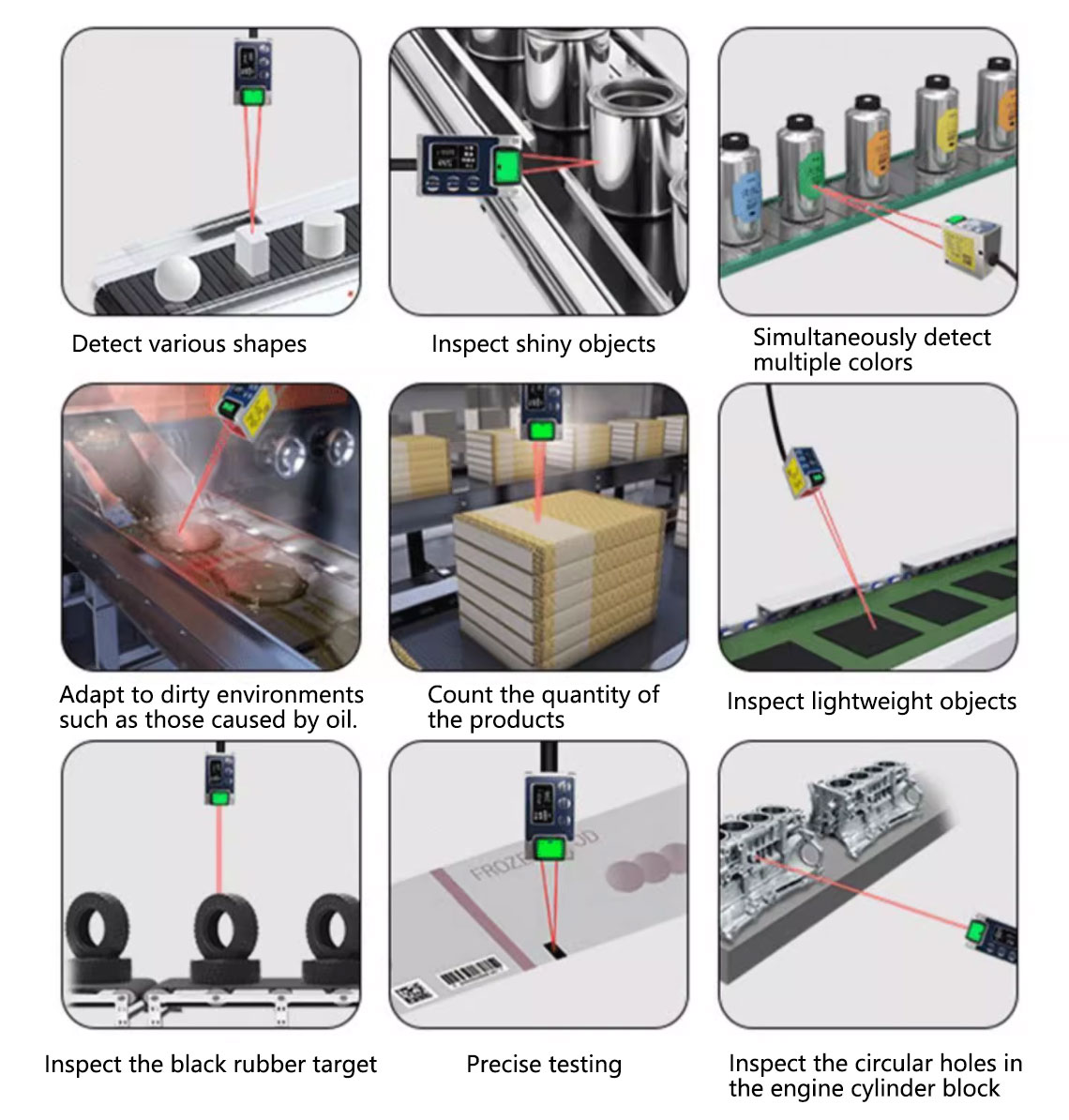
Product Highlights
- Fast response: JNS10 down to ≤0.5 ms; G20 ~1 ms typical (up to 2 kHz measure frequency).
- Wide working range: JNS10 0.05–5 m; G20 0.05–10 m (10%–80% reflectivity, extended capability noted).
- Accuracy: JNS10 absolute error ±10 mm, repeatability ±2 mm; G20 absolute accuracy ±100 mm, repeatability ±5 mm.
- Outputs selectable by model: PNP/NPN, 4–20 mA, or RS-485 Modbus-RTU; load capacities as listed.
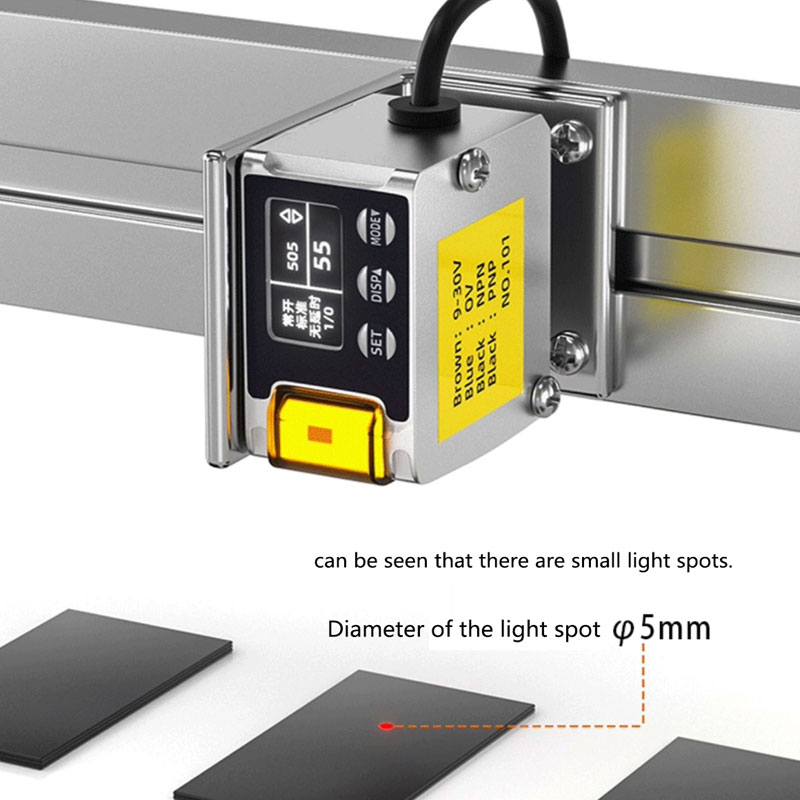
- Optics & safety: JNS10 laser 650 nm Class 2, G20 905 nm Class 1; strong ambient-light immunity.
- Rugged: IP65 enclosure; −20…+55/50 °C operating ranges; compact aluminum body.
- Install anywhere: tolerant to vibration/EMI; supports far-from-line mounting to avoid collisions.
Resolution & Typical Applications
| Use Case | Typical Setup |
|---|---|
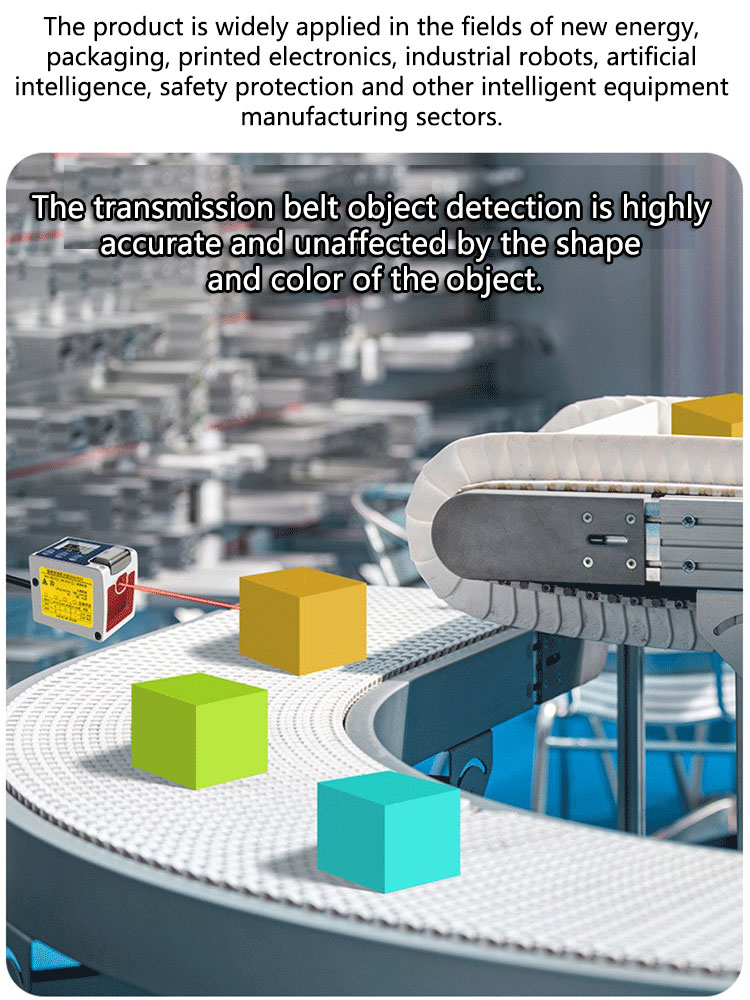
| Presence / gap detection on conveyors | JNS10-PN (PNP/NPN) or G20-MK2 (PNP/NPN+4–20 mA); set threshold/window mode. |
| Level / loop control (roll-to-roll, tanks) | 4–20 mA variants (JNS10-MI / G20-MK2) to PLC analog input; apply hysteresis. |
| Robot reach / safety approach cues | RS-485 models (JNS10-485 / G20-RS) with Modbus distance readout. |
| Packaging access points / part picking | PNP/NPN models with millisecond response for fast reject/trigger. |
Note: choose laser class & optics appropriate to your site's safety policy; observe ISO/IEC laser safety labeling.
Detailed Specifications
| Item | DAI-JNS10-PN | DAI-JNS10-MI | DAI-JNS10-485 |
|---|---|---|---|
| Laser / Class | 650 nm diode, ≤1.3 mW, Class 2 | ||
| Measuring frequency | Up to 2 kHz | ||
| Working distance | 50–5000 mm | ||
| Response time | ≤0.5 ms (fastest) | ||
| Absolute error / Repeatability | ±10 mm / ±2 mm | ||
| Supply | 9–30 V | 18–30 V | 9–30 V |
| Interface | PNP & NPN | 4–20 mA | RS-485 (Modbus-RTU) |
| Load capability | ≤100 mA | ≤400 Ω @24 V | — |
| Power / IP / Temp. | <1 W (no output), IP65, −20…+55 °C; storage −40…+85 °C; humidity 35–85%RH (no condensation) | ||
| Ambient light immunity | Incandescent: >10,000 Lux @1 m; >3,000 Lux @5 m (receiving surface) | ||
| Size / Weight | 41×37.5×23 mm, ≈85 g | ||
| Item | DAI-G20-MK2 | DAI-G20-RS |
|---|---|---|
| Laser / Class | 905 nm diode, ≤0.4 mW (aiming 650 nm ≤5 mW), Class 1 | |
| Measuring frequency | 2 kHz | 20 Hz–5 kHz |
| Working distance | 10 m @10% reflectance; 0.05–10 m @80% reflectance (extendable capability noted) | |
| Response time | ~1 ms | |
| Absolute / Repeatability | ±100 mm / ±5 mm | |
| Supply | 9–30 V (analog 18–30 V) | 9–30 V |
| Interface | PNP, NPN + 4–20 mA | RS-485 (Modbus-RTU) |
| Load / Power | ≤100 mA | ≤500 Ω @24 V |
| Size / Weight | 52×44×31 mm, ≈140 g | |
| Ingress / Temp. | IP65; −20…+50 °C operating; storage −40…+80 °C; ambient light <10,000 Lux | |
Wiring & Modbus-RTU
DAI-JNS10 wiring (by variant)
| Variant | Wire color | Function |
|---|---|---|
| JNS10-PN | Brown | +9–30 V DC |
| JNS10-PN | Blue | GND |
| JNS10-PN | Black | NPN output |
| JNS10-PN | White | PNP output |
| JNS10-MI (4–20 mA) | Brown | +18–30 V DC |
| JNS10-MI | Blue | GND |
| JNS10-MI | Gray | 4–20 mA |
| JNS10-485 | Brown | +9–30 V DC |
| JNS10-485 | Blue | GND |
| JNS10-485 | Black | RS-485 B |
| JNS10-485 | White | RS-485 A |
DAI-G20 wiring (by variant)
| Variant | Wire color | Function |
|---|---|---|
| G20-MK2 | Brown | +9–30 V DC (analog 18–30 V) |
| G20-MK2 | Blue | GND |
| G20-MK2 | Black | NPN output |
| G20-MK2 | White | PNP output |
| G20-MK2 | Gray | 4–20 mA |
| G20-RS | Brown | +9–30 V DC |
| G20-RS | Blue | GND |
| G20-RS | Black | RS-485 B |
| G20-RS | White | RS-485 A |
Modbus-RTU map (RS-485 models)
| Register type | Address (rel.) | R/W | Len | Datatype | Function / Unit | Values |
|---|---|---|---|---|---|---|
| Input | 0x00 | RO | 2 | uint16 | Measured distance (mm) | 0–65535 (out-of-range flags by 0 & 65535) |
| Holding | 0x00 | RW | 2 | int16 | Response speed (×100 µs) | 5=0.5 ms … 10000=1000 ms |
| Holding | 0x01 | RW | 2 | int16 | Baudrate (×100) | 96=9600; 192=19200; 1152=115200; 2560=256000; 4608=460800 |
| Holding | 0x02 | RW | 2 | int16 | Slave address | 1–247 |
| Holding | 0x03 | RW | 2 | int16 | Laser switch | 1=ON, 0=OFF |
Framing: RS-485, 8-N-2, Modbus-RTU. Function codes 0x03 / 0x04 / 0x06 / 0x10 and MEI 0x2B (Read Device ID).
Operating Modes (JNS10)
Detection modes
- Standard: single-point or two-point threshold.
- Reference-plane: set current distance as zero; trigger on ±set value.
- Window: NEAR/FAR window by one-point (±20 mm default) or two-point learn.
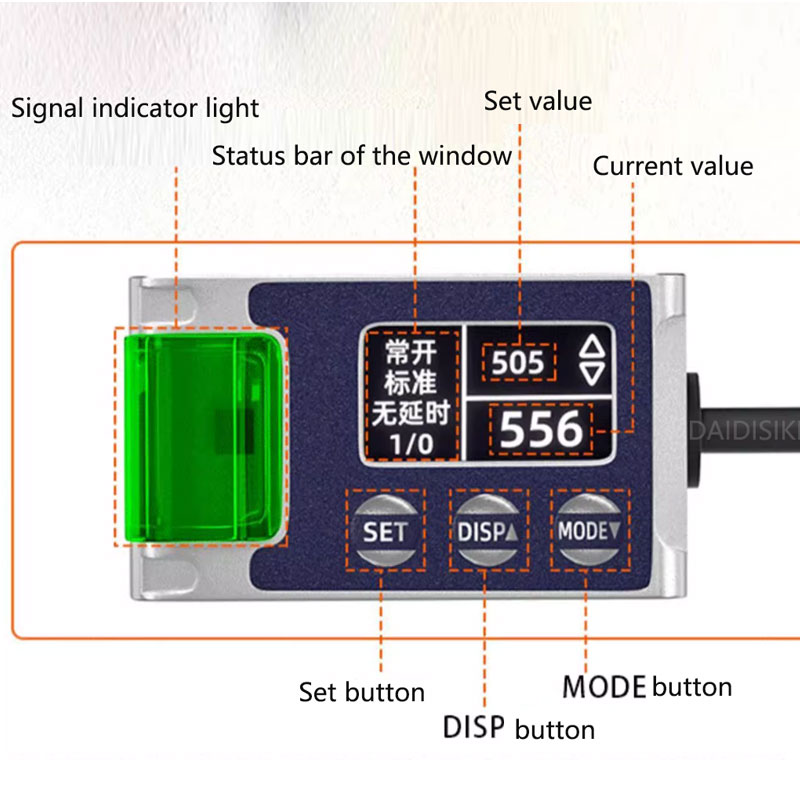
Hysteresis, delay (on/off/one-shot), NO/NC logic, and initialization (factory reset) are available via front keys.
Environmental notes
- Power wiring separate from high-voltage lines; power-up inhibit ~1 s.
- Protect the front lens; avoid direct sun/outdoor without shielding.
- Keep within specified temperature/humidity; check for vibration/leakage.
Frequently Asked Questions
What is the measuring range and accuracy of the DAI-JNS10 and DAI-G20 laser ranging sensors?
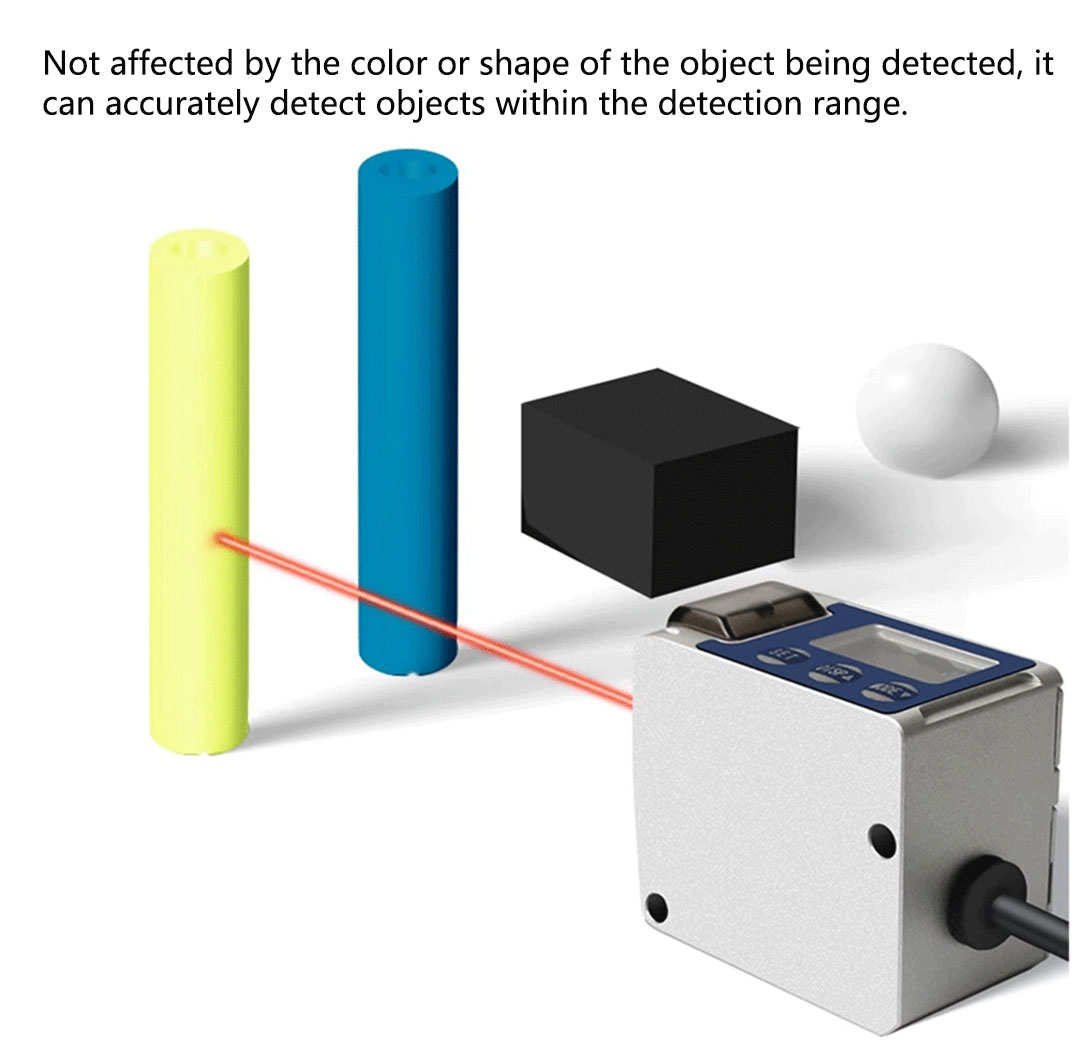
The DAI-JNS10 TOF laser distance sensor measures 0.05–5 m with an absolute error of ±10 mm and ±2 mm repeatability. The DAI-G20 extends to 0.05–10 m (10 m at 10% reflectivity) with ±100 mm absolute accuracy and ±5 mm repeatability. Both use time-of-flight ranging, so readings stay stable regardless of target color or shape.
What output options do these TOF laser sensors support?
Outputs depend on the model. Switching variants provide dual-channel PNP and NPN for direct PLC connection, analog variants give a 4–20 mA loop signal for level or loop control, and RS-485 variants stream distance over Modbus-RTU. The JNS10-PN offers PNP/NPN, the JNS10-MI is 4–20 mA, and the G20-MK2 combines PNP, NPN and 4–20 mA in one unit.
How do I read distance over RS-485 Modbus-RTU?
The RS-485 models (JNS10-485, G20-RS) use Modbus-RTU framing at 8-N-2. Read the measured distance in millimetres from input register 0x00 with function code 0x03 or 0x04. Holding registers set response speed (0x00), baudrate (0x01), slave address 1–247 (0x02) and laser on/off (0x03). Supported baud rates include 9600 up to 460800.
What laser class and ambient-light immunity do these sensors have?
The DAI-JNS10 uses a 650 nm visible Class 2 laser, while the DAI-G20 uses a 905 nm infrared Class 1 laser that is eye-safe under normal use. Both feature strong ambient-light immunity so they hold accuracy under bright factory lighting. Always follow ISO/IEC laser-safety labeling and site policy when aiming the visible beam.
What is the IP rating and where are these laser distance sensors typically used?
Both sensors carry an IP65-rated aluminum enclosure with operating ranges around −20 to +55/50 °C and are tolerant to vibration and EMI. Typical uses include conveyor part and gap detection, roll-to-roll and tank level control, robotic pick-and-place reach cues, and packaging access monitoring, where millisecond response (≤0.5 ms on JNS10) enables fast triggering.
Specs reviewed by Engineer Cai, Senior Application Engineer. See certificates.
Contact DAIDISIKE for application matching, aiming laser usage, and PLC integration tips.