
M12 Series Metal Inductive Proximity Switch
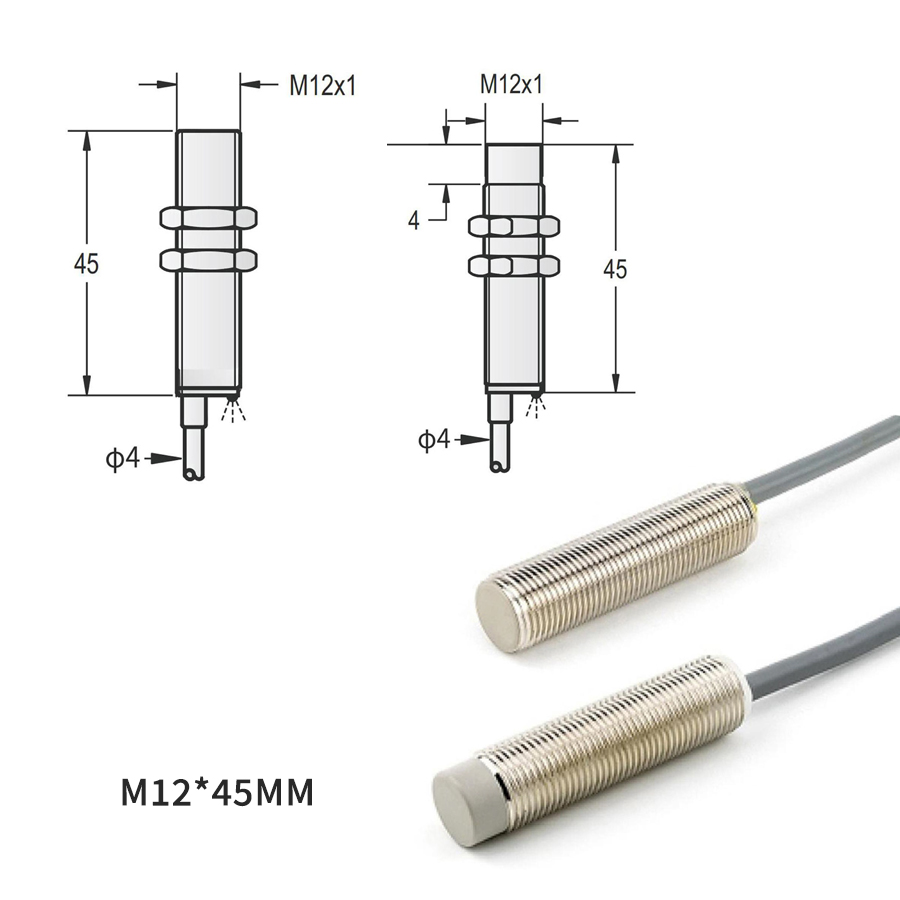
The DAIDISIKE M12 series metal inductive proximity switch is a high-performance cylindrical electromagnetic sensor designed for industrial automation. It uses DC three-wire power supply, supports NPN / PNP outputs, and detects metal objects without contact.
Product Introduction
The DAIDISIKE M12 series metal inductive proximity switch is a high-performance cylindrical electromagnetic proximity sensor designed for industrial automation applications. This series uses DC three-wire power supply, supports NPN and PNP output modes, and can detect metal objects without physical contact. The product complies with RoHS standards, has an IP67 protection rating, and is suitable for harsh industrial environments. The series includes various models such as M12 × 35 (flush) and M12 × 45 (non-flush), with detection distances ranging from 2 mm to 8 mm.
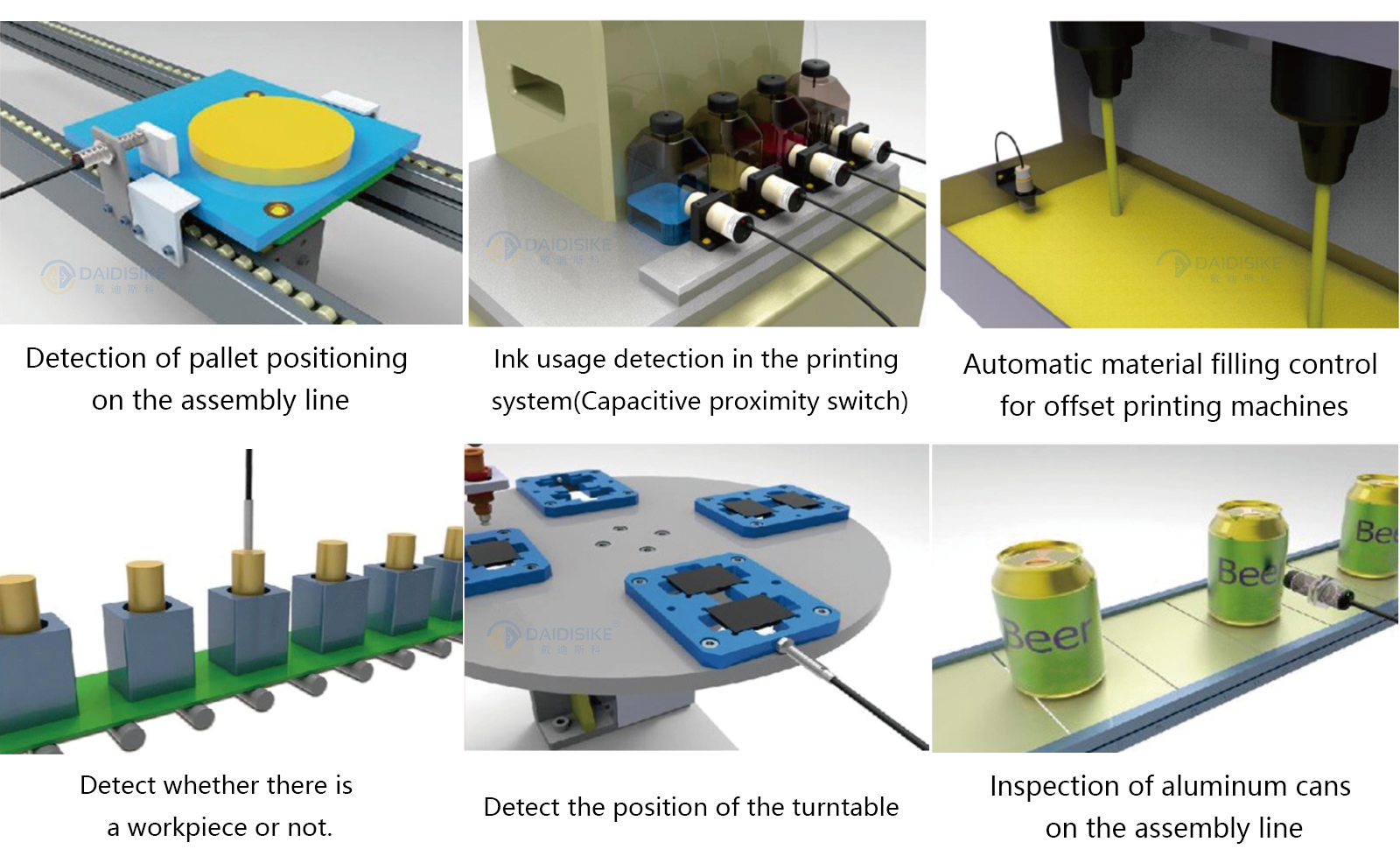
The sensor housing is made of nickel-plated brass for high corrosion resistance, and is equipped with an LED indicator for easy status monitoring. This product is widely used in mechanical manufacturing, automotive industry, food processing and similar fields for object position detection, counting and limit control.
Specifications — Flush vs Non-flush
| Parameter | M12 Flush Type | M12 Non-flush Type |
|---|---|---|
| Brand | DAIDISIKE | DAIDISIKE |
| Product name | M12 Metal Inductive Proximity Switch (Flush) | M12 Metal Inductive Proximity Switch (Non-flush) |
| Installation method | Flush (Shielded) | Non-flush (Unshielded) |
| Detection distance (standard iron target) | 2 mm / 4 mm (Standard / Extended) | 4 mm / 8 mm (Standard / Extended) |
| Output mode | NPN / PNP — NO / NC / NO+NC | NPN / PNP — NO / NC / NO+NC |
| Operating voltage | 10 – 30 V DC (some models support 6 – 36 V DC) | 10 – 30 V DC (some models support 6 – 36 V DC) |
| Maximum load current | 100 mA / 200 mA / 300 mA | 100 mA / 200 mA / 300 mA |
| No-load current | < 10 mA | < 10 mA |
| Voltage drop | < 1.5 V / < 2 V | < 1.5 V / < 2 V |
| Leakage current | < 0.01 mA | < 0.01 mA |
| Switching frequency | 500 Hz / 1000 Hz / 2000 Hz | 300 Hz / 500 Hz / 1000 Hz |
| Response time | < 0.5 ms / < 1 ms | < 0.5 ms / < 1 ms |
| Switch hysteresis | < 15 % (Sr) | < 15 % (Sr) |
| Repeatability | < 3.0 % (Sr) / < 5 % | < 3.0 % (Sr) / < 5 % |
| Indicator light | Yellow LED — on when detecting | Yellow LED — on when detecting |
| Protection rating | IP67 / IP68 | IP67 / IP68 |
| Operating temperature | −25 °C to +70 °C / −40 °C to +85 °C | −25 °C to +70 °C / −40 °C to +85 °C |
| Storage temperature | −40 °C to +85 °C | −40 °C to +85 °C |
| Temperature drift | < 10 % (Sr) | < 10 % (Sr) |
| Short-circuit protection | Yes | Yes |
| Reverse-polarity protection | Yes | Yes |
| Overload protection point | 120 mA / 220 mA | 120 mA / 220 mA |
| Shell material | Nickel-plated brass / Stainless steel | Nickel-plated brass / Stainless steel |
| Sensing-face material | ABS / PBT | ABS / PBT |
| Standard wire length | 2 m (PVC cable) | 2 m (PVC cable) |
| Connection method | Cable / M12 connector | Cable / M12 connector |
| Dimensions | M12 × 35 mm – 40 mm | M12 × 45 mm – 50 mm |
| Weight | ≈ 40 g – 80 g | ≈ 50 g – 90 g |
| Compliance | RoHS · CE · UL | RoHS · CE · UL |
| Vibration resistance | 10 – 55 Hz, 1 mm amplitude | 10 – 55 Hz, 1 mm amplitude |
| Shock resistance | 500 m/s², 10 times | 500 m/s², 10 times |
| Electromagnetic compatibility | IEC 61000 series | IEC 61000 series |
Technical Parameters
The M12 series technical parameters cover detection distance (depends on installation method, target material, and environmental factors; typical values are for standard iron targets, with correction factors for stainless steel 0.9, aluminum 0.4, brass 0.5, copper 0.4), supply voltage range (10 – 30 V DC, three-wire: brown = V+, blue = 0 V, black = output; some models support wider ranges), and output types (NPN or PNP open-collector, supporting NO, NC or NO+NC combinations).
The sensor supports high switching frequency up to 2000 Hz for high-speed applications, with response time < 0.5 ms. Protection features include short-circuit protection (auto-reset), reverse-polarity protection, overload protection (typical trigger 120 – 220 mA), and surge suppression. Environmental performance includes temperature drift < 10 % and repeatability within 3 – 5 %. Electromagnetic compatibility complies with IEC 61000 standards, ensuring strong anti-interference capability.
Working Principle
Inductive proximity sensors operate based on electromagnetic induction. An internal high-frequency oscillator drives an LC coil to generate an alternating electromagnetic field. When a conductive metal object enters this field, eddy currents are induced in the target, creating a counter-field that absorbs energy and changes the oscillator amplitude / frequency. The detection circuit (e.g. a Schmitt trigger) converts this change into a digital switching signal.
Flush (shielded) types concentrate the field at the sensing face and are suited for embedded mounting; non-flush (unshielded) types have a broader field and longer sensing distance but require greater side clearance.
Frequently Asked Questions
What sensing distance does the M12 inductive proximity switch have?
The DAIDISIKE M12 detects a standard iron target at 2 / 4 mm in the flush (shielded) version and 4 / 8 mm in the non-flush (unshielded) version. The rated Sn sensing distance assumes mild steel; apply the correction factor for other metals — about 0.9 for stainless steel, 0.5 for brass and 0.4 for aluminium or copper.
What is the difference between flush and non-flush M12 sensors?
Flush (shielded) M12 sensors mount level with surrounding metal and resist side interference, but give a shorter 2 / 4 mm range. Non-flush (unshielded) sensors need a clear zone around the M12 × 45 face and deliver a longer 4 / 8 mm sensing distance. DAIDISIKE offers both so you can match the mounting and required range.
Should I order NPN or PNP, and NO or NC output?
PNP (sourcing) 3-wire is the default for most modern PLCs, while NPN (sinking) is common in some Asian controls. NO closes the output on detection, NC opens it; NO+NC is also available. Wire brown to V+, blue to 0 V and black to the PLC input. The M12 runs on 10–30 V DC three-wire.
Can the DAIDISIKE M12 replace an Omron, Balluff or Autonics M12 sensor?
Usually yes. It shares the M12 × 1 thread, DC 3-wire NPN/PNP wiring, IP67 / IP68 rating and standard 2–8 mm range, so it fits the same bracket, cable or M12 connector. Match the flush / non-flush type, body length (35 or 45 mm) and output (NPN/PNP, NO/NC) to the unit being replaced.
What ingress protection, temperature range and compliance does it have?
The DAIDISIKE M12 is rated IP67 / IP68 with a nickel-plated brass or stainless-steel housing and a −25 °C to +70 °C operating range (storage to −40 / +85 °C). It is RoHS, CE and UL compliant, with short-circuit, reverse-polarity and overload protection — suitable for machine tools, robotics and packaging lines.
Specs reviewed by Engineer Cai, Senior Application Engineer. RoHS, CE & UL compliant — see certificates.
Safety Light Curtain — Customer Cases
Real installations from DAIDISIKE clients. Click any case to view in full. Filter by scenario to quickly find a similar setup.