
M12 / M18 Laser Diffuse Reflection (one)
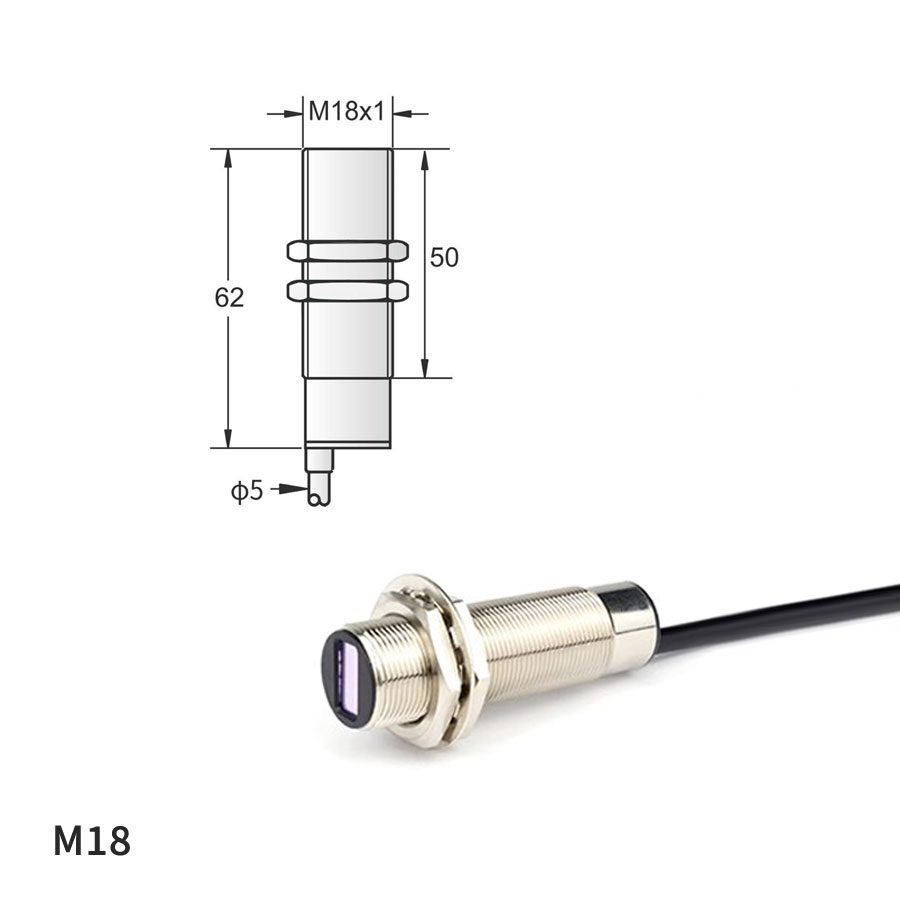
The M12 and M18 series Laser Diffuse Reflection Sensors are high-precision photoelectric proximity sensors operating on the diffuse-reflection principle. An integrated transmitter and receiver in a coaxial optical design simplifies installation and alignment. A 650 nm red visible laser (Class 2) source offers adjustable sensing ranges — M12: 20 – 300 mm, M18: 30 – 500 mm — with a high-precision Φ 2 mm spot for reliable detection of small objects. Nickel-plated brass housing, IP67, status LED — built for demanding industrial non-contact applications.
Product Overview
The M12 and M18 series Laser Diffuse Reflection Sensors are high-precision photoelectric proximity sensors operating on the diffuse-reflection principle. An integrated transmitter and receiver within a coaxial optical design simplifies installation and alignment. Using a 650 nm red visible laser (Class 2) source, they offer adjustable sensing ranges (M12 series 20 – 300 mm, M18 series 30 – 500 mm) and a high-precision micron-level spot (standard Φ 2 mm), enabling reliable detection of minuscule objects. Nickel-plated brass housing with IP67 protection and a status-indicator LED delivers stable performance in demanding industrial non-contact detection applications.
Application Scenarios
- Precision positioning & detection: presence detection and counting of IC chips, micro-components and precision springs.
- Automated assembly lines: robot gripping positioning, part-presence verification, height-differential detection.
- Packaging & material handling: detection of transparent films, labels, small caps and missing-product identification.
- Electronics manufacturing: PCB positioning, component-insertion verification, semiconductor wafer alignment.
- Food & pharmaceutical: package-integrity checks, liquid-level detection (suitable for non-transparent containers).
Working Principle
As diffuse-reflection sensors, the emitter and receiver are housed in the same unit. The emitter projects a modulated laser beam onto the target object. Light diffusely reflected from the object's surface is partially captured by the photodiode in the receiver. Internal circuitry uses synchronous demodulation and threshold judgment to filter out ambient-light interference, responding only to the specific frequency of the reflected signal — ensuring stable and reliable detection.
Detailed Specifications — 5 Variants
| Parameter | M12×62 (20–100 mm) | M12×62 (20–200 mm) | M12×62 (30–300 mm) | M18×62 (30–300 mm) | M18×62 (50–500 mm) |
|---|---|---|---|---|---|
| Sensing Range | 20 – 100 mm | 20 – 200 mm | 30 – 300 mm | 30 – 300 mm | 50 – 500 mm |
| Standard target | 100 × 100 mm white paper | ||||
| Light source | 650 nm red laser (Class 2) | ||||
| Spot size | Φ 2 mm (typ.) | ||||
| Output configuration | NPN / PNP, NO+NC (dual output) | ||||
| Operating voltage | 10 – 30 V DC | ||||
| No-load current | < 10 mA | ||||
| Max. load current | 150 mA | ||||
| Leakage current | < 0.01 mA | ||||
| Voltage drop | < 1.5 V | ||||
| Switching frequency | 150 Hz | ||||
| Response time | 5 ms | ||||
| Switching hysteresis | < 15 % Sr | ||||
| Repeat accuracy | < 5 % Sr | ||||
| Protection rating | IP67 | ||||
| Operating temperature | 0 °C to +55 °C | ||||
| Short-circuit protection | Yes | ||||
| Overcurrent protection | 300 mA | ||||
| Housing material | Nickel-plated brass | ||||
| Indicator | Yellow LED | ||||
| Certification | CE · RoHS | ||||
| Connection | Φ 4.0 mm PVC cable | Φ 4.0 mm PVC cable | Φ 4.0 mm PVC cable | Φ 5.0 mm PVC cable | Φ 5.0 mm PVC cable |
| Cable Specification | 3 × 0.15 mm² / 4 × 0.15 mm² | 3 × 0.15 mm² / 4 × 0.15 mm² | 3 × 0.15 mm² / 4 × 0.15 mm² | 3 × 0.33 mm² / 4 × 0.33 mm² | 3 × 0.33 mm² / 4 × 0.33 mm² |
Frequently Asked Questions
What is the sensing range of the M12 and M18 laser diffuse reflection sensors?
Ranges are adjustable. The M12×62 versions cover 20–100 mm, 20–200 mm or 30–300 mm, while the M18×62 versions reach 30–300 mm or 50–500 mm against a 100×100 mm white-paper target. Darker or smaller targets shorten the effective range, so set the potentiometer against the actual object you need to detect.
Is the 650 nm red laser eye-safe, and what spot size does it produce?
The light source is a 650 nm red visible laser classified as Class 2, which makes alignment easy because the spot is visible to the eye. As with any Class 2 laser, avoid staring directly into the beam. The typical Φ 2 mm spot allows reliable detection of small parts such as IC chips, micro-components and precision springs.
Does this sensor support NPN and PNP wiring with NO and NC outputs?
Yes. Each unit provides NPN / PNP output with both NO and NC (dual output), so it suits most PLC inputs. PNP (sourcing) is common in European controls and NPN (sinking) in many Asian systems. Supply is 10–30 V DC, max load current 150 mA, with built-in short-circuit and 300 mA overcurrent protection.
Can it replace an Omron, SICK, Keyence or Autonics M12/M18 photoelectric sensor?
Usually yes. It shares the standard M12 or M18 threaded barrel, 10–30 V DC 3-wire NPN/PNP wiring and IP67 rating, so it fits the same bracket and cable gland. Match the housing size, sensing range and output type to the unit you are replacing, then re-teach the threshold against your target.
What ingress protection and operating temperature does it offer?
The housing is nickel-plated brass rated IP67, suitable for dusty and washdown-adjacent industrial areas. The operating temperature range is 0 °C to +55 °C with switching frequency 150 Hz and 5 ms response time. A yellow LED indicates output status, and the sensor carries CE and RoHS compliance.
Specs reviewed by Engineer Cai, Senior Application Engineer. CE & RoHS compliant — see certificates.
Safety Light Curtain — Customer Cases
Real installations from DAIDISIKE clients. Click any case to view in full. Filter by scenario to quickly find a similar setup.