
M3 / M4 / M5 Laser Diffuse Reflection (one)
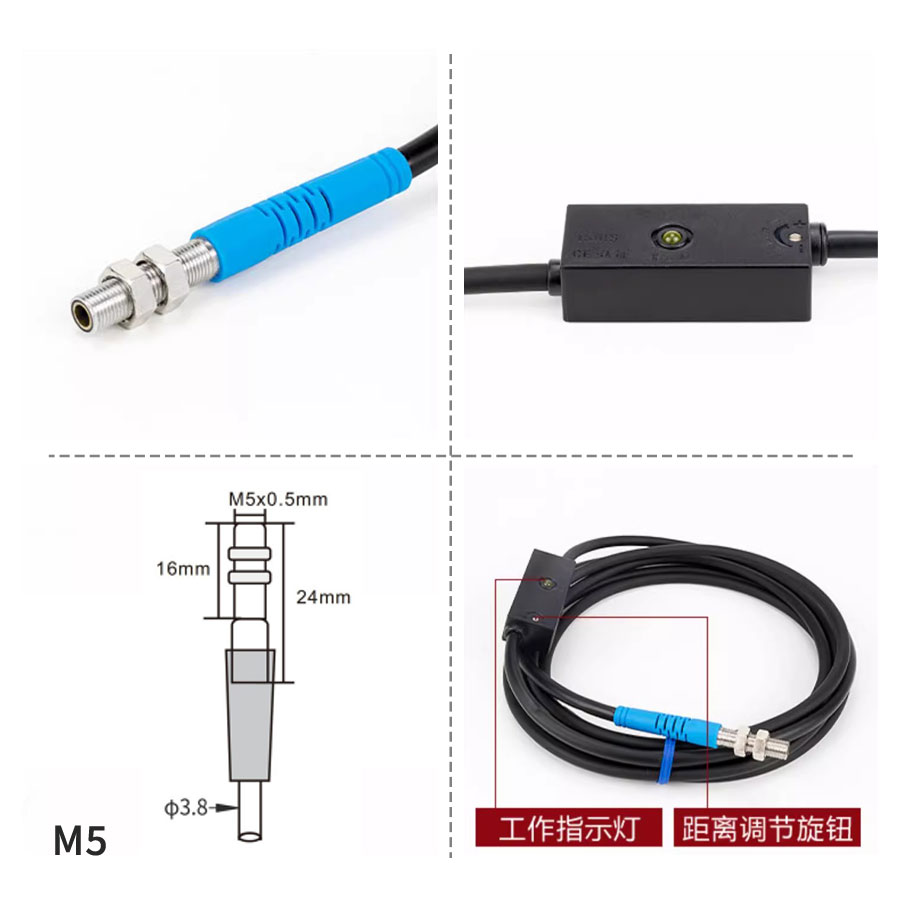
The sensor emits a 650 nm red laser; the target diffusely reflects light back to the integrated receiver. The sensor outputs (NPN / PNP, NO / NC) when reflected intensity exceeds threshold. Depending on model and surface reflectivity, detection ranges span 5 – 50 mm up to 20 – 200 mm, with 1 ms response and 500 Hz switching frequency. Hysteresis < 15 % (Sr) stabilizes output. IP67 rating ensures robust operation in industrial environments.
Detailed Specifications — 6 Variants
The table summarizes models M3′20, M4′20, M4′18-TZ, M5′24, M6′26 and M6′20-TZ. All are DC-powered diffuse-reflection sensors integrating emitter & receiver in one body, with ranges from 5 – 50 mm to 20 – 200 mm depending on model. Light source is a 650 nm red laser. TZ models are elbow-type designs for space-constrained installs.
| Parameter | M3′20 | M4′20 | M4′18-TZ | M5′24 | M6′26 | M6′20-TZ |
|---|---|---|---|---|---|---|
| Detection distance | 5 – 50 mm | 10 – 100 mm | 10 – 100 mm | 15 – 150 mm | 20 – 200 mm | 20 – 200 mm |
| Light source | 650 nm red laser | |||||
| Indicator | Red LED | |||||
| NPN NO model | DSK0320N1 | DSK0420N1 | JNS0420N1-90° | DSK0524N1 | DSK0620N1 | DSK0620N1-90° |
| NPN NC model | DSK0320N2 | DSK0420N2 | JNS0420N2-90° | DSK0524N2 | DSK0620N2 | DSK0620N2-90° |
| PNP NO model | DSK0320P1 | DSK0420P1 | JNS0420P1-90° | DSK0524P1 | DSK0620P1 | DSK0620P1-90° |
| PNP NC model | DSK0320P2 | DSK0420P2 | JNS0420P2-90° | DSKB0524P2 | DSK0620P2 | DSK0620P2-90° |
| Light source | 650 nm red laser | |||||
| Indicator | Red LED | |||||
| Operating voltage | 10 – 30 V DC | |||||
| Leakage current | < 0.01 mA | |||||
| Voltage drop | < 0.8 V | |||||
| Load current | 100 mA | |||||
| Frequency | 500 Hz | |||||
| Response time | 1 ms | |||||
| Hysteresis | < 15 % (Sr) | |||||
| Ambient temperature | 0 °C to +55 °C | |||||
| Protection grade | IP67 | |||||
| Housing material | Nickel-plated copper · ABS | |||||
| Cable specification | Ø 3 mm, 1.5 m PVC, 3 × 0.15 mm² | |||||
| Weight | ≈ 15 g | |||||
| Certification | CE · RoHS | |||||
| Installation method | M3 × 0.5 thread | M4 × 0.5 thread | M4 × 0.5 thread | M5 × 0.5 thread | M6 × 1 thread | M6 × 1 thread |
| Dimensions | L 32 mm, thread 20 mm, head Ø3 mm | L 32 mm, thread 20 mm, head Ø4 mm | L 29 mm, thread 18 mm, head Ø4 mm | L 34 mm, thread 24 mm, head Ø5 mm | L 36 mm, thread 26 mm, head Ø6 mm | L 30 mm, thread 20 mm, head Ø6 mm |
Notes
- TZ models are elbow-type with side-emitting beam for confined spaces.
- Detection distance depends on surface reflectivity — white / highly reflective targets improve performance.
- Sr denotes reference sensing range — hysteresis figures are expressed as a percentage of Sr.
Detailed Introduction
Compact threaded mounting (M3 – M6), with straight and elbow (TZ) options. Sensing distances of 5 – 200 mm suit small-object detection in electronics, printing, packaging and precision assembly. The integrated emitter / receiver design simplifies installation; IP67 durability handles dust and washdown; the red LED indicator confirms detection at a glance; and 10 – 30 V DC compatibility lets the sensor drop directly into common PLC / controller systems. Regular lens cleaning is recommended to maintain optical margin under industrial conditions.
Frequently Asked Questions
What detection range does the M3 / M4 / M5 laser diffuse reflection sensor offer?
Range depends on model and target reflectivity. The M3′20 detects from 5 – 50 mm, the M4 models 10 – 100 mm, the M5′24 15 – 150 mm, and the M6 models up to 20 – 200 mm. The 650 nm red laser gives a small, visible spot ideal for precise small-object detection. White or highly reflective surfaces extend range; dark, matte targets shorten it.
Should I wire it as PNP or NPN, NO or NC?
Each model is available in four output variants. PNP (sourcing) is the default for most modern PLCs, while NPN (sinking) suits some Asian control systems. NO (normally open) switches on detection; NC (normally closed) switches off on detection. Pick the model code accordingly — for example DSK0320P1 is M3 PNP NO, DSK0320N2 is M3 NPN NC. All are DC 3-wire and run on 10 – 30 V DC.
How does a diffuse reflection laser sensor differ from a through-beam or proximity sensor?
A diffuse-reflection sensor integrates emitter and receiver in one body and detects the light a target scatters back, so no separate reflector or receiver unit is needed. Unlike an inductive proximity switch, it senses any material — metal, plastic, paper or glass — not just metal. The 650 nm visible laser spot makes alignment and small-object detection easier than infrared diffuse sensors.
What ingress protection and operating conditions does it support?
The sensor is rated IP67 with a nickel-plated copper and ABS housing, so it withstands dust and washdown in industrial environments. Operating temperature is 0 °C to +55 °C, response time is 1 ms and switching frequency reaches 500 Hz. A 1.5 m PVC cable (Ø 3 mm, 3 × 0.15 mm²) is fitted. Regular lens cleaning is recommended to keep optical margin stable.
What are the TZ (elbow) models and when should I use them?
TZ models such as M4′18-TZ and M6′20-TZ are elbow-type designs with a side-emitting beam, letting the laser fire at 90° to the body axis. They are intended for confined or low-clearance installations where a straight sensor will not fit, for example inside compact assembly fixtures, printing lines or packaging machinery. Optical and electrical specs match the equivalent straight model.
Specs reviewed by Engineer Cai, Senior Application Engineer. CE & RoHS compliant — see certificates.
Safety Light Curtain — Customer Cases
Real installations from DAIDISIKE clients. Click any case to view in full. Filter by scenario to quickly find a similar setup.