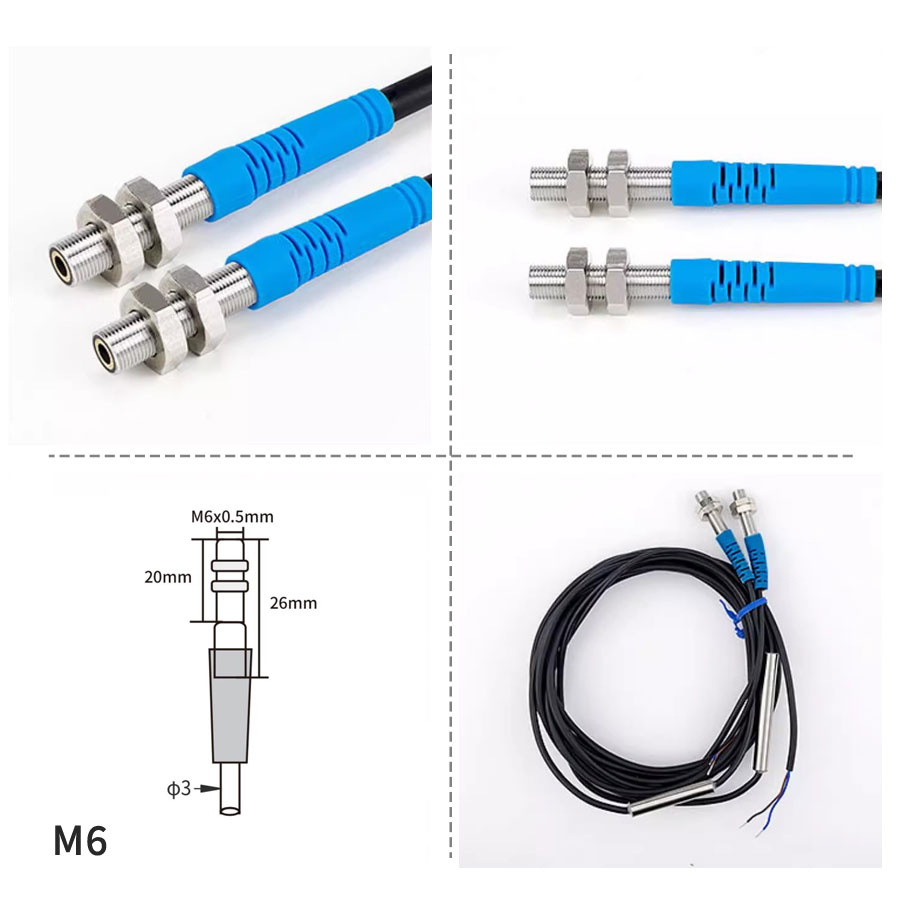
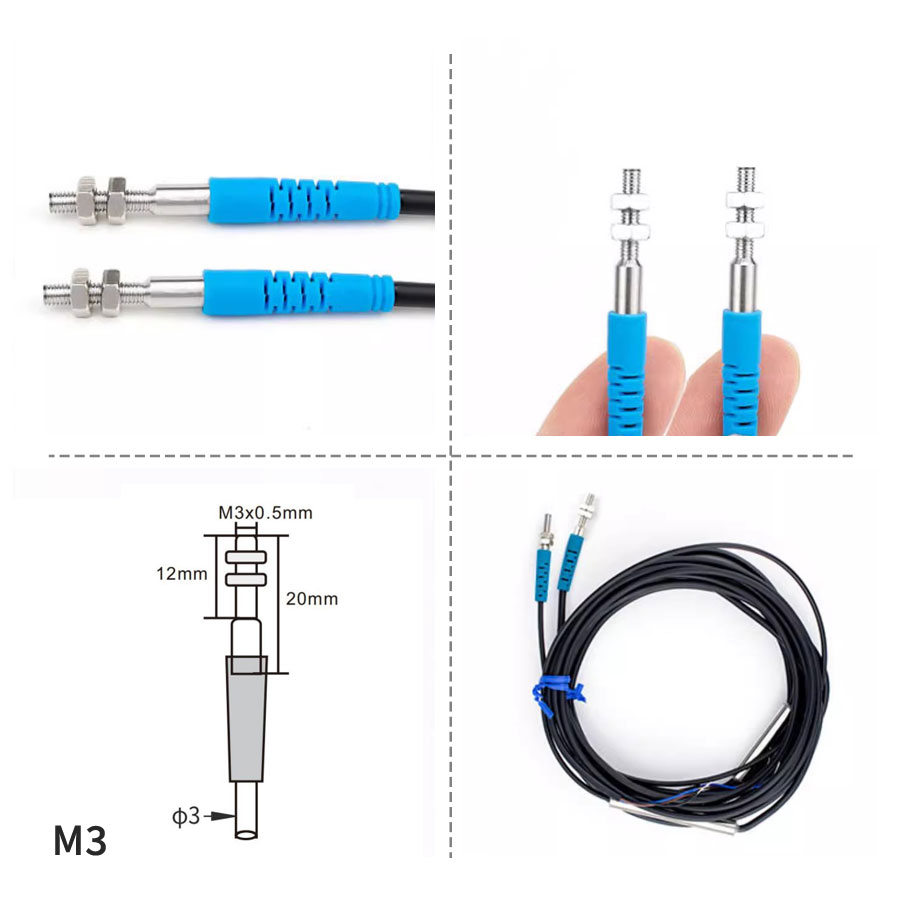
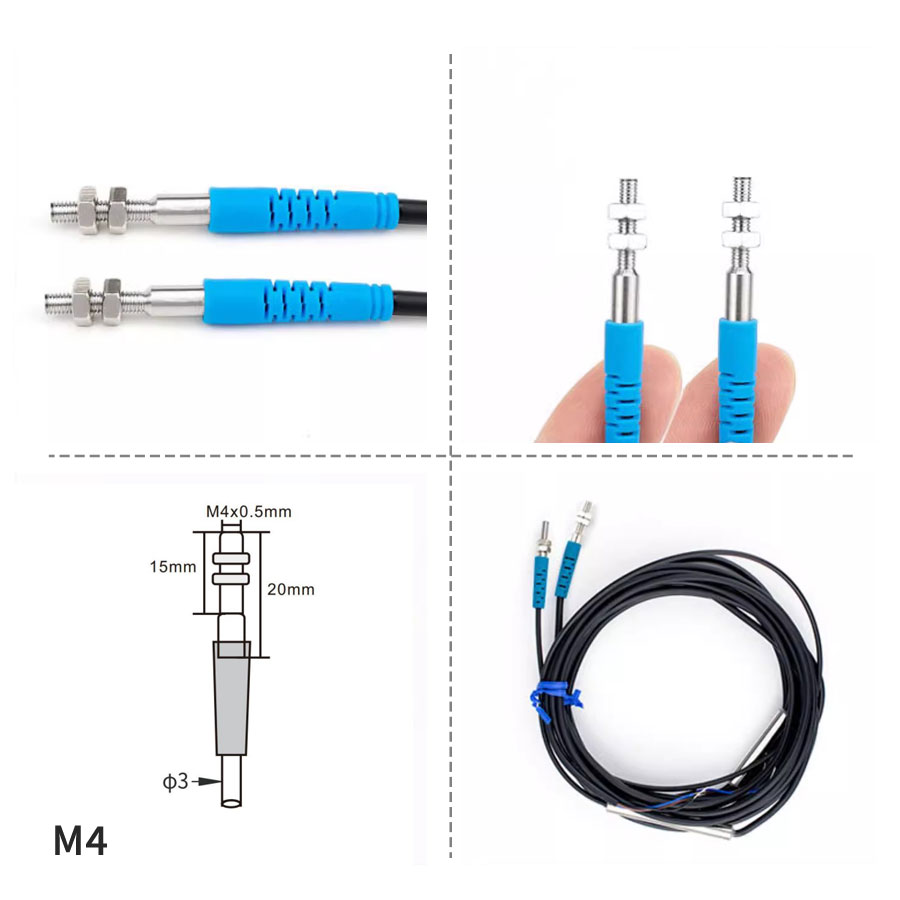
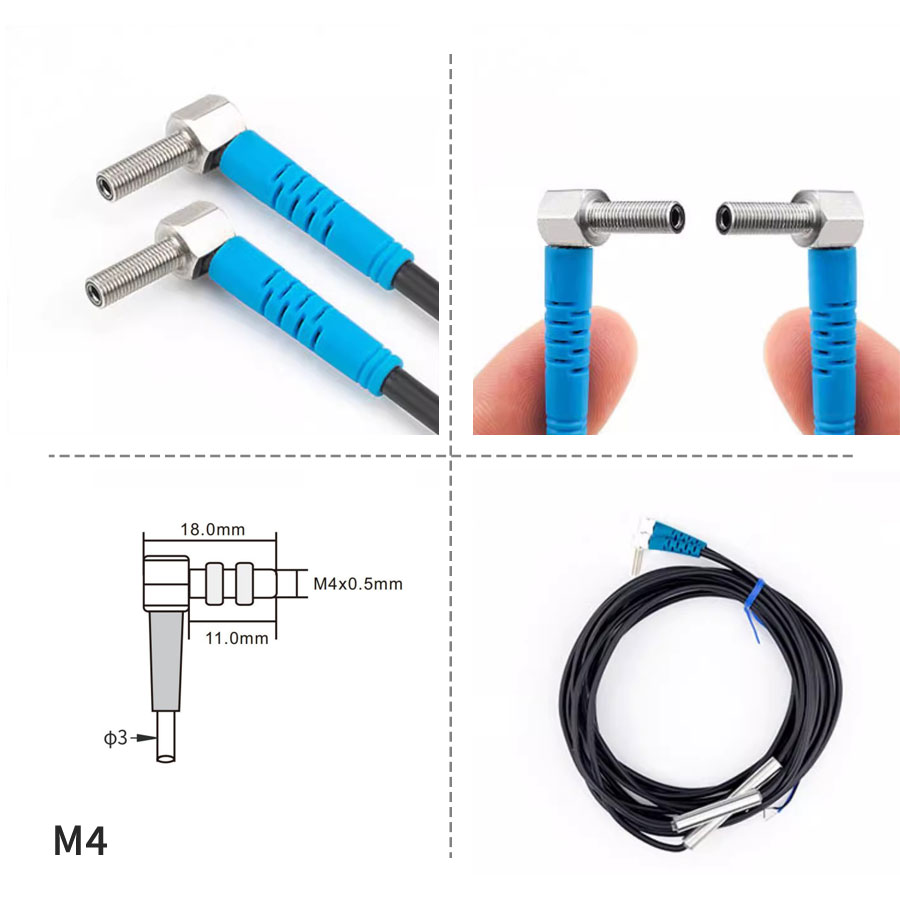
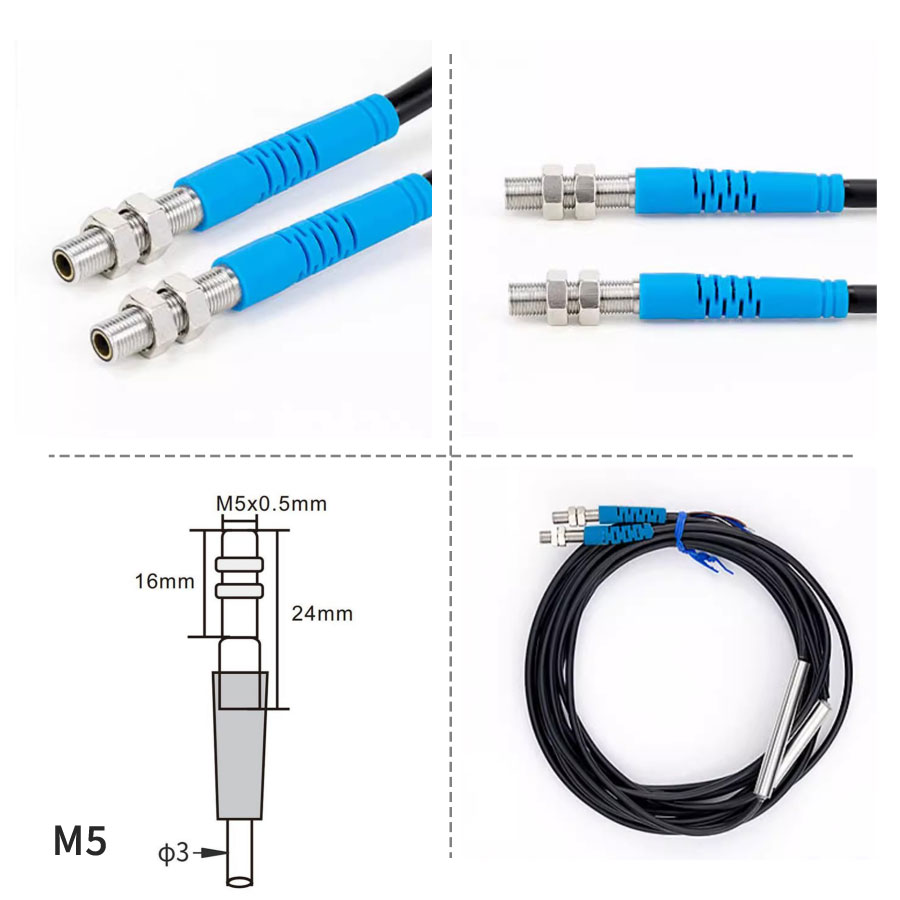
The laser through-beam sensor (also known as laser thru-beam photoelectric sensor) is a high-precision detection device that utilizes the principle of laser beam interruption to detect objects. It consists of independent transmitter and receiver units placed opposite each other to form an optical path.
The M3, M4, M5, and M6 series are ultra-miniature laser through-beam sensors engineered for high-precision detection in space-constrained installations. Operating on the classic through-beam principle with separate transmitter and receiver units, these sensors utilize a 650 nm red visible laser source. They achieve an impressive 20 meter sensing range while maintaining an exceptionally small spot size (Standard 1.5 mm, customizable down to 0.3 mm for some models), enabling precise long-range detection. Constructed with stainless steel housing and featuring an IP55 protection rating, they guarantee reliable performance in harsh industrial environments. Their ultra-compact threaded body design (M3/M4/M5/M6) makes them the ideal solution for automation applications where space is at a premium.
Application Scenarios
Micro-Electronics Manufacturing: Positioning and missing-part detection of chips, wafers, and micro-connectors.
Precision Instruments & Medical Devices: Part counting, position verification, and process control on high-precision assembly lines.
Robotics: Object detection and grip confirmation for micro-robot end-effectors.
Textile & Light Machinery: Detection of broken fine yarns, edge alignment control of ultra-thin materials (e.g., films, papers).
Working Principle
This series operates on the through-beam photoelectric sensing principle. The transmitter emits a modulated, collimated red laser beam. The photodetector inside the receiver is specifically tuned to detect this unique light signal. When an object passes between the transmitter and receiver, interrupting the laser beam, the receiver's output state changes, generating a switch control signal. This principle makes the sensor highly immune to the target's color, material, or surface reflectivity, ensuring extremely stable and reliable detection.
Detailed Specifications
Parameter
M3×20 Model
M4×20 Model
M4×18-TZ Model
M5×24 Model
M6×26 Model
M6×20-TZ Model
Thread Size
M3×0.5
M4×0.7
M4×0.7
M5×0.8
M6×1.0
M6×1.0
Sensing Distance
20 m
20 m
20 m
20 m
20 m
20 m
Standard Target
100×100 mm White Paper
100×100 mm White Paper
100×100 mm White Paper
100×100 mm White Paper
100×100 mm White Paper
100×100 mm White Paper
Light Source
650 nm Red Laser
650 nm Red Laser
650 nm Red Laser
650 nm Red Laser
650 nm Red Laser
650 nm Red Laser
Spot Size (at 2 m)
~Φ5 mm
~Φ5 mm (Customizable)
~Φ1.5 mm (Customizable)
~Φ1.5 mm (Customizable)
~Φ1.5 mm
~Φ1.5 mm (Customizable)
Housing Material
Stainless Steel
Stainless Steel
Stainless Steel
Stainless Steel
Stainless Steel
Stainless Steel
Output Configuration
NPN/PNP NO/NC
NPN/PNP NO/NC
NPN/PNP NO/NC
NPN/PNP NO/NC
NPN/PNP NO/NC
NPN/PNP NO/NC
Operating Voltage
10–30 V DC
10–30 V DC
10–30 V DC
10–30 V DC
10–30 V DC
10–30 V DC
No-load Current
<10 mA
<10 mA
<10 mA
<10 mA
<10 mA
<10 mA
Max. Load Current
150 mA
150 mA
150 mA
150 mA
150 mA
150 mA
Leakage Current
<0.01 mA
<0.01 mA
<0.01 mA
<0.01 mA
<0.01 mA
<0.01 mA
Voltage Drop
<1.5 V
<1.5 V
<1.5 V
<1.5 V
<1.5 V
<1.5 V
Switching Frequency
100 Hz
100 Hz
100 Hz
100 Hz
100 Hz
100 Hz
Response Time
5 ms
5 ms
5 ms
5 ms
5 ms
5 ms
Switching Hysteresis
<15% Sr
<15% Sr
<15% Sr
<15% Sr
<15% Sr
<15% Sr
Repeat Accuracy
<5% Sr
<5% Sr
<5% Sr
<5% Sr
<5% Sr
<5% Sr
Protection Rating
IP55
IP55
IP55
IP55
IP55
IP55
Operating Temperature
0 °C ~ +55 °C
0 °C ~ +55 °C
0 °C ~ +55 °C
0 °C ~ +55 °C
0 °C ~ +55 °C
0 °C ~ +55 °C
Short-Circuit Protection
Yes
Yes
Yes
Yes
Yes
Yes
Overcurrent Protection
180 mA
180 mA
180 mA
180 mA
180 mA
180 mA
Connection
Φ3.0 mm PVC Cable
Φ3.0 mm PVC Cable
Φ3.0 mm PVC Cable
Φ3.0 mm PVC Cable
Φ3.0 mm PVC Cable
Φ3.0 mm PVC Cable
Cable Specification
3×0.15 mm²
3×0.15 mm²
3×0.15 mm²
3×0.15 mm²
3×0.15 mm²
3×0.15 mm²
Front-end Connection
Tx: 2-core wire Rx: Fiber optic
Tx: 2-core wire Rx: Fiber optic
Tx: 2-core wire Rx: Fiber optic
Tx: 2-core wire Rx: Fiber optic
Tx: 2-core wire Rx: Fiber optic
Tx: 2-core wire Rx: Fiber optic
LED Indicator
Tx: Green Rx: Yellow
Tx: Green Rx: Yellow
Tx: Green Rx: Yellow
Tx: Green Rx: Yellow
Tx: Green Rx: Yellow
Tx: Green Rx: Yellow
Certification
CE, RoHS
CE, RoHS
CE, RoHS
CE, RoHS
CE, RoHS
CE, RoHS
Frequently Asked Questions
What is a laser through-beam photoelectric sensor and how does it work?
It is a pair of separate transmitter and receiver units. The transmitter emits a modulated 650 nm red visible laser beam that the receiver detects. When an object breaks the beam between them, the output switches. Because it relies on beam interruption rather than reflection, detection is largely immune to target color, material and surface reflectivity, giving very stable non-contact sensing.
What sensing range and spot size do the M3/M4/M5/M6 lasers offer?
All variants reach up to a 20 m sensing distance against a 100×100 mm white-paper target. The visible red laser keeps a tight spot — about Φ5 mm on the M3/M4 and down to roughly Φ1.5 mm on the M4-TZ, M5 and M6 models (some customizable). The small spot allows precise detection of tiny parts and thin materials at long range.
Should I order NPN or PNP, NO or NC output?
These sensors ship with NPN/PNP and NO/NC configurations. PNP (sourcing) is the default for most modern PLCs, while NPN (sinking) suits some Asian control systems. NO conducts when the beam is clear; NC conducts when the beam is broken. Operating voltage is 10–30 V DC with short-circuit and overcurrent protection built in.
What protection rating and housing do these laser sensors have?
Each unit uses a stainless-steel threaded body (M3×0.5 to M6×1.0) with an IP55 protection rating, suited to dusty and lightly washed-down industrial settings. The operating temperature range is 0 °C to +55 °C. The compact threaded design fits space-constrained machinery, SMT lines, robotics end-effectors and precision assembly stations.
Where are M3/M4/M5/M6 laser through-beam sensors typically used?
They excel in micro-electronics and semiconductor SMT equipment for PCB and component positioning, in precision instruments and medical assembly for part counting and presence verification, in robotics for grip confirmation, and in textile and light machinery for broken-yarn or thin-film edge detection. The 20 m range and tiny spot make them ideal where space is tight and accuracy is critical.