
M8 / M12 / M18 Laser Photoelectric Sensor (one Pair)
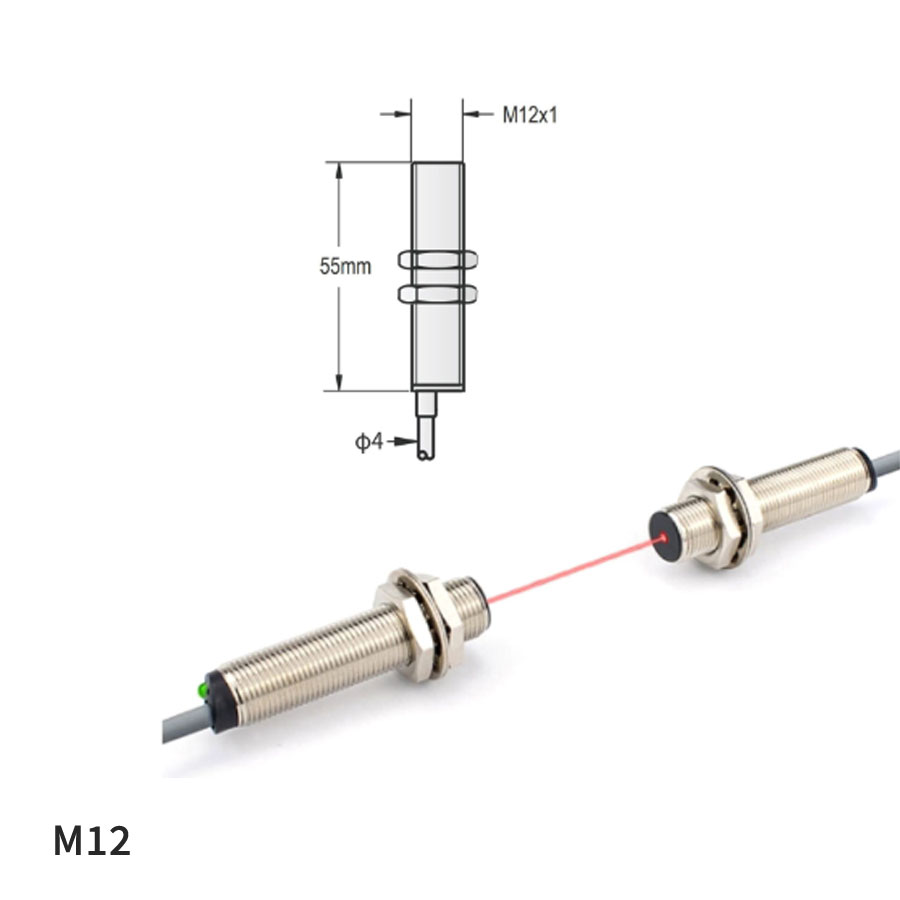
The M8 / M12 / M18 series laser through-beam sensors are high-precision, highly reliable photoelectric sensors featuring a 650 nm red laser source. They offer small spot size, high directivity, and strong anti-interference capability. Available in M8, M12, and M18 housing sizes with sensing ranges of 30 m, 50 m and 50 m respectively, they support NPN / PNP outputs and NO / NC configurations — suitable for various industrial automation applications.
Product Overview
The M8 / M12 / M18 series laser through-beam sensors are high-performance photoelectric switches built around a 650 nm red laser diode. Designed with a through-beam sensing mode, they feature small spot size, high collimation, and excellent resistance to ambient-light interference. Available in M8, M12, and M18 industrial housing standards with maximum sensing ranges of 30 m, 50 m, and 50 m respectively, they support both NPN and PNP output configurations with selectable normally open (NO) / normally closed (NC) operation — ideal for high-precision and high-stability industrial automation applications.
Application Scenarios
- Industrial automation: material detection on production lines, workpiece positioning, counting and sorting.
- Safety & security: area-intrusion detection, safety-door monitoring, light-curtain replacement in hazardous zones.
- Logistics & conveying: package detection, conveyor-jam monitoring, high-speed counting.
- Precision manufacturing: detection of micro components, edge positioning, tension control.
- Harsh environments: suitable for dusty, oily or vibrating conditions, with IP55 protection rating.
Working Principle
The laser through-beam sensor consists of a transmitter and a receiver. The transmitter emits a modulated red laser beam, which is received by a photodiode in the receiver. When the beam is interrupted by an object, the receiver's output state switches, triggering a control signal. The built-in synchronous demodulation circuit effectively suppresses ambient-light interference, enhancing signal-to-noise ratio and detection reliability.
Detailed Specifications — 3 Variants
| Parameter | M8 × 45 Model | M12 × 55 Model | M18 × 52 Model |
|---|---|---|---|
| Max. sensing distance | 30 m | 50 m | 50 m |
| Light source | 650 nm red laser, Class 2 | 650 nm red laser, Class 2 | 650 nm red laser, Class 2 |
| Spot size (at 3 m) | Std. Φ 2 mm (customizable) | Std. Φ 2 mm | Std. Φ 2 mm |
| Output configuration | NPN / PNP, NO / NC selectable | NPN / PNP, NO / NC selectable | NPN NO (others customizable) |
| Operating voltage | 10 – 30 V DC | 10 – 30 V DC | 10 – 30 V DC |
| No-load current | < 10 mA | < 10 mA | < 10 mA |
| Max. load current | 150 mA | 150 mA | 150 mA |
| Leakage current | < 0.01 mA | < 0.01 mA | < 0.01 mA |
| Voltage drop | < 1.5 V | < 1.5 V | < 1.5 V |
| Response frequency | 100 Hz | 100 Hz | 100 Hz |
| Response time | 5 ms | 5 ms | 5 ms |
| Switching hysteresis | < 15 % Sr | < 15 % Sr | < 15 % Sr |
| Repeat accuracy | < 5 % Sr | < 5 % Sr | < 5 % Sr |
| Protection rating | IP55 | IP55 | IP55 |
| Operating temperature | 0 °C to +55 °C | 0 °C to +55 °C | 0 °C to +55 °C |
| Short-circuit protection | Yes | Yes | Yes |
| Overcurrent protection | 180 mA | 180 mA | 180 mA |
| Connection | Φ 3.0 mm PVC cable | Φ 4.0 mm PVC cable | Φ 5.0 mm PVC cable |
| Cable specification | 3 × 0.15 mm² | 3 × 0.15 mm² | 3 × 0.33 mm² |
| Housing material | Nickel-plated brass | Nickel-plated brass | Nickel-plated brass |
| LED indicator | Tx: green · Rx: yellow | Tx: green · Rx: yellow | Tx: green · Rx: yellow |
| Beam alignment | Mechanical alignment lens | Mechanical alignment lens | Mechanical alignment lens |
| Certification | RoHS | CE · RoHS | CE · RoHS |
Frequently Asked Questions
What is the maximum sensing distance of the M8 / M12 / M18 laser through-beam sensor?
As a through-beam pair, the M8 model reaches up to 30 m, while the M12 and M18 models both reach up to 50 m. Because it uses a collimated 650 nm Class-2 red laser with a small ~Φ2 mm spot, the beam stays tight over distance, giving precise edge detection and strong directivity compared with standard LED photoelectric switches.
How does a through-beam laser sensor differ from a diffuse or retro-reflective photoelectric switch?
A through-beam pair uses a separate transmitter and receiver facing each other, so detection happens when an object breaks the beam. This gives the longest range (30–50 m here) and the most reliable switching, independent of target colour or surface. Diffuse and retro-reflective types are simpler to wire but offer shorter range and less immunity to ambient light.
Should I order NPN or PNP, and NO or NC outputs?
PNP (sourcing) suits most modern PLC inputs, while NPN (sinking) is common in some Asian controls. NO closes the output when the beam is blocked; NC opens it. The M8 and M12 models are selectable NPN / PNP and NO / NC; the M18 model ships as NPN NO by default with other configurations customizable. Match the output to the device being replaced.
Is the 650 nm laser safe, and what protection rating does the sensor have?
The light source is a 650 nm red laser classified as Class 2, which is visible and considered safe for momentary exposure; avoid staring directly into the beam. The housing is nickel-plated brass rated IP55, so it tolerates dust, oil and vibration in typical industrial automation, logistics and conveyor environments over a 0 °C to +55 °C operating range.
How do I align the transmitter and receiver for reliable detection?
Each unit has a mechanical alignment lens and LED indicators — green on the transmitter and yellow on the receiver — so you can confirm the beam is centred. Power both units, mount them facing each other within the rated range (up to 30 m or 50 m), then adjust until the receiver indicator is stable. The visible 650 nm spot makes alignment far easier than infrared sensors.
Specs reviewed by Engineer Cai, Senior Application Engineer. CE & RoHS compliant — see certificates.
Safety Light Curtain — Customer Cases
Real installations from DAIDISIKE clients. Click any case to view in full. Filter by scenario to quickly find a similar setup.