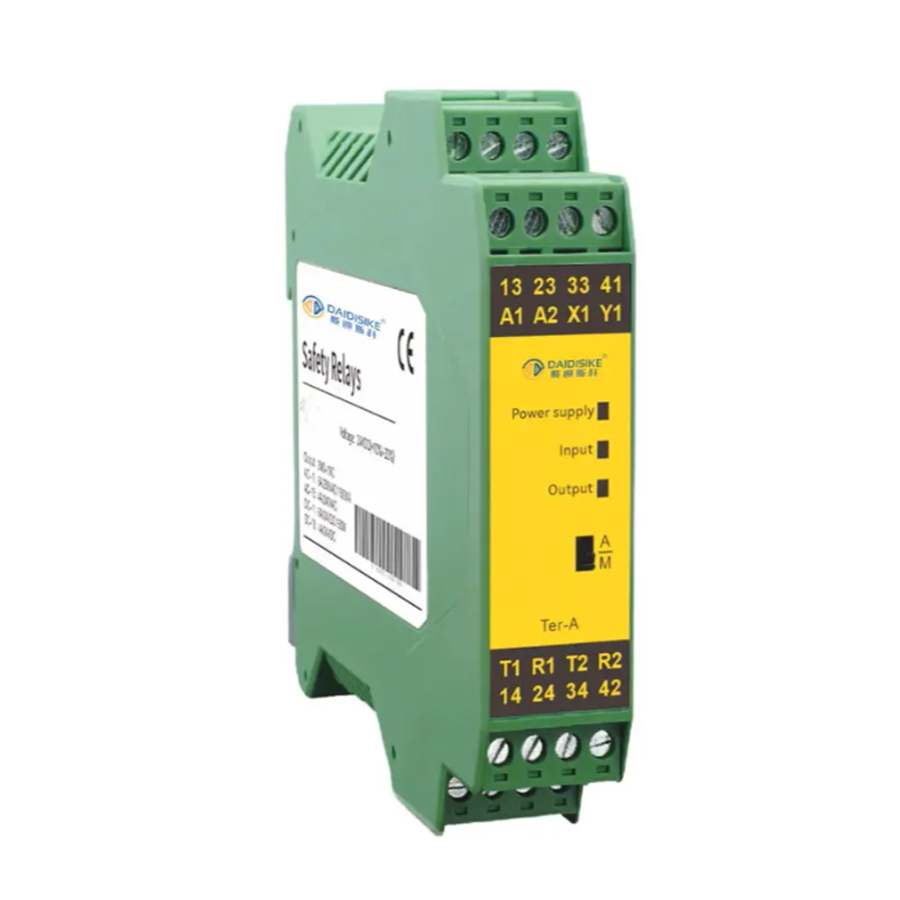
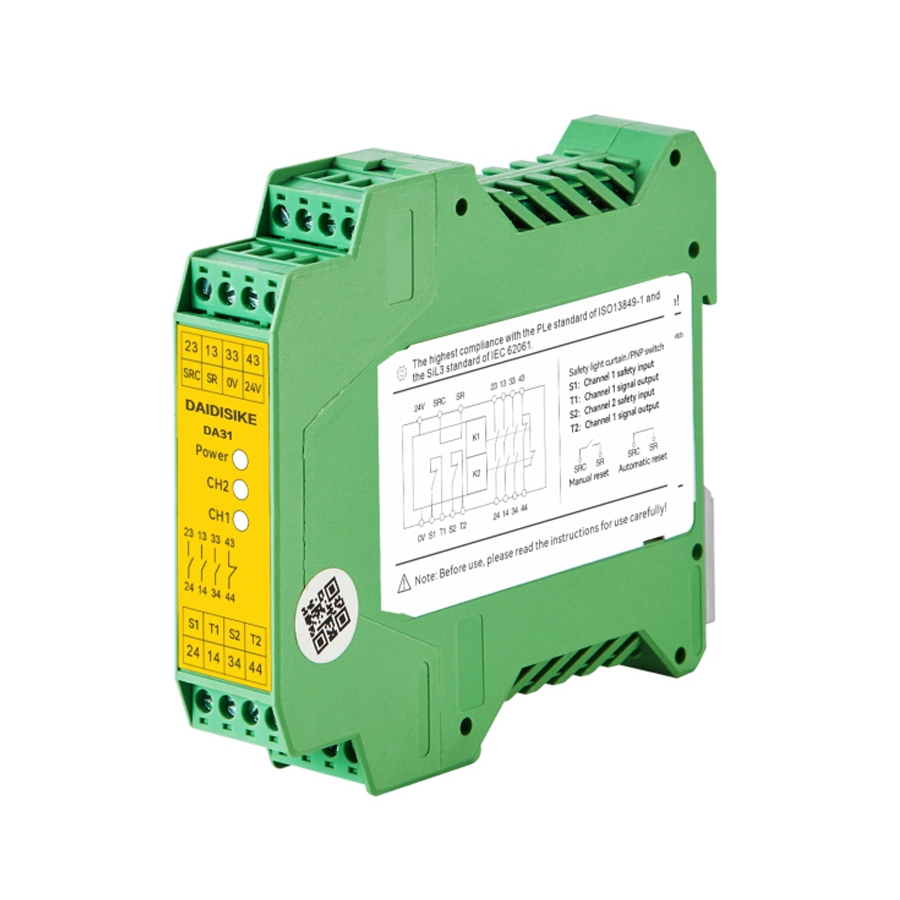
The DA31 series safety relay by DAIDISIKE is a compact, reliable device for industrial safety, monitoring emergency stops, safety switches, and more. Used in industries like CNC, robotics, and hydraulics, it meets ISO 13849-1 PLe and IEC 62061 SiL3 standards. With a 22.5mm width, it offers screw/spring terminals, PLC output, LED indicators, and certified components. Fast response and configurable resets help streamline installation and reduce wiring complexity.
The technical parameters of the DA31 series focus on safety performance and electrical characteristics. The power supply is 24V DC, with a tolerance range of +10% to -20%, and power consumption not exceeding 2.9W. The input supports dual-channel safety inputs, capable of detecting tail resistance of 1kΩ~10kΩ for open-circuit detection and channel mutual inspection. The output provides 3 normally open (NO) and 1 normally closed (NC) instantaneous safety contacts, with contact capacity supporting AC/DC loads, and a maximum switching current of 12A. The response time is less than 30ms, ensuring quick release. Electrical life reaches 80,000 cycles, suitable for pollution degree 2 environments. Wide operating temperature range from -25°C to 85°C, humidity 35%-85% without condensation. Protection grade is IP30 (housing) and IP20 (terminals), with impulse withstand voltage of 2.5kV. Connections use screw or spring terminals, supporting AWG 24-12 wires. The overall design complies with EN/ISO 13849-1 Cat.4/PLe and IEC 62061 SiL3 standards, ensuring reliable monitoring in high-risk industrial sites.
Working Principle of DA31 Series Safety Relay
The core working principle of the DA31 series safety relay is based on a dual-channel redundant safety monitoring circuit design (Dual-Channel Redundant Safety Monitoring), which is a fail-safe architecture that ensures system safety even in the event of a single-channel failure. The relay uses high-speed mutual verification technology (High-Speed Mutual Verification) to monitor input signals from two independent channels in real time. If the signals from the two channels are inconsistent or an abnormality is detected (such as open circuit, short circuit, or external interference), the system immediately cuts off the output to prevent hazardous actions.
The specific workflow is as follows:
Input Detection: The input terminals (S1/PNP signal 1 and T2/S1) receive signals from safety devices (such as safety light curtains or emergency stop buttons). It supports PNP or NPN signal sources and has built-in tail resistance for open-circuit detection. Channel 1 and Channel 2 perform mutual inspection; if the signals are synchronous and valid, the internal relay is activated.
Logic Processing: The built-in microcontroller verifies signal integrity and supports configuration via DIP switches for automatic reset (Automatic Reset) or manual reset (Manual Reset). In manual mode, an external reset button is required to confirm safety recovery.
Output Control: Once the input is valid, the output 3NO+1NC contacts supply power to actuators (such as motor contactors). The release response time is <30ms, ensuring quick disconnection in emergency situations. PLC signal output is used for system feedback.
Fault Handling: It adopts force-guided contacts (Force-Guided Contacts); if one contact sticks, the other will detect and report the fault. Compliant with functional safety standards, it achieves PL e/Cat.4 level safety through redundancy and self-diagnosis.
Application Extension: In safety light curtain applications, when an intrusion is detected by the light curtain, the input is interrupted, and the relay output immediately stops machine operation. It supports various wiring diagrams, such as dual-channel emergency stops and safety door locks, ensuring multifunctional adaptability in industrial automation.
This principle draws from safety integrated systems (Safety Integrated System, SIS) in industrial automation, emphasizing preventive maintenance and minimization of risk propagation to ensure protection of personnel and equipment.
Frequently Asked Questions
What is the difference between a safety relay and a safety PLC?
A safety relay like the DA31 is a hardwired, fixed-function device that monitors emergency stops, safety light curtains or door switches through dual-channel redundant inputs and cuts output in under 30 ms. A safety PLC is programmable and scales to many zones and complex logic. For a single machine or a few safety functions, the DA31 is faster to wire and lower cost.
What safety standards and performance level does the DA31 meet?
The DA31 is designed to EN/ISO 13849-1 Category 4 / PL e and IEC 62061 SIL 3. It achieves this through dual-channel redundancy, high-speed mutual verification and force-guided (positively guided) contacts, so a single fault such as a welded contact is detected and the module stays in the safe state rather than failing silently.
How do force-guided contacts and EDM feedback work on the DA31?
Force-guided contacts mechanically link the safety and feedback contacts, so if a normally open contact welds shut, the linked NC monitoring contact cannot close. The DA31 uses this for external device monitoring (EDM): the feedback loop checks downstream contactors before allowing a reset. If a contactor sticks, the relay will not re-energize, protecting the machine.
How is the DA31 wired and mounted?
The DA31 mounts on a standard 35 mm DIN rail with spring-clip fixing and is 112 × 99.5 × 22.6 mm. It accepts dual-channel safety inputs supporting PNP or NPN signal sources with tail resistance of 1 kΩ–10 kΩ for open-circuit detection. Terminals are screw or spring type accepting 0.5–2.5 mm² (AWG 24–12) conductors, with a strip length of 8 mm and 0.5–0.6 Nm tightening torque.
What outputs and contact ratings does the DA31 provide?
The DA31 provides 3 normally open (3NO) plus 1 normally closed (1NC) instantaneous safety contacts, with AgSnO2 + 0.2 μm Au contact material. Ratings include AC-1 6 A/250 VAC and DC-1 6 A/24 VDC, with a maximum switching capacity of 12 A distributed across the contacts. A transistor signal output (<500 mA, 24 V DC) provides PLC status feedback, and electrical life is 80,000 cycles.