
DQE Series Safety Light Curtain Sensor and Safety Relay Connection Guide
The main link between safety light curtains and safety relays in the modern industrial automation system, and the reliable safety, is vital to the safe function of human and equipment. As such these safety light curtains are used extensively in stamping, machining, automated assembly line, etc in various situations.
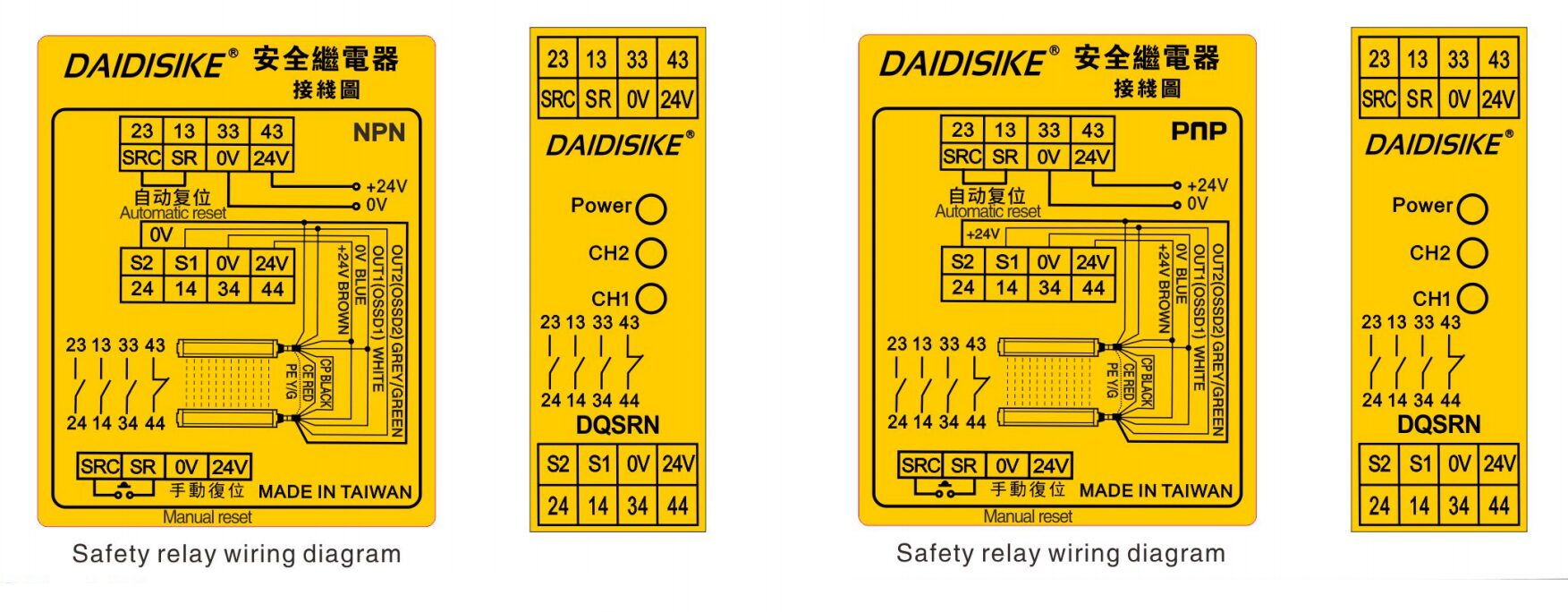
DAIDISIKE series safety light curtains have dual OSSD outputs, noise-resistant design as well as interfacing with many safety relays that can be used. DAIDISIKE DQE Series Safety Light Curtains are broadly used such as in stamping, machining, automated assembly lines, and other applications. We have detailed in this article the connection principle and we will take a brief step in each step, examples, and key consideration of both the DQE series safety light curtains and safety relays to fast get the wiring compliance in order to complete the safety compliance in less time.
I. Principles and Prerequisites of Connectivity core.
In addition, it operates through two OSSD (Output Signal Switching Device) outputs. When it is triggered, outputs via EDM (External Device Monitoring) function are supported, and the equipment complies with IEC 61496-1 Type 4, PL e/SIL 3 safety level. Safety relay (e.g. DA31, DQSRN series): As the safety control core, it takes OSSD signal from the light curtain to block out power circuit with a pair of safety contacts and simultaneously EDM feedback checking to prevent the exposure hazard caused by contactor contact welding and the other faults.
2.2.2 Connection Requirement
Check that the safety relay model is in compliance with safety level requirements (to meet Type 4/PL e of DQE series); specify the output type of DQE Light Curtain (NPN/PNP) has polarity similar to that for safety relay input; Design and configure shielded twisted pair cables (recommended AWG 22–24), terminal blocks, fuses (5A gL/gG) and other accessories; independent and isolated from inverter, motor and other power supply, the power supply has to be kept independent of and separate from the power supply (voltage tolerance ±10%/-20%).
II. General Wiring Process (use dual OSSD+EDM as a case in point)
1. Preparation before wiring
Unplug power supplies, check the line with a multimeter through and through so as not to short-circuit; Matching up DQE light curtain cables based on the wiring diagram (brown: +24VDC, blue: 0V, white: OSSD1, black: OSSD2, yellow-green: shielding ground); The safety relay was mounted on the 35mm DIN rail and the heat dissipation space was ≥5cm.
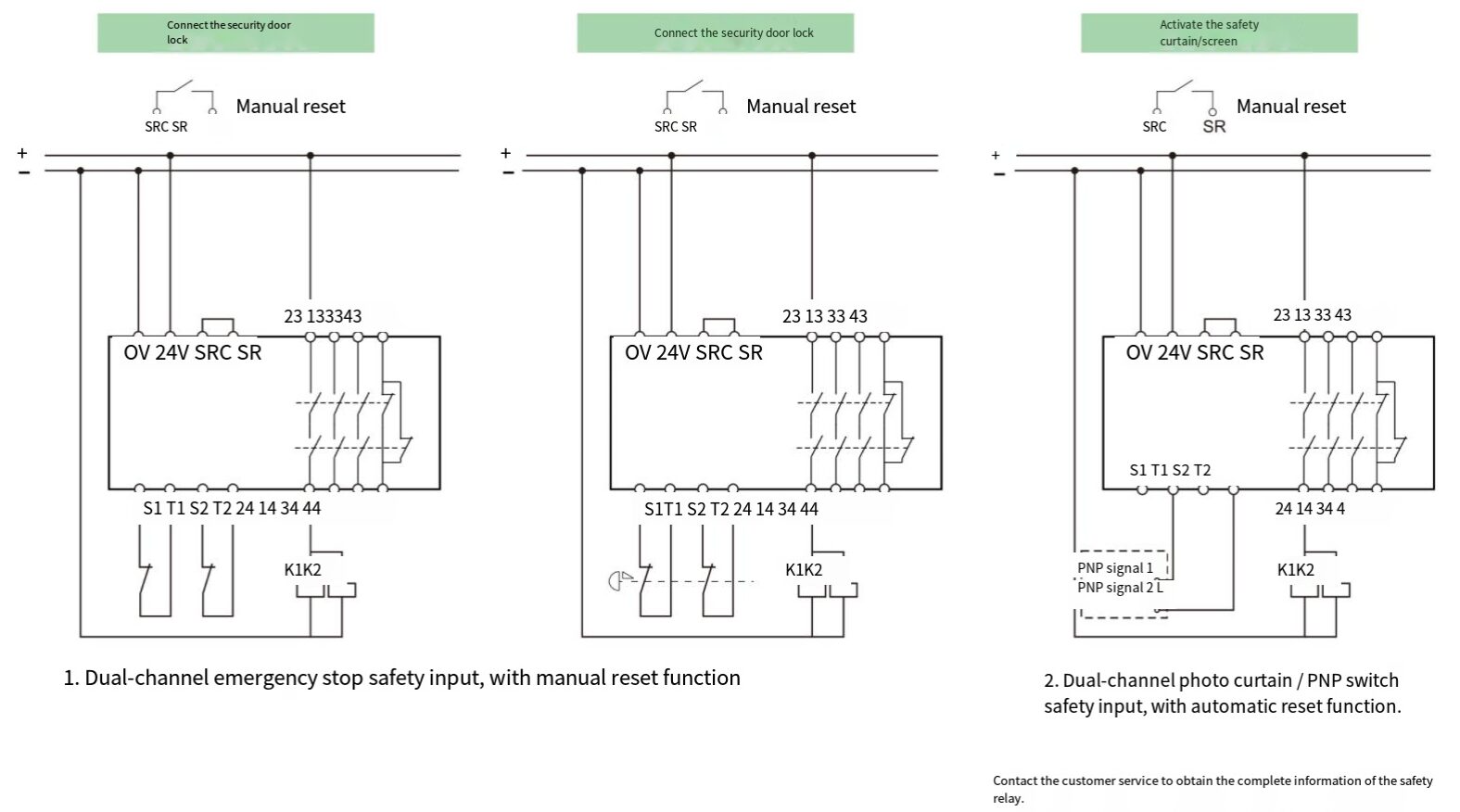
Step-by-step wiring
(1) Power connection DQE light curtain power supply: brown wire to 24VDC positive (series 5A fuse), blue wire to 24VDC negative safety relay power supply: the corresponding terminal (+) which is connected to 24VDC positive, (0V) which is connected to 24VDC negative, so the power supply has ripple ≤10%.
(2) The OSSD signal connection (dual redundancy) DQE light curtain white line (OSSD1) → safety relay channel 1 input terminal (as shown below S1); DQE light curtain black line (OSSD2) → safety relay channel 2 input terminal (S2), and, if the light curtain is NPN output type, common terminal of the safety relay input is connected to the negative terminal of 24VDC; If it is PNP type, common terminal (CP) is connected to positive terminal of 24VDC (see wiring logic of DQSRN series).
(3) EDM Feedback Circuit Connection safety relay EDM output terminal (T1/T2) → contactor auxiliary normally closed contact (K1/K2 in series); other side of the contactor contact → DQE Light Curtain EDM input terminal (some models have multiplexed OSSD common terminal, review manual). At the other end of the contactor contact → DQE Light curtain EDM input terminal (a number of models multiplexed are OSSD common terminal; product manual); Role of check: To check on contactor contact state, after contact is melted and welded the EDM signal should be abnormal, after the light curtain is in alarm mode, it should prohibit reset.
(4) Reset function connection Manual reset button (two keys anti-false-touch, SR and SRC) → Safety relay reset terminal (SR) and reset control terminal (SRC). SR and SRC shorted, for automatic reset and disconnected for manual reset (manual reset must be configured according to the scenario, manual reset is recommended, particularly if risks are high).
(5) Shield and ground DQE light curtain yellow-green shielding line → safety relay grounding terminal and then single-ended grounding (cabinet grounding row, grounding resistance ≤ 4Ω); signal line and power line spaced ≥ 200mm, vertical cross-wiring designed to prevent electromagnetic interference.
Sample Connection (DAIDISIKE Safety Relay Adapted)
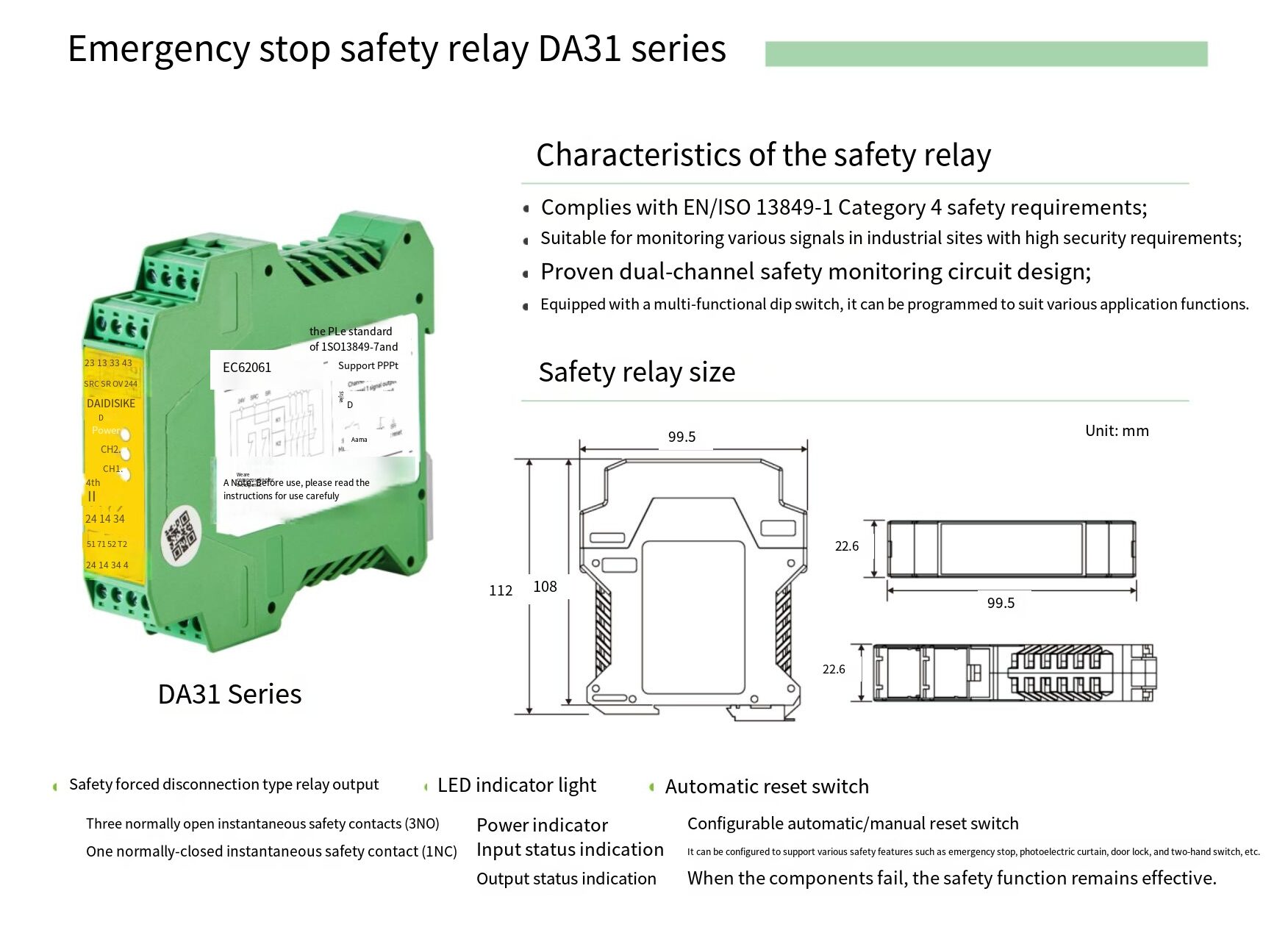
Example 1: DQE series (PNP type) + DA31 series safety relay
| DQE light curtain cable | Function | DA31 safety relay terminals | Note |
|---|---|---|---|
| brown | +24VDC | + | Series 5A fuse |
| Blue | 0V | 0V | Power supply common ground |
| White (OSSD1) | Safety output 1 | S1 | Dual inputs need to be connected at the same time |
| Black (OSSD2) | Safety output 2 | S2 | |
| Yellow-green | Shield Ground | Ground Terminal | Single-Ended Ground |
| EDM feedback | T1→K1 (NC)→DQE EDM terminal | Contactor normally closed contacts in series | |
| Reset button | Manual reset | SR + SRC | Manual reset in disconnected state |
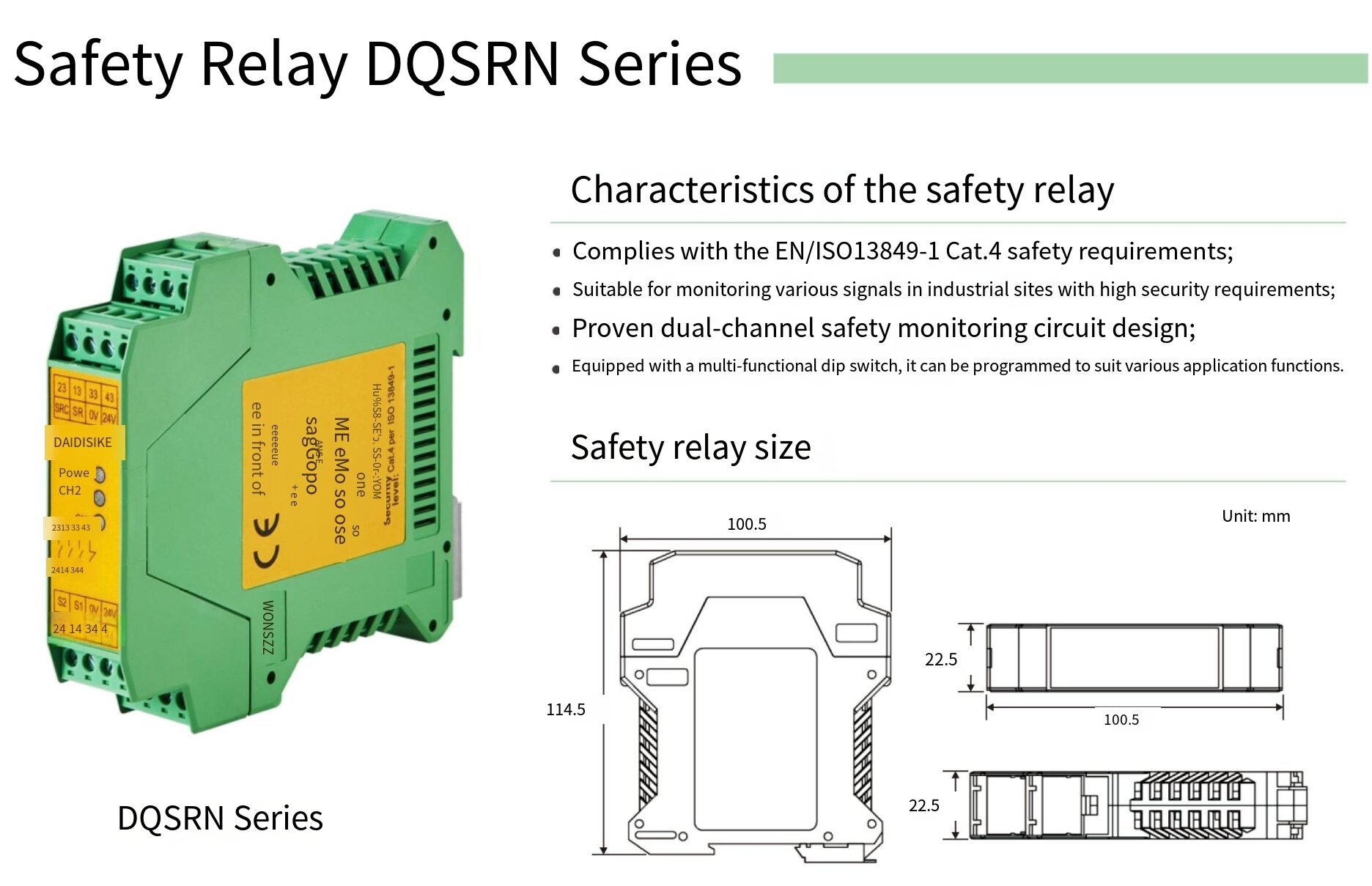
Example 2: DQE series (NPN type) + DQSRN series safety relay (2 outputs)
Power supply connection: same as Example 1, safety relay CP terminal connected to 0V; OSSD signal: OSSD1→S1, OSSD2→S2, to ensure the synchronisation of the two signals; Safety output: relay 23/14, 33/43 (NO contact) to contactor coil, 41/42 (NC contact) to alarm indicator; Wiring diagram for reference: DQSRN Series 2-Channel Safety Output Wiring Diagram, strictly matching the terminal identification.
Check Before Power-on
Verify that the wiring is correct according to the schematic diagram and does not reverse or short circuit; Use a multimeter to measure the voltage of the power supply terminals and ensure it is 24VDC±10%; Check if the grounding of the shield is good, no overhang. Ensure that the shielding layer is properly grounded and there is no overhang.
Functional debugging
No blocking state: DQE light curtain OSSD1/OSSD2 output high level, safety relay indicator green light is always on, the safety contact is closed; blocking test: blocking the light curtain, OSSD1/OSSD2 out of step, the relay immediately trips, the safety contact is disconnected, the alarm indicator light is on. EDM failure test: analogue contactor contact welding (shorting K1), the relay cannot be reset, the light curtain maintains the alarm state; reset test: after lifting the masking, manually press the reset button, the relay returns to normal, and the safety contact closes.
DAIDISIKE Tech & Video Center
Advanced Sensor Solutions for Industrial Safety and Automation
DAIDISIKE Corporate Profile
Discover our commitment to precision engineering and manufacturing.
Safety Interlock DX Series
Real-world application for advanced machine safeguarding.
AGV LiDAR DLD30T-5N 40
Enhanced perimeter security and collision prevention solutions.
Vehicle DQLV Light Curtains
Optimized for toll stations and weighbridges profiling.
Measuring DQL Series 3D
Dimensional measurement and object positioning principles.
DQC Universal Grating
Installation guide for hand & finger safeguarding.
Waterproof DQR Series
Performance under high-pressure washdowns.
Color Mark Sensors
Intelligent recognition for high-speed packaging lines.
Strip DK-D461 Sensors
Advanced background suppression for irregular shapes.
Area DQSA Protection
Cost-effective side safeguarding using mirror reflection.
Frequently Asked Questions
How do I wire a safety light curtain to a safety relay?
Connect the curtain's two OSSD outputs to the safety relay's dual safety inputs, supply 24 V DC to both devices, wire the relay's safety outputs to the contactors that cut hazardous motion, and close the EDM loop from the contactor auxiliary contacts back to the relay. Confirm reset and start behaviour before commissioning.
What do I check before powering on?
Verify supply voltage and polarity, that both OSSD channels go to the correct relay inputs, that the EDM loop is complete, and that the output contactors are correctly connected. A pre-power check prevents damage and helps the safety function work on the first test.
Why use a safety relay instead of wiring directly?
A safety relay provides the monitored, redundant switching and fault detection a safety function needs — single-fault tolerance, EDM and a controlled reset. Wiring a curtain straight to a standard contactor would not provide that diagnostic coverage or single-fault detection.
How do I test the wiring is correct?
After power-on, interrupt the field and confirm the relay drops out and the machine stops; clear the field and confirm restart needs a deliberate reset where manual reset is used. Then simulate a held contactor to test EDM, which should block restart. Record the results.
Does manual or automatic reset change the wiring?
Yes. Manual reset uses an extra terminal for a reset button so the operator must acknowledge before restart; automatic reset links that terminal so outputs re-arm when the field clears. Manual reset is the default for access guarding; automatic reset is limited to specific cases that preserve the safety distance.