
M3M4 Ultra-Small Inductive Proximity Sensor
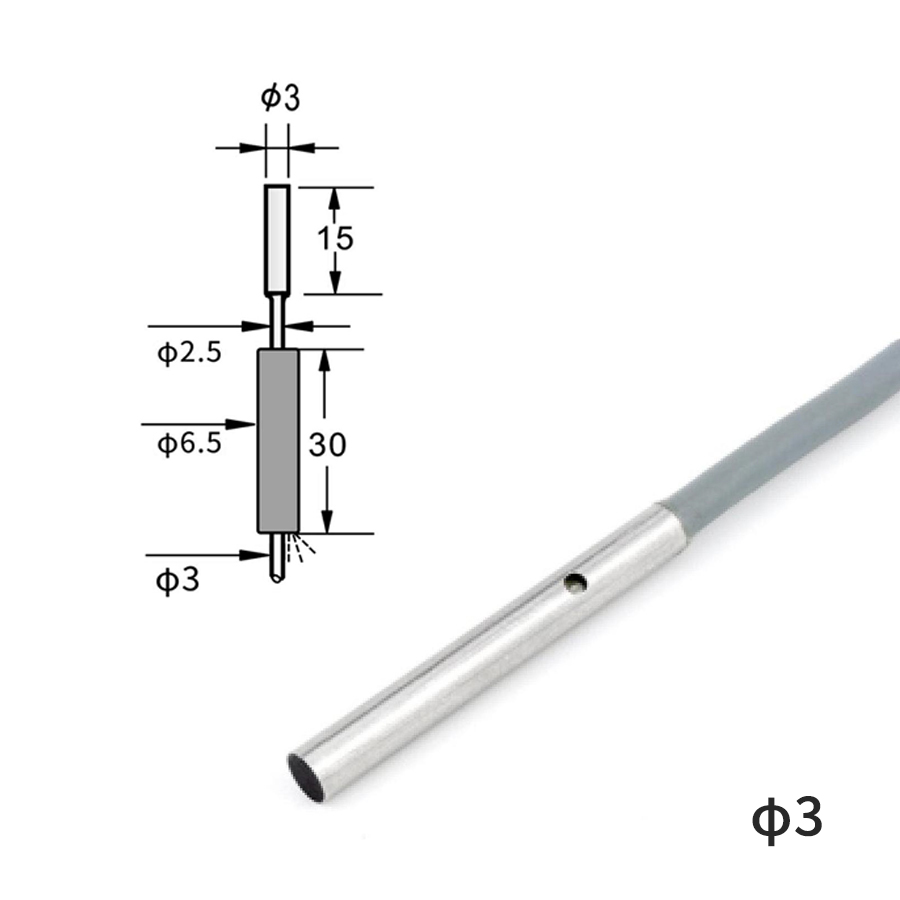
The M3M4 Ultra-Small Inductive Proximity Sensor is a DC 3-wire metal-detection switch designed for industrial automation, with a compact size (M4 × 25 flush mounting) and precise 1 mm detection distance, supporting NPN / PNP outputs. CE and RoHS certified, it offers reliable non-contact metal sensing for space-constrained environments.
Product Description
The M3M4 Ultra-Small Inductive Proximity Sensor is a high-performance metal-detection switch designed for industrial automation, featuring a DC 3-wire configuration with NPN or PNP output and a compact M4 × 25 (flush) design. With its 1 mm precise detection distance and durable nickel-plated brass housing, it is ideal for space-constrained industrial environments. The sensor includes an LED indicator for real-time detection feedback, making it easy to monitor and integrate into various automation systems. It complies with CE and RoHS certifications, ensuring high quality and environmental standards.
Product Specifications
| Parameter | Description |
|---|---|
| Model | M3M4 (Flush) |
| Detection distance | 1 mm ± 10 % |
| Operating voltage | DC 10 – 30 V |
| Output type | NPN / PNP (NO / NC optional) |
| Load current | ≤ 150 mA |
| Operating frequency | 1 kHz |
| Protection rating | IP65 |
| Operating temperature | −25 °C to +70 °C |
| Housing material | Nickel-plated brass |
| Cable length | 2 m (customizable) |
| Certifications | CE · RoHS |
Model Specifications — 8 Variants
| Model | Output | Detection | Mount | Dimensions | Voltage | Load | Response | IP | Temp. | Housing | Cable | Cert. | Notes |
|---|---|---|---|---|---|---|---|---|---|---|---|---|---|
| LJ4A3-1-Z/BY | PNP NO | 1 mm ± 10 % | Flush | M4 × 25 | DC 10-30 V | ≤ 150 mA | 1000 Hz | IP67 | −25 °C ~ +70 °C | Stainless steel | 2 m PVC | CE · RoHS | Standard, high sensitivity |
| LJ4A3-1-Z/AX | NPN NC | 1 mm ± 10 % | Flush | M4 × 25 | DC 10-30 V | ≤ 150 mA | 1000 Hz | IP67 | −25 °C ~ +70 °C | Stainless steel | 2 m PVC | CE · RoHS | High stability, harsh environments |
| LJ4A3-0.8-Z/BY | PNP NO | 0.8 mm ± 10 % | Flush | M4 × 25 | DC 10-30 V | ≤ 100 mA | 500 Hz | IP67 | −25 °C ~ +70 °C | Nickel-plated brass | 2 m PVC | CE · RoHS | Micro detection, precision applications |
| LJ4A3-1-Z/EX | DC 2-wire NO | 1 mm ± 10 % | Flush | M4 × 25 | DC 12-24 V | ≤ 150 mA | 1000 Hz | IP68 | −25 °C ~ +70 °C | Stainless steel | 2 m PVC | CE · RoHS | Custom voltage, multi-system compatible |
| LR04-01N1 | NPN NO | 1 mm ± 10 % | Flush | M4 × 25 | DC 10-30 V | ≤ 150 mA | 1000 Hz | IP67 | −25 °C ~ +70 °C | Stainless steel | 2 m PVC | CE | Industrial grade, non-contact |
| LR04-01N2 | NPN NC | 1 mm ± 10 % | Flush | M4 × 25 | DC 10-30 V | ≤ 150 mA | 1000 Hz | IP67 | −25 °C ~ +70 °C | Stainless steel | 2 m PVC | CE | Compact design, easy integration |
| EB-M4-NO | NPN NO | 0 – 2 mm | Flush | M4 × 25 | DC 12-24 V | ≤ 150 mA | 500 Hz | IP68 | −25 °C ~ +70 °C | Metal cylindrical | 2 m | CE · RoHS | Auto-type, shielded / non-shielded optional |
| EB-M4-NC | NPN NC | 0 – 2 mm | Flush | M4 × 25 | DC 12-24 V | ≤ 150 mA | 500 Hz | IP68 | −25 °C ~ +70 °C | Metal cylindrical | 2 m | CE · RoHS | High response frequency, durable |
Application Environments
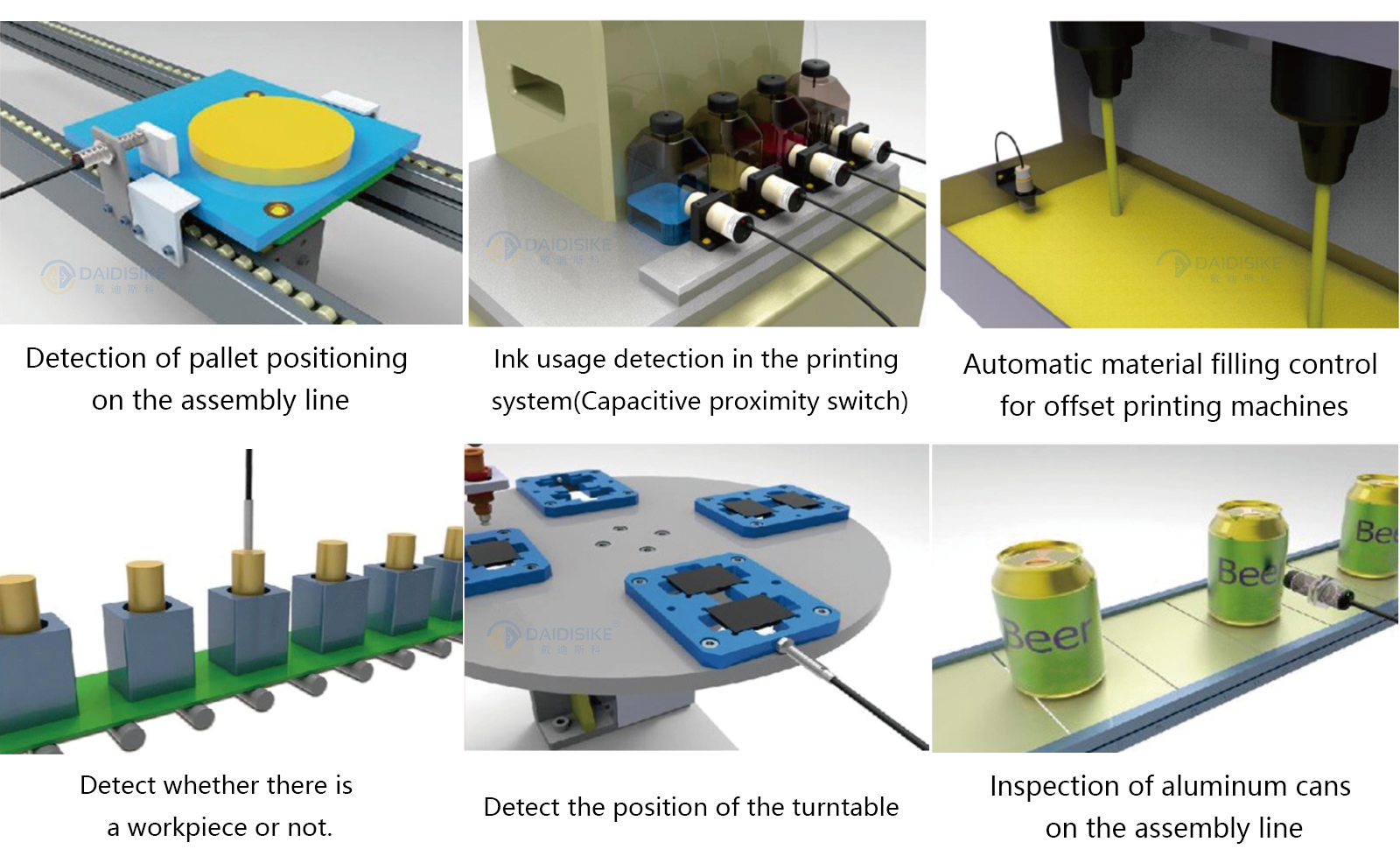
The M3M4 proximity sensor is suitable for various industrial automation scenarios, including but not limited to:
- Machinery manufacturing: detects precise positioning of metal components, enhancing production efficiency.
- 3D printing: ensures accurate detection of metal platforms or parts for precise printing.
- Automated production lines: monitors metal objects on conveyor belts, optimizing logistics and sorting.
- Robotics: enables non-contact metal detection in robotic systems, improving operational safety.
With an IP65 protection rating, the sensor operates reliably in temperatures from −25 °C to +70 °C, suitable for harsh environments with moisture, dust or high temperatures.
Working Principle
The inductive proximity sensor generates an electromagnetic field from its front end. When a metal object enters this field, it alters the inductance of the sensor's coil. This change is detected by the internal circuit, which converts it into an electrical signal to trigger the switch output (normally open or normally closed).
The M3M4 sensor uses a DC 3-wire configuration (brown = power positive, blue = power negative, black = signal output), providing reliable signal feedback via NPN or PNP output. It detects metal targets without physical contact, offering high sensitivity and fast response for precision industrial applications.
Frequently Asked Questions
What sensing distance does the M3M4 ultra-small proximity sensor have?
The M3M4 has a rated sensing distance (Sn) of about 1 mm ± 10 % for a standard mild-steel target, with a 0.8 mm micro-detection variant. Because it is a flush (shielded) M4 × 25 sensor, non-ferrous targets such as aluminium, brass or stainless steel reduce the range by a known correction factor, so size the target accordingly.
Should I choose NPN or PNP, NO or NC output for the M3M4?
PNP (sourcing) is the default for most modern PLCs, especially in Europe, while NPN (sinking) is common in many Asian control systems. NO closes the output on metal detection and NC opens it. The M3M4 is a DC 3-wire sensor (brown +, blue −, black signal) offered in NPN/PNP and NO/NC, plus a DC 2-wire variant.
Can the M3M4 replace an Omron, Balluff or Autonics M4 proximity sensor?
Usually yes. It shares the M4 × 25 flush thread, DC 3-wire NPN/PNP wiring, IP67 rating and roughly 1 mm sensing distance, so it fits the same bracket and cable run. Match the output type (NPN/PNP, NO/NC), detection distance and housing material to the unit being replaced for a drop-in swap.
What ingress protection and temperature range does the M3M4 offer?
Standard models are rated IP65/IP67, with IP68 variants for submerged or wash-down use. The housing is stainless steel or nickel-plated brass, and the operating range is −25 °C to +70 °C. This makes the M3M4 suitable for machine tools, 3D printers, conveyors and robotics exposed to moisture, dust or vibration.
Why use an ultra-small M3/M4 sensor instead of a larger M8 or M12?
The M4 × 25 body fits where M8 or M12 sensors cannot — tight fixtures, robot end effectors, small jigs and precision positioning. It trades a longer range for compactness, delivering a precise 1 mm detection distance and 1 kHz response. Choose M3M4 for space-constrained metal detection; step up to M8/M12 when you need more range.
Specs reviewed by Engineer Cai, Senior Application Engineer. CE & RoHS compliant — see certificates.
Safety Light Curtain — Customer Cases
Real installations from DAIDISIKE clients. Click any case to view in full. Filter by scenario to quickly find a similar setup.