The Future of AI-Integrated Safety Sensors: Beyond Simple Beam Breaking
For decades, the “safety” in industrial sensors was binary: either the beam was clear, or it was broken. If a stray spark, a heavy plume of dust, or a piece of scrap metal flew through the sensing field, the machine stopped. While safe, this led to countless hours of lost productivity due to “nuisance trips.”
At DAIDISIKE (戴迪斯科), we are seeing a shift. The next generation of safety technology isn't just about stopping a machine; it's about understanding why it needs to stop. This is where Artificial Intelligence (AI) integration begins to redefine the factory floor.
1. Smart Filtering: Ending the “Nuisance Trip”
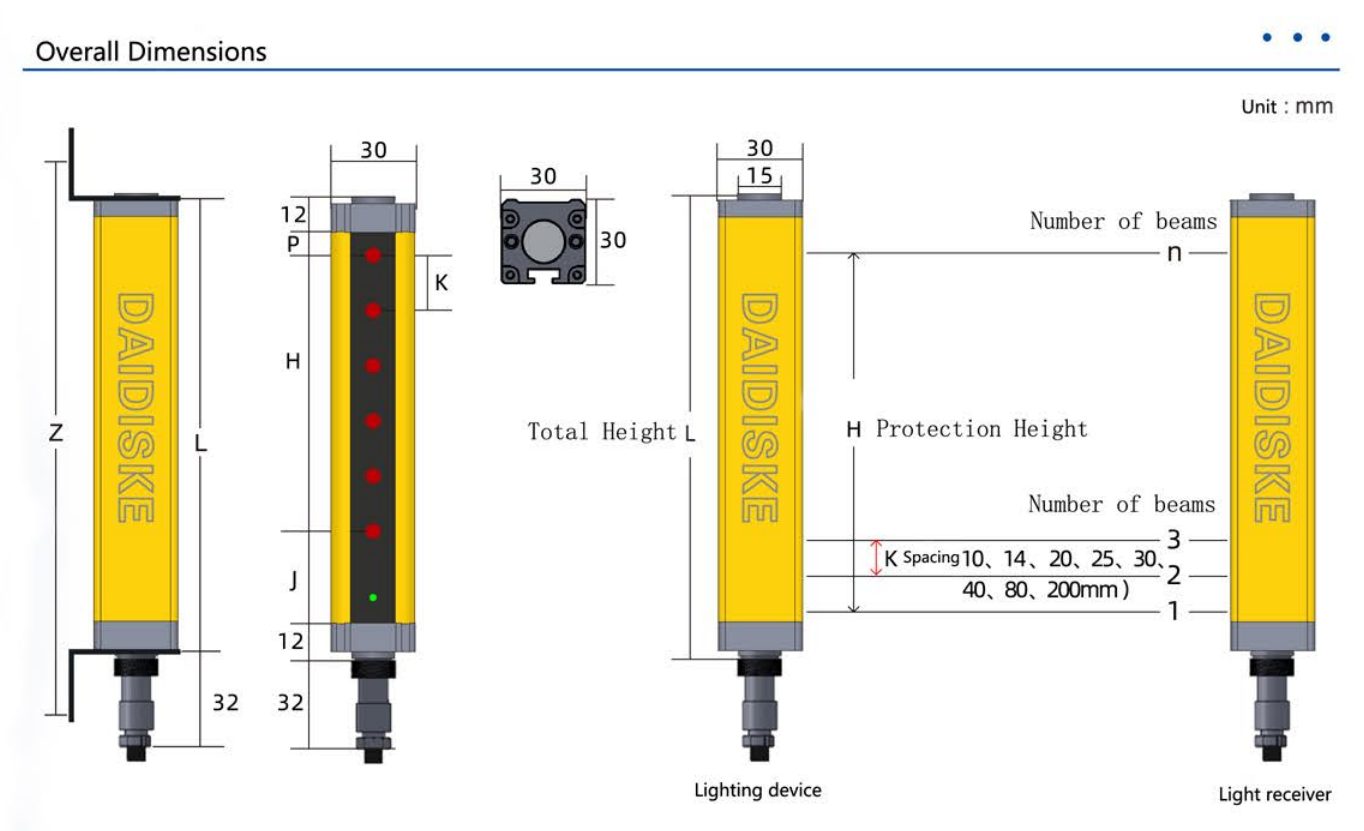
Traditional sensors, like our reliable DQC Series, are built for precision. However, when integrated with AI-driven edge computing, these sensors can now distinguish between a human hand and an inanimate object. Imagine a DQT4 Type 4 light curtain that can ignore a falling wood chip or a cooling spray while still reacting instantly to a finger. This “smart filtering” is the holy grail of high-speed manufacturing, balancing maximum safety with zero unnecessary downtime.
2. Predictive Maintenance and Self-Diagnostics
The most common cause of sensor failure isn't a broken component — it's environment buildup. Dust, oil, and grime slowly degrade the signal strength. Future AI-enabled sensors will monitor their own health in real-time. Instead of a sudden machine stop, a DQO No-Blind-Zone sensor could send an alert to the maintenance team's tablet: “Lens at 70% clarity; please clean during next scheduled break.”
This proactive approach moves us away from reactive repairs and toward a world of “zero unplanned downtime.” If you are curious about the technical foundation of these systems, you can explore the underlying optical safety mechanisms that make this precision possible.
3. Human-Robot Collaboration (HRC)
As “Cobots” become more common, the barrier between humans and machines is disappearing. Future safety systems won't just create a “forbidden zone”; they will create a “dynamic zone.” Using advanced logic found in our MK and JER Series, AI can allow a robot to slow down as a human approaches and only stop at the very last moment, rather than cutting power abruptly. This fluid movement is the hallmark of a truly modern, efficient workspace.
4. Conclusion: The Road Ahead
AI isn't going to replace the fundamental physics of the safety light curtain, but it is going to make it significantly smarter. By reducing false alarms and providing deep data insights, AI-integrated sensors will turn safety from a “cost center” into a “productivity driver.”
As we continue to innovate at DAIDISIKE, we remain committed to the belief that the safest factory is the one that never has to stop for the wrong reason.
Reliability in Every Rotation | DAIDISIKE (戴迪斯科)