
What Is a Safety Light Curtain?
Global Supplier of EU CE Certified Sensors for Industrial Automation & Long-Range Perimeter Security
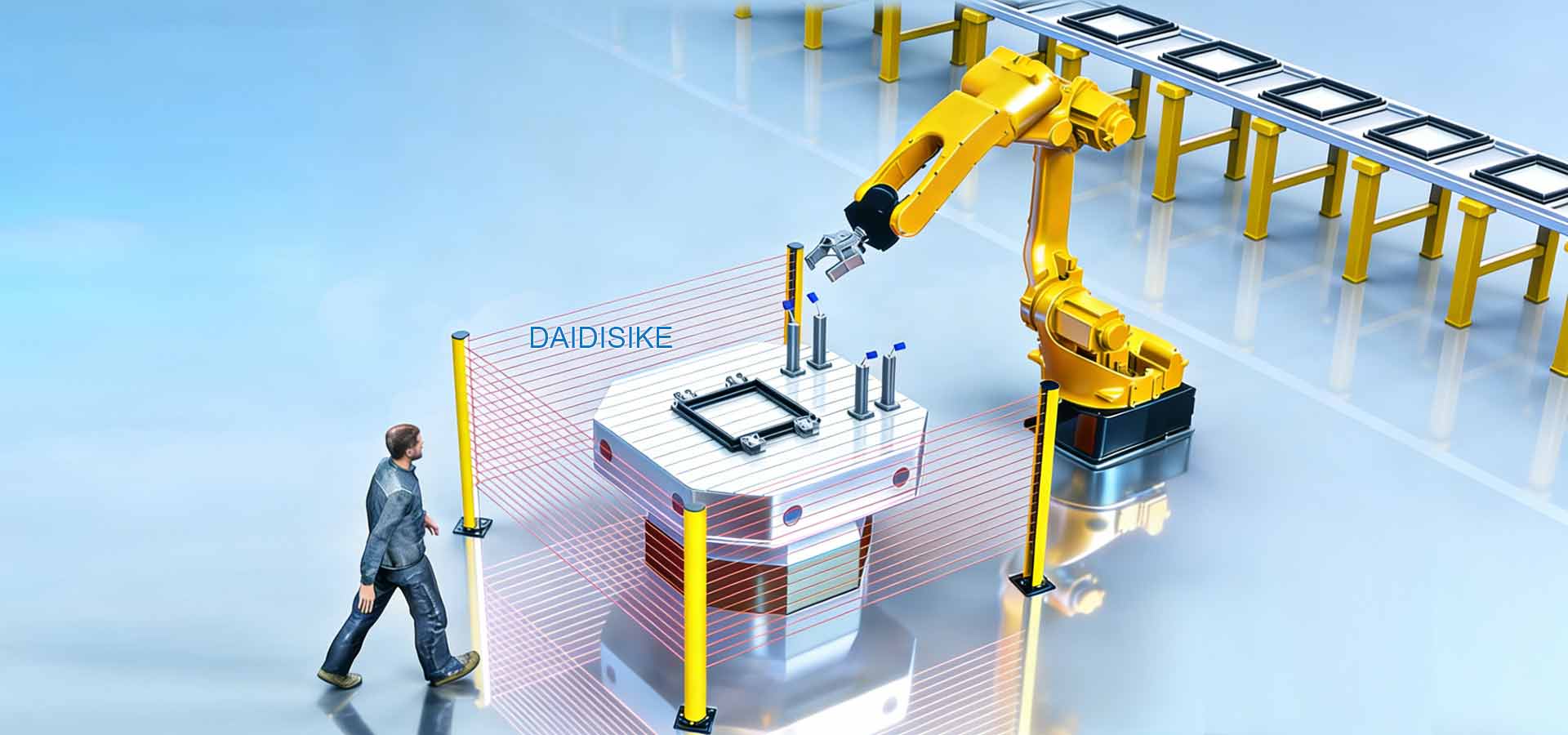
A safety light curtain is a non-intrusive safeguarding solution that uses infrared technology to create an unseen barrier, protecting workers from potential harm when operating near industrial equipment. Unlike traditional systems that rely on physical obstacles, these devices offer a contactless means of detection, establishing a secure perimeter around hazardous areas.
Commonly installed on machinery such as presses, robotic cells, and packaging lines, safety light curtains swiftly respond to human presence within designated zones, effectively preventing accidents that could result in severe injuries like crushing or pinching.
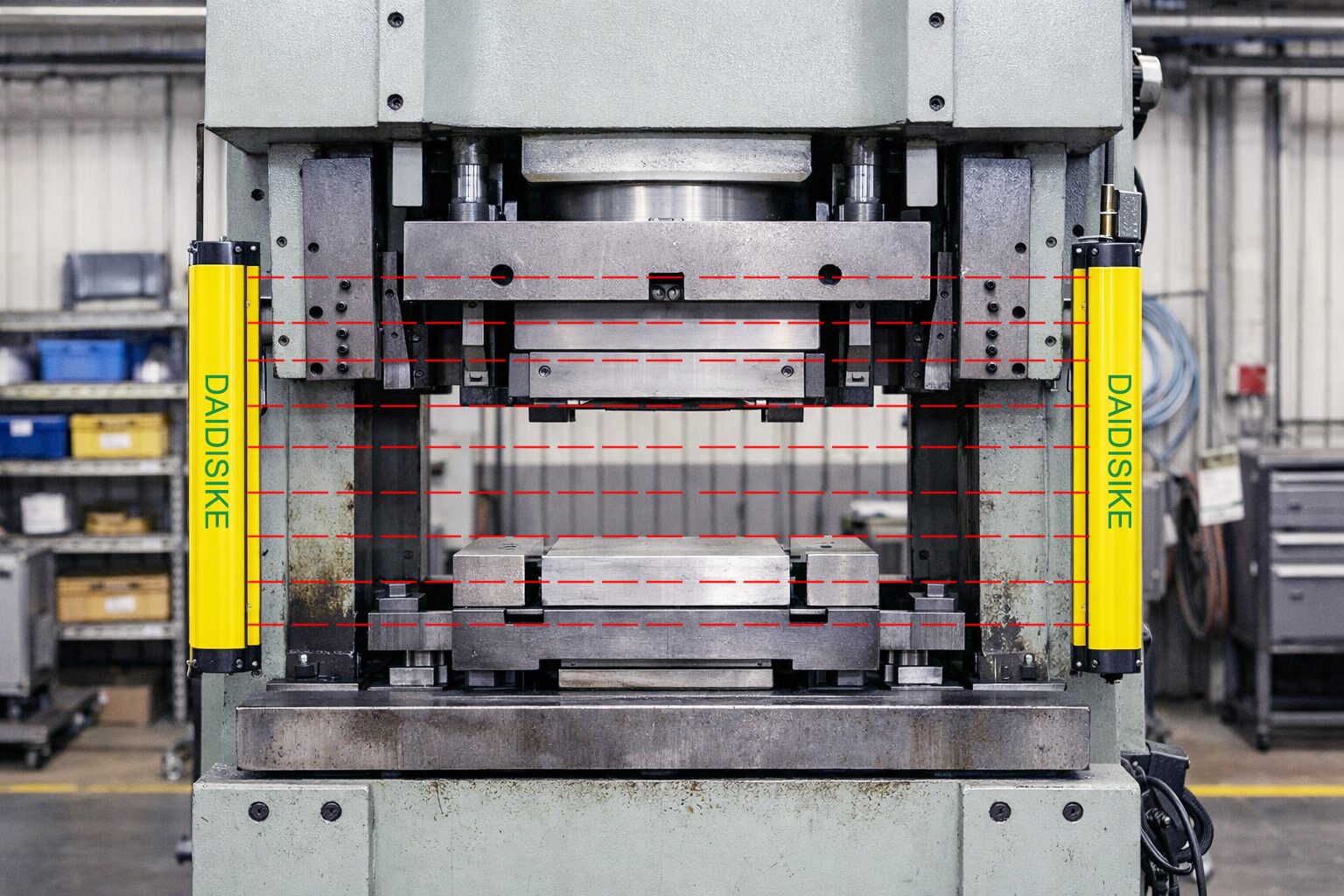
Core Principle: An Invisible Infrared Safety Barrier
The setup includes an Emitter (Transmitter) that emits numerous parallel, modulated infrared light beams, and a Receiver that watches over these beams. Positioned opposite each other, they form an unseen light barrier.
If anything blocks one of the beams, the Receiver promptly registers the disruption and sends a halt command to the safety control system of the device.
This basic yet dependable principle of "obstruct the light, halt the machine" offers a very efficient safety shield. Following the elimination of the hazard, a manual reset is needed to avoid unintended restarts.
Resolution Options for Different Protection Levels
| 2.5 mm / 5 mm | Fine object detection and measurement | DAIDISIKE DQL / DQM Series |
| 14 mm | Finger protection | Stamping presses and hydraulic presses |
| 20 mm / 30 mm | Hand protection | General automation equipment |
| 40 mm and above | Body protection | Area and perimeter guarding |
| 80 mm / 200 mm+ | Vehicle and large object detection | DAIDISIKE DQSA Series |
Main System Components
- Emitter: generates parallel, modulated infrared beams, typically in the 850–950 nm range.
- Receiver: monitors each beam continuously to detect interruptions.
- Controller (DQCA / DQCA2): processes signals and outputs safety commands to a PLC or safety relay.
Operational Sequence
| Normal Operation | All infrared beams are received correctly. Safety outputs remain ON and the machine operates normally. |
| Interruption Detection | Any beam is blocked and detected within ≤15 ms. |
| Safety Stop | OSSD outputs switch OFF and a stop command is sent to the PLC or safety relay. |
| Manual Reset | A reset is required after clearance to prevent accidental restart. |
Integration with Time Delay Relay Modules
To achieve advanced safety control, safety light curtains are often integrated with delay relay modules. In this configuration, the light curtain’s output signal acts as the "Trigger" for the relay's timed operations.
The following guide provides a technical overview for connecting modules such as B2J0601 or E4J0101.
1. Wiring Configuration
- Power Supply: Connect the module's positive and negative supply terminals to a DC power source (ensure voltage compatibility, typically 12V or 24V DC).
- Signal Triggering:
- Connect the safety light curtain’s output wire (PNP or NPN) to the module’s Trigger Terminal.
- Note: Use the Positive Input for High-level triggering, or the Negative Input for Low-level triggering.
- Load Connection: Connect the target device (e.g., alarm, motor contactor) between the relay’s Normally Open (NO) and Common (COM) terminals.
2. Operational Logic
- Detection: When a person or object enters the light curtain's field, it sends a trigger signal to the delay relay.
- Timing: Upon receiving the signal, the relay initiates the pre-set delay period (adjustable in seconds, minutes, or hours).
- Execution: Once the delay is complete (or triggered, depending on the mode), the internal relay switches, controlling the connected equipment accordingly.
3. Configuration Tips
- Mode Selection: For applications requiring a "delayed disconnection after blockage," select the corresponding delay mode. (e.g., B2J0601 supports 26 modes; E4J0101 offers extended multifunctional modes).
- Time Adjustment: Use the on-board potentiometer knob or digital buttons to calibrate the exact delay duration required for your safety protocol.
Frequently Asked Questions
What is a safety light curtain and how does it protect operators?
A safety light curtain is an opto-electronic protective device that places a screen of modulated infrared beams across a machine opening. When a hand or body interrupts the beams, its dual OSSD outputs switch off and command the machine to stop, protecting the operator without a physical guard.
What standards apply to safety light curtains?
The main standards are IEC 61496-1 and -2, which define Type 2 and Type 4 devices, ISO 13849-1 for Performance Level, and ISO 13855 for safety distance. The required Type and Performance Level come from a risk assessment of the specific machine.
What resolutions are available and what do they protect?
Common resolutions are 10–14 mm for finger protection, 20–30 mm for hand protection, and 40 mm and above for body or area detection. A finer resolution detects smaller objects and allows mounting closer to the hazard under ISO 13855.
How fast does a safety light curtain respond?
Typical response times are in the order of 10–30 ms. Because response time feeds into the ISO 13855 safety-distance calculation, a faster device can be mounted closer to the hazard while still stopping it in time.
Where are safety light curtains used?
They suit machines where operators frequently load, unload or reach into a hazard — power presses, press brakes, robot cells, packaging and assembly lines. They guard the access opening while keeping it open, which a fixed barrier cannot do.