
DQC Series Safety Light Curtain Wiring Guide: Standard Connection Method
In industrial automation production lines, the correct wiring of safety light curtains not only ensures normal equipment operation but also serves as the first line of defense for operator safety. As a leading domestic sensor manufacturer, DAIDISIKE (戴迪斯科) DQC series universal safety light curtains have gained market recognition for their high reliability and simplified installation process.
I. DQC Series 5-Core Cable Color and Function Definitions
DQC series safety sensors connect via aviation connectors to M12 five-core cables. Before wiring, strictly verify cable colors and their corresponding electrical functions to prevent circuit burnout from reverse polarity.
| Cable Color | Signal Definition | Function Description |
|---|---|---|
| Brown | +12~24VDC | Power Positive |
| Blue | 0V / GND | Power Negative |
| Black | CP (Control Signal) | Synchronization signal line between transmitter and receiver |
| White | OSSD Output | Safety switch signal output (connects to relay or PLC) |
| Yellow-Green | Shielding Wire | Suppresses electromagnetic interference; connects to ground |
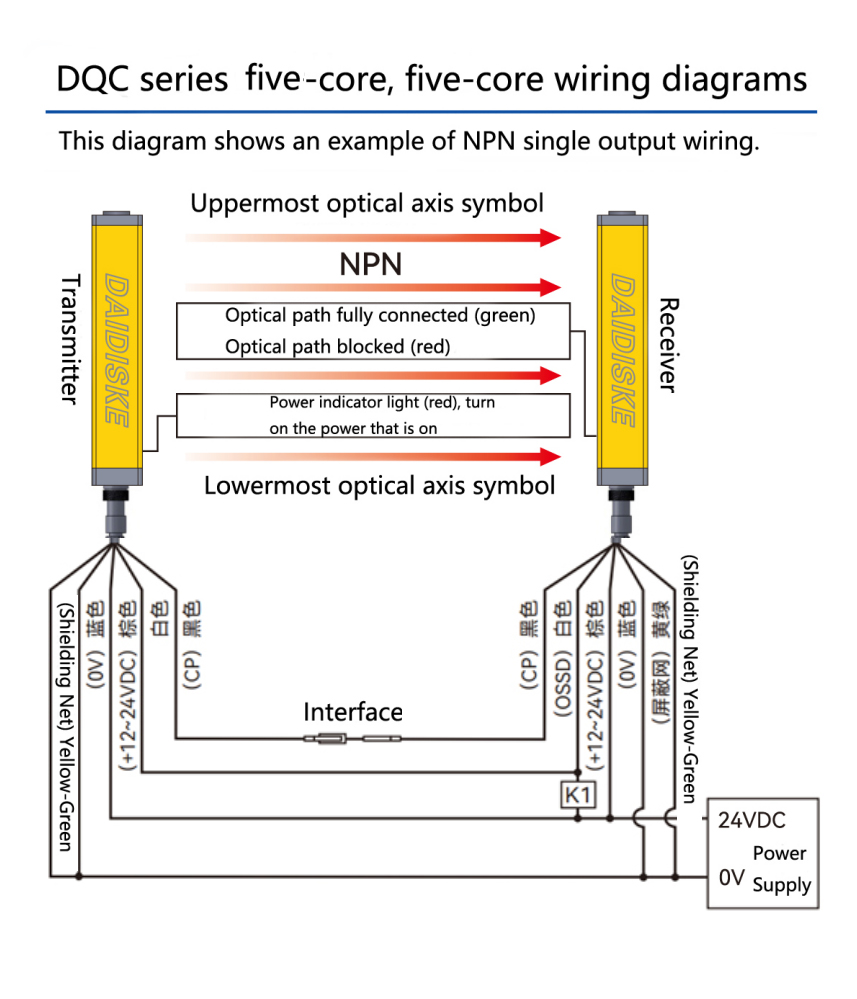
II. Bilateral 5-Pin Standard Wiring Diagram Analysis
The DQC series typically supports both NPN and PNP logic output modes. The following explanation uses the most common NPN single-output wiring as an example.
1. Transmitter Wiring
The transmitter primarily emits the infrared beam. The brown wire connects to the 24VDC positive terminal, and the blue wire connects to 0V. The black wire (CP) must be connected to the receiver's black wire via the interface to achieve optical axis synchronization.
2. Receiver Wiring
The receiver detects signals and outputs logic based on light flux status. The brown wire connects to 24VDC, and the blue wire to 0V. The white wire (OSSD) is the core output line, typically connected to a safety relay (e.g., K1 load) to control motor disconnection.
III. Importance of the Shielded Wire (Yellow-Green)
The DAIDISIKE DQC series is specially equipped with a yellow-green shielded cable to handle complex electromagnetic environments.
- Interference Resistance: Suppresses electromagnetic interference when reliably grounded.
- Preventing False Alarms: Failure to connect the shielded wire may cause momentary false alarms from surges.
- Connection: Bundle the yellow-green wires and connect to the factory's common ground (PE) or 0V terminal.
IV. Selection Parameters and Recommendations
Verify your requirements against these DQC specifications:
- Response Time: ≤15ms for rapid safety disconnection.
- Protection Rating: IP65-rated housing, dustproof and waterproof.
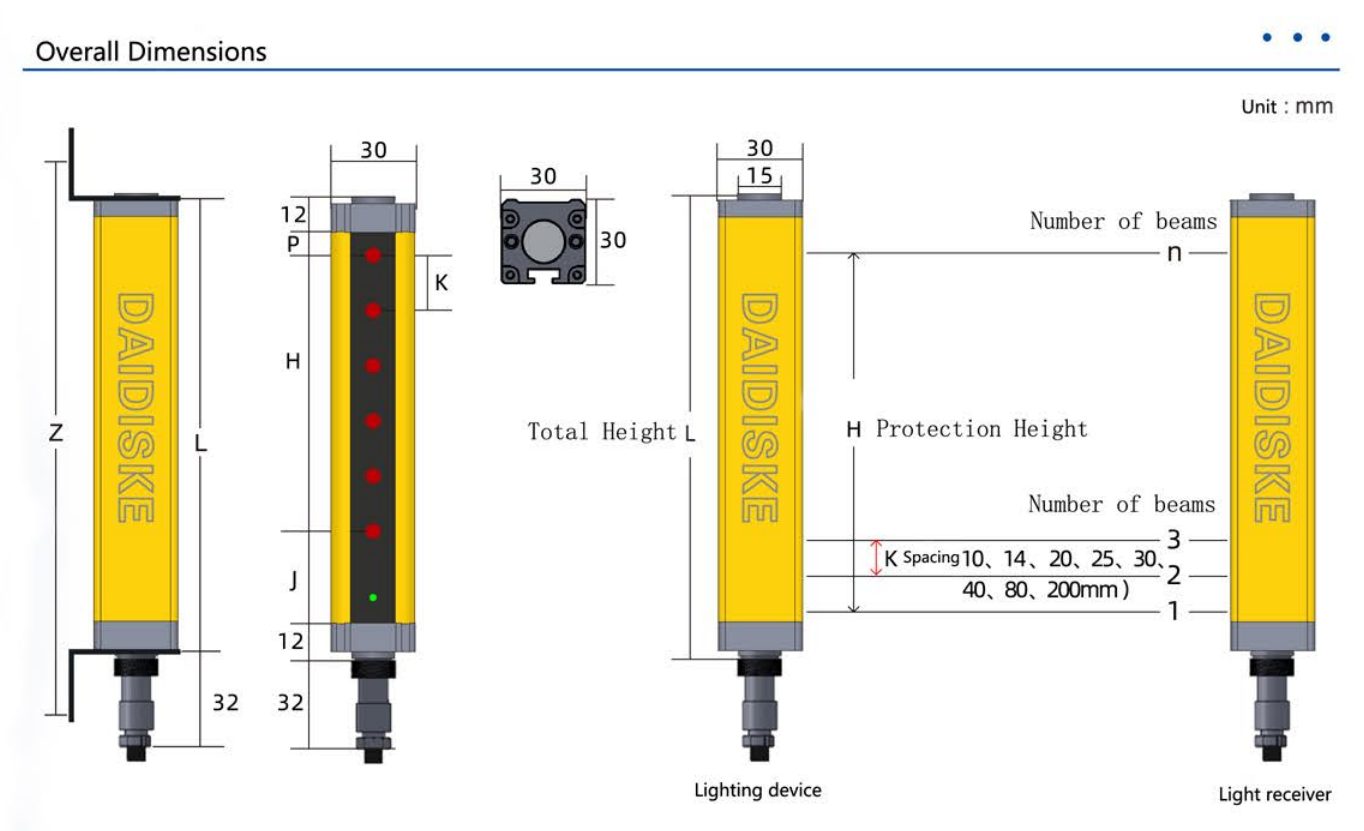
- Resolution: Choose Finger (10/14mm), Palm (20/25/30mm), or Full-Body (40/80/200mm) protection.
V. Summary
Correctly completing the 5-core wiring for DQC series safety light curtains is the first step in ensuring workshop safety. Always remember: The CP synchronization wire must not be left floating, and the shielded wire must be grounded.
Choose DAIDISIKE (戴迪斯科) — Professional Safety Solutions for Modern Industry.