
How to Select the Right Safety Light Curtain
I. Define Your Core Requirements
To avoid incorrect model selection, first determine the primary application of the safety light curtain:
- Equipment Safety Protection: Ideal for hydraulic presses, punch machines, and automated production lines to prevent limbs or workpieces from entering hazardous zones.
- Hazardous Area Perimeter: Designed for safeguarding fixed or mobile danger zones, such as the operating radius of robotic arms.
- Detection & Measurement: Used for counting workpieces, presence detection, or dimensional measurements (e.g., sheet thickness, workpiece width).
- Specialized Environments: For instance, waterproof light curtains for underwater operations or other extreme industrial conditions.
II. Key Parameters and Model Identification
1. Definition of Core Parameters
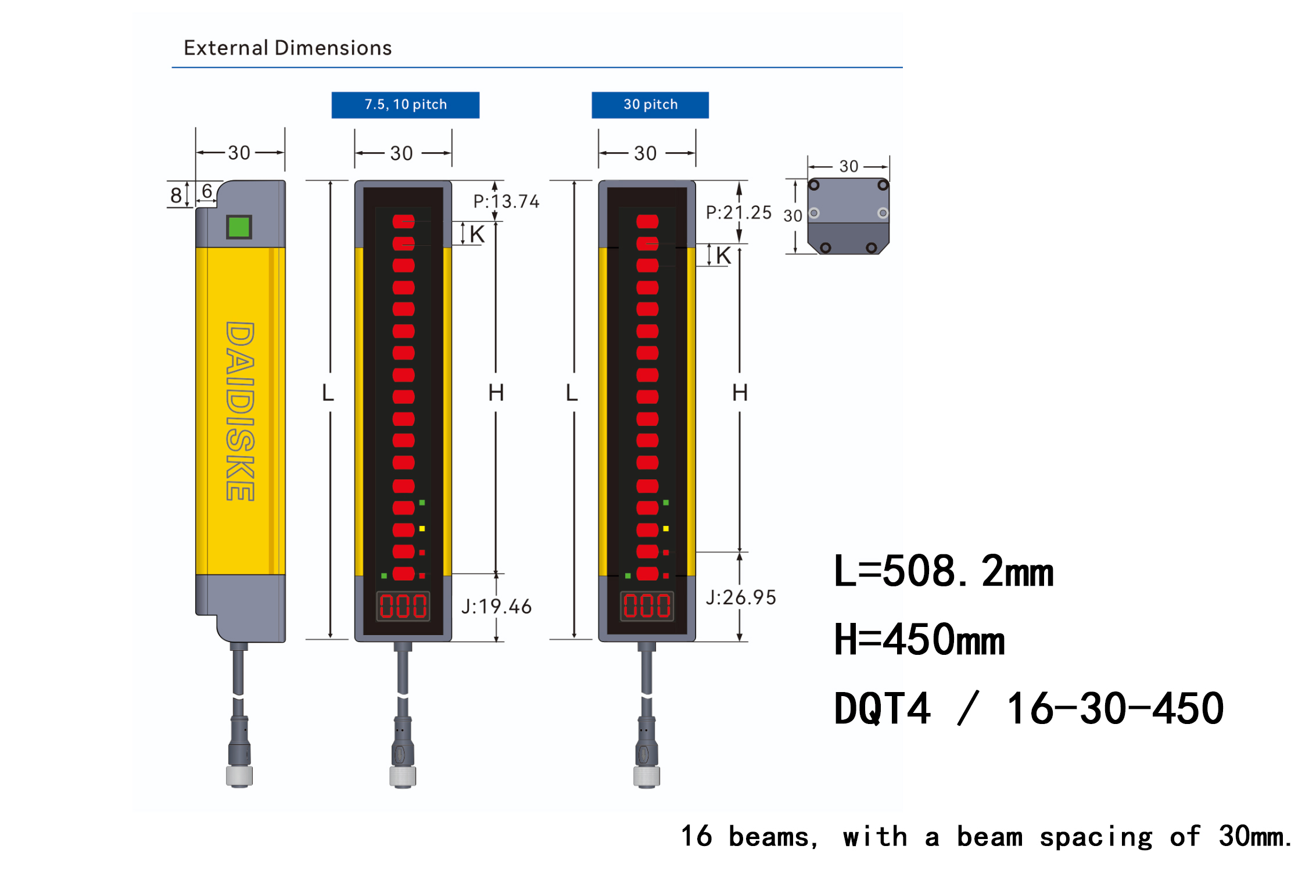
- Effective Protection Height (H): Must cover the entire hazardous opening of the equipment (e.g., the distance from the upper mold to the lower mold).
- Total Height (L): The actual physical height of the grating, including the top and bottom housing.
- Optical Axis Pitch (K): The distance between adjacent optical axes. This determines the resolution. For example, if K=30mm, any object larger than 30mm passing through will trigger a signal.
2. Safety Distance Calculation
Model selection must comply with international standard EN ISO 13855.
Formula: S = K × T + C
Example Case: For a hydraulic press whose total stopping time T = 0.5 s (machine stop time of 0.49 s plus a curtain response time of 10 ms), using the ISO 13855 hand-approach constant K = 2000 mm/s and an intrusion supplement C = 100 mm:
S = 2000 mm/s × 0.5 s + 100 mm = 1100 mm.Ensure the installation distance is ≥ 1100 mm.
III. Case Study
Hydraulic Press Protection (Colombian Client):
Based on the measured distance between the upper and lower molds and the precise safety distance calculation, the client selected the DQT4/16-30-450 model. This solution perfectly covers the effective protection area while maintaining the required optical axis pitch to ensure 100% operator safety.